Episodes Irish Mythology Season 3 — The Mythology
The Lie Behind The Children of Lír
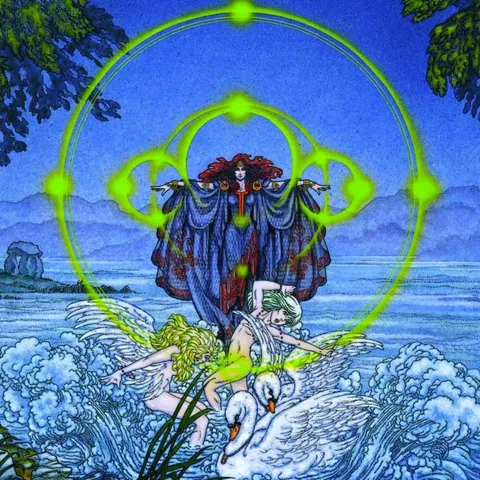
In this episode we look at The Fate of the Children of Lír and explore how Ireland's most famous myth is not a myth at all. In fact, it's a Christian parable in a shape of myth. A bit like a child who's been turned into a swan.
The artwork for this episode is THE CHILDREN OF LIR. THE ENCHANTMENT by Jim FitzPatrick.
Transcript
Welcome to the History of Ireland. Today, we’re going to look at arguably one of Ireland’s most famous myths. But I’m going to tell you now, I don’t think Ireland’s most famous myth is a myth at all. When we think of myths, we’re thinking pre-Christian, pagan stories that people passed down from generation to generation. But as we discussed, it’s very hard to unpack that. Very hard to unpack what the Irish believed pre-Christianity. And that every story we do have is seen through a lens of Christianity. As it was the Christians who were writing them all down.
And today, we’re looking at a story that many argue was not an attempt to record an older mythic tale at all. Something very different. A late medieval literary creation. Something closer to a crafted, Christian-framed romantic tale than any kind of ancient myth or piece of folklore. Today, I’m making the case that we have totally misunderstood and misrepresented the fate of the Children of Lear. And because of that, we’ve actually done it a disservice.
The fate of the Children of Lear is one of the quintessential stories of Irish culture. You can’t walk into an Irish bookstore without finding books and books on the Children of Lear. Picture books, stories, anything you can imagine. It spawned countless pieces of art, grabbed the imagination of generations and cemented itself in the Irish psyche. But to call it an Irish myth or even a legend in the traditional sense, well, I would argue that that’s a bit disingenuous.
This isn’t like the Second Battle of Moitura or a story from the Dinshankas or even the Wooing of Adin. It’s not a story that was told in pagan times. It’s not something that was passed down and developed over centuries. It is, in essence, a religious parable set in a mythic landscape. A learned, late medieval Irish tale that puts Tuath Dé names into a narrative with an explicit Christian worldview. It’s basically Christian fan fiction about the Tuath Dé.
The Children of Lear was composed in Ireland in the later Middle Ages, most likely in the 15th or early 16th century by, academics seem to agree, a single unknown author, potentially in a monastery in Westmeath. Over the next few episodes, we’ll tell the story as close to its earliest form as possible and unpack its fascinating origins and see why it has been held up as a great Irish myth when, strictly speaking, it isn’t. As Mark Williams writes, Children of Lear is the most blatant example of the Irish gods as we know them owing at least as much to Christianity as they do to paganism.
And to start, we’re going to look at the titular character and explain how he’s actually been born of a complete misunderstanding. You see, Lear never appears in any Irish story before the 13th century and is very much a fabrication of the late Middle Ages. And his creation is really interesting. To understand Lear, we have to introduce a character who most certainly was a real pagan god but doesn’t pop up in this story at all. And that is Manannán MacLear.
Manannán was most likely a sea god with links to the Isle of Man. And the argument is that he was a very old god indeed. He’s usually held quite separate from the people of the She instead depicted as a ruler of quote the other world over the water. You’ll remember he’s mentioned in the Children of Turin as a powerful being who’s gifted magic horses to lug. And it makes sense that an island nation like Ireland would have revered the sea and had quite an important sea god. And that’s Manannán.
But in late medieval times, people latched on to his second name MacLear and assumed, not unfairly, that it meant son of Lear. So, therefore, their thinking was that Lear, the father of Manannán, must have existed. But the word Lear was an old Irish synonym for mer, which means sea. So MacLear would have been the sea’s son. And Williams and others argue this was used to highlight Manannán’s power over the sea and his exceptional abilities as a sailor rather than being a literal patronymic.
But in the 13th century, people did not cop this Lear-Moor Sea connection. And while hunting for mythological characters, assumed MacLear meant son of Lear. They then assumed Lear must have existed in the Irish mythological canon. And he became a handy mythological character with no history, no predefined traits, who they could use in whatever way they wanted. And so, King Lear was born out of this linguistic mix-up.
The other thing I’ll say as we dive into the story is that Lear is not the only character who is new. Bob Darragh, a king of the Tuath Dé and son of the Dagda, is an old Tuath Dé character, but one we have not come across. He’s probably, quote, more real than Lear. But his inclusion here and not in, say, the second battle of Moitúra, is just another example of the messiness of the Irish mythological canon. Does all of this take away from the story? I don’t think so. It just reframes the children of Lear, not as a myth, but as a singular and very impressive piece of creativity. One that is rightly celebrated, and we, as a country, should be very proud of.
So with all that in mind, let’s delve into the first section of the fate of the children of Lear. One day, after the dust had settled on many great wars, the chiefs of the Tuath Dé gathered together to solve a bit of a problem. Ireland at this point was ruled by many different kings, a messy, patchwork kingdom. It was decided that it would be better to have one king rule over the entire country. But who would be chosen?
The gathered nobles agreed there were only four people up to the task. Bob Darragh, the eldest son of the Dagda, Ilbric of Asrua, Lear of Shí Finnachí, Midr of Brelith, and Angus Óg, the Dagda’s other son. Angus, typical youngest son, did not want the job, and quickly removed himself from the running. It sounded like too much work. And so all the nobles of the Tuath Dé went into council together, except those in line for the crown. After much discussion, it was decided Bob Darragh would be crowned king because of the power of his father, because of his own power, and because he was the eldest.
Lear was furious to be overlooked, and when the ascension was announced he stormed out of the assembly without a farewell to anyone. As he left, a murmur went through the crowd. How dare Lear ignore the wishes of the group! How rude of him to leave! The crowd of nobles, their blood boiling, decided to chase Lear, to burn his house down and kill him with spears. But the new king, Bob Darragh, did not want his reign to begin with a war. Proving that he was indeed the right choice, Bob Darragh quickly stood up in front of the angry nobles and shouted for calm. We shall not act, he said, for Lear would defend his territory, and I am no less a king even if he does not submit to me. And so war did not break out, but instead tension simmered across the land, ready to explode into violence at any moment.
This stalemate continued for many weeks until fate intervened. Lear’s wife became ill, and after three long nights she died, plunging Lear into a deep depression. Lear’s wife was well known and much loved in her own right, and so news of her death quickly spread across the country. And when word of her death reached Bob Darragh, he spotted his chance, not for an invasion, but for an alliance. He called his assembly together and declared, If Lear choose he can have my assistance and friendship. Since he is alone, I would offer him three maidens of the fairest form, Ave, Aoife, or Alva. And with this offering, peace was brokered.
Lear came to Bob Darragh’s house and married Ave. And whether it was due to the death of his old wife or the love of his new wife, Lear was no longer angry with Bob Darragh’s rule. He spent a fortnight in Bob Darragh’s mansion, celebrating and enjoying a great royal wedding feast. The two men were finally allies. A happy ending, some would say. Except the story does not end there.
Lear loved Ave, his new wife, and together they had four children. One daughter, Vanula, and three sons, A, and the two twins, Veacre and Con. But when giving birth to the twins, poor Ave died in childbirth. And for the second time in his life, Lear had his wife taken from him. If not for his four children, he would have almost died from grief.
With Ave dead, Bob Darragh was worried for his alliance with Lear, and so proclaimed, We grieve for that girl, and we are so grateful for Lear’s new friendship and his constancy, but we cannot let this death tear apart the peace treaty. So, I shall give Lear Ave’s other sister as a wife. Lear will marry Aoife. When Lear heard this, he agreed, and was soon married to Aoife, taking her home to live with him and his children.
Now, everyone loved Lear’s four children, for their beauty and symmetry of form. Bob Darragh would visit often, and they would stay at his home. And at first Aoife, like everyone else, felt a deep sense of honor and affection for her foster children. But none loved the children more than Lear himself. They were his joy and delight, and he would rise up early at dawn every morning to lie down among his children.
And Aoife watched this. She saw the love he gave them, a love that she felt was stolen from her. Over time, a bitter corrosive jealousy began to twist in her heart. Soon it grew into hatred, and soon she decided she would have them killed.
One day Aoife yoked her chariot and offered to take the four children on a journey to Bob Darragh’s house. Vanula the eldest had been dreaming of treachery and fratricide, and somehow she knew Aoife’s mind. Vanula sensed that her stepmother was planning to kill or ruin her brothers, and she tried desperately to convince the other children not to travel with Aoife. But she could not convince them, and soon all four set off with their stepmother.
On the way, Aoife said to her servants, Kill the four children of Lyre, for whom my love has been abandoned by their father. I shall give you your own reward of every kind in the world. But the servants recoiled in horror. Not so indeed, they said. They shall not be killed by us, and it is an evil deed you have thought of. And evil will it be to you to have mentioned it. Furious, Aoife drew forth a sword to kill and destroy the children of Lyre herself. But her womanhood and her natural cowardice and the weakness of her mind prevented her.
So she hatched another plan. She continued on the journey until they arrived at the shores of Loch Darbuck in West Meath. Go on, she told the children. Go for a swim. Ever obedient, the four children waded into the water, maybe laughing and splashing. As soon as Aoife found them upon the lake, she struck them with a metamorphosing druidical wand. She transformed them. The four children of Lyre were gone, and in their place floated four beautiful, perfectly white swans.
And there we will leave our story for today, as Aoife has turned the children of Lyre into the famous swans. Thanks for listening. Subscribe wherever you get your podcasts, and if you’re enjoying it, give us a review on Apple Podcasts or tell your friends. It really helps. If you want to go further, you can support the show, get ad-free listening, and bonus content on our Patreon page. Simply follow the Patreon link in the show notes or visit our website, thehistoryofireland.com. You can also get in touch through the website or on Facebook and Twitter. It’s always great hearing from you guys, and if I’ve made a mistake, please do let me know.
The History of Ireland was written and produced by me, Kevin Dolan, with music by Liam Doyle, and additional help from assistant producer Aoife Murphy. This podcast was recorded in the lands of the Wurundjeri people of the Kulin Nation. Sovereignty was never ceded.