Episodes Irish Mythology Season 3 — The Mythology
The Scholars on the Edge of the World
Transcript
Welcome to the history of Ireland. First of all, a huge apology for the delay in this episode. A little bit of illness combined with some travel for some work means there’s been quite an unplanned gap in episodes. Please forgive the tardiness. And no, I will have a second episode finishing up the fate of the children of Turin popping up right after this one, as a sort of mea cupla.
In the last episode, we were exploring the fate of the children of Turin, watching as Lug dished out a rather impossible fine for the Turin brothers. Today, we’ll see them go about paying that fine. But before we do, the globetrotting, Herculean in a very literal sense, nature of the brothers’ quest gives us a fascinating insight into how the Irish of the 11th century viewed themselves in the context of the wider world.
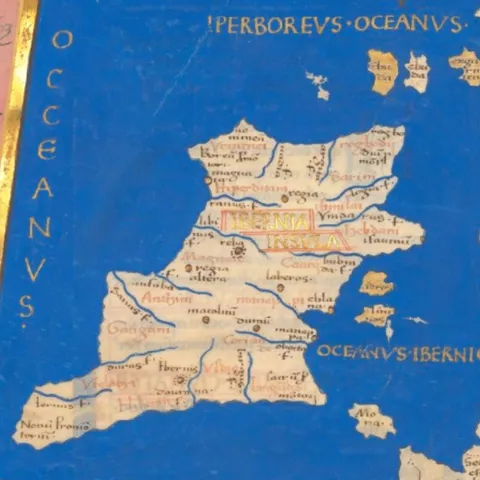
Now, Ireland has an interesting duality, especially around this early medieval period. First of all, as we’ve discussed, Ireland was never really conquered by the Romans and so kept its Celtic origin. It had its own language, laws, as we went through last episode, and very much its own distinct culture. Ireland never became Romanised like Britain or most of Europe, so there’s this sense of a wild Celtic Ireland that survives on the fringes of Europe.
But there’s also the image of Ireland, especially in this period, of the land of saints and scholars, the place held up as the last bastion of classical learning, the island that saved Europe from the Dark Ages by preserving old Latin manuscripts. As always, the reality is a little more complicated than popular imagination would suggest, but the fate of the children of Turin is almost a tailor-made metaphor for this duality.
The story is written in Irish and showcases the importance of the written word in the local language, which wasn’t always the case everywhere else. But, as we’ll see, it is a story hugely influenced by Greek and Roman classics. Basically, it’s a story written by a group of people, or one writer, who was very confident in the beauty and importance of their native tongue, while being deeply versed in that of Latin. And that gives us such a cool window into these writers and the culture they inhabited.
It should be said that Ireland was not the only place preserving Latin manuscripts, and to quote historian Ralph O’Connor, the story of how the Irish saved civilisation is too simple and too chauvinistic. It leaves out all the Frankish, Italian, German and other scholars who performed no less important and no less enlightened roles in the transmission of classical literature and learning during the same period.” But having said that, Ireland was a very well-respected source of Latin learning and Irish schools and writers were major players in the Latin intellectual world.
The Irish had a weird advantage of being one of the few Christian areas that never spoke Latin as a first language. And so, over the centuries, they learned Latin as a completely foreign language, not one used by everyday people and with very few links to their own language. This meant, or so Davio Cronin argues in the book Early Irish Mythology, the Irish dove deeply into grammar and may have even designed a new kind of Latin grammar for beginners. And European scholars did travel to Ireland to learn. Throughout the 6th, 7th and 8th century, Ireland was the acknowledged leader in the space.
So it’s no surprise how strong the classical elements of the fate of the children of Turin are. And it’s no surprise that our characters disguise themselves as poets. It very well could point to the fact that the Irish saw this as one of their biggest exports. Their writing, their learning, their poetry. And the story highlights that, far from being an edge of the world backwater, Ireland was deeply embedded in the literary world of the medieval ages.
So without further ado, let’s dive into the next section of the story and see the children of Turin head to Greece. After hearing the extent of the fine laid on them for killing Lug’s father, the children of Turin went to their own father for advice. He listened, his face growing grayer with every magical fire-flung item.
It is bad news, that is, Turin said, staring unhelpfully. It is to your death and destruction you will be going looking for those things. But if Lug were to lend you his aid, you might just stand a chance. Go to him, ask for the loan of Anvar, the horse of Lenon Maclear, which can travel over sea as easily as land.
He’ll never agree to that, said Brian. I know, said Turin, and when he refuses, ask him instead for his boat, the Sculptoon, the wavesweeper. It is also a gift from Maclear, and Lug will be bound by honour not to refuse a second, lesser request for aid. The boat will serve you better anyway.
And so the brothers went to Lug and everything went down as their father had suggested. Lug would not give away Menaron Maclear’s horse, but would happily give them the boat. Side note, I’m not going to go into who Menaron Maclear is today, but he’s such a cool and important figure, so remember the name.
Then the brothers went away, and they left Turin sorrowful and lamenting, and their sister, Ethna, went with them to where the Kirk was. As Brian got into it, he said, He said, Don’t you dare find fault with this boat, Ethna snapped, her grief sharpened into anger. It was a wicked thing you did killing that man. Whatever doom comes for you, you’ve earned it.
Do not say that, Ethna, the brothers replied, for we are in good heart and we will do brave deeds, and we would sooner be killed a hundred times over than to meet with the death of cowards. There is nothing more sorrowful than this, Ethna cried, to see you driven out from your own country. Then the three pushed out their Kirk from the beautiful clear-bade shore of Ireland.
What course shall we take first, said Joker? We’ll go look for the apples, said Brian, as they were the first thing we were bade to bring. And so we ask of you, Kirk of Manannan, that is under us, to sail to the garden in the east of the world. And the magic Kirk did just that.
As they arrived to the garden in the east of the world, Brian asked his brothers, How are we going to get into this garden? For I think the king’s champions and the fighting men of the country are always guarding it. Let’s make straight at them and attack them, said Joker back, grabbing on to the simplest plan. We’ll bring away the apples or fall ourselves, since we cannot escape these dangers anyway.
That’s certainly a plan, Brian said, but I have a better one. He tapped his brothers with the druid rod, and in a shimmer of air, the three mighty warriors were gone, replaced by three magnificent sharp-eyed hawks. They flew towards the garden, and as soon as the king’s men spotted the birds, they hurled a shower of spears and darts. The hawks dipped and weaved until all the spears were spent. Then they dove bravely on the apples and stole them away with so much as a scratch.
But the king had three crafty daughters who turned to ospreys and gave chase, sending flashes of lightning after them. But Brian had planned for this too. The daughters were looking for hawks, and so Brian turned himself and his brothers into swans who gently glided towards their kirk. And so they escaped.
Next, they headed to the king of Greece to bring away the healing pigskin Lug had demanded. Again, Brian had a cunning plan. We will disguise ourselves as poets from Ireland so that the high people of Greece will hold us in respect and honour. The brothers were unsure. It’ll be hard for us to do that, we without a poem and no knowledge of how to write one. Brian, already twisting his hair into the traditional knot of a bard, ignored them.
They presented themselves at the court of the Greek king Theus and were welcomed with respect due to Irish artists. They fell to drinking and pleasure without delay. They had never seen, and there was not in the world, a court so good or a place where they had met with better treatment.
Eventually, however, the inevitable moment arrived when the king cleared his throat and said, A poem, if you would be so kind. The two younger brothers panicked, spluttering something about being men of strength. Brian, however, quickly stepped in and started to recite a poem.
He said this, O Theus, we do not hide your fame. We praise you as the oak among kings. The skin of a pig, bounty without hardness. This is the reward I ask for it. The war of a neighbour against an ear, the fair ear of his neighbour will be against him. He who gives us what he owns, his court will not be the scarcer for it. A raging army and a sudden sea are a danger to whoever goes against them. The skin of a pig, bounty without hardness. This is the reward I ask, O Theus.
The king looked utterly bewildered. A fine poem, I suppose, he said slowly. Though I confess I don’t really understand it. It means, Brian said with a charming smile, that we would like you to give us your magical pig skin as a reward.
Um, well, I’d praise your poem, the king said, if it was a little less about giving you my pig skin. How about I give you three times the pig skin’s weight in gold? That could work, Brian said, but I’ll need to see the skin weighed against the gold.
The king agreed, and so a great scale was brought out. The glittering gold was piled on one side, a magical pig skin was laid on the other. And the moment it was within arm’s reach, Brian grabbed the pig skin and legged it, because sometimes cunning plans will only get you so far. They rushed out of the court, cutting down any man who would stand in their way. In fact, even the king of Greece fell by the hand of Brian.
And we’ll leave it there for today. In the next episode, see the brothers continue on their quest through the Mediterranean and beyond. It’s always great hearing from you guys, and if I’ve made a mistake, please do let me know.
The History of Ireland was written and produced by me, Kevin Dolan, with music by Liam Doyle, and additional help from assistant producer Aoife Murphy. This podcast was recorded in the lands of the Wurundjeri people of the Kulin Nation. Sovereignty was never ceded.