Episodes Irish Mythology Season 3 — The Mythology
A Lost Story of how the God's Fought Over Newgrange
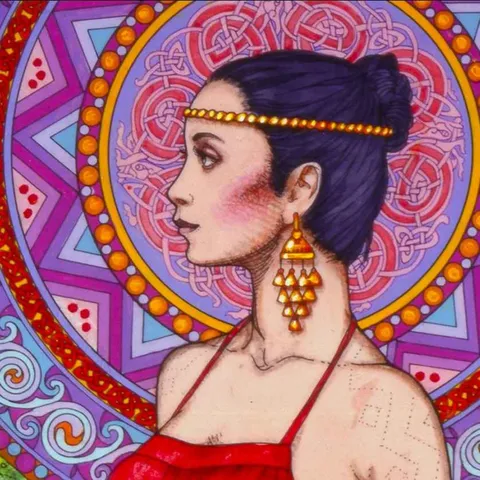
In this episode we look at the history behind how The Wooing of Étain was uncovered and then dive into the story itself — as the Dagda swindles a poor man out of his home in Newgrange.
Imagery for the episode, used with permission, is Boann Bru Na Boinne by the iconic Jim FitzPatrick. You can view more of Jim's stunning work and purchase prints at jimfitzpatrick.com
Transcript
Welcome to the History of Ireland In the last episode we finished up the second battle of Moitúr Which followed the Tuath Dé taking full control of Ireland Today we’ll jump into the wooing of Éadín Which starts during a period where the Tuath Dé are living in peace And causing trouble amongst each other Rather than being beset by an evil enemy
Before we get into the story though I want to explore how we found it Because that in itself is a fascinating story Involving a German linguist, an Irish president And centuries of fragmented texts The oldest copy we have comes from the 12th century In the book of the Thun Cow But we know the story is older than that As it’s mentioned in a list of stories from the 10th century
It was then also written down in the Yellow Book of Lacan Written between 1390 and 1410 This was compiled by the scribe Giolla Isamor Macphershig I hope I’m pronouncing his name right Giolla was an alumn Or master of bardic learning And in fact his whole family were famous filly Who acted as genealogists for centuries Accumulating a huge library of historical texts In Lacan county Sligo
But unfortunately the book of Lacan was separated And we lost a section of the wooing of Éadín And so for a long time it was believed That it was actually three separate stories
That’s where Sir Thomas Phillips comes into the story Born in 1792 Phillips was quote a vellomaniac I.e. someone obsessed with old calfskin or vellum manuscripts He collected 40,000 books and 60,000 manuscripts And at times put his family into deep debt to do so
Then you had Douglas Hyde, founder of the Gaelic League And a man who would go on to be president Who spent years eyeing up those thousands of manuscripts Eventually, in 1933 He convinced the government to fund the purchase of 42 manuscripts And inside those, as Geoffrey Gantz writes A complete version of the wooing of Éadín was discovered Lying innocently among a part of the yellow book of Lacan
Hyde didn’t know he was getting a full copy of the wooing of Éadín And it wasn’t until another man, a Swiss German By the name Rudolf Thrunson, studied the fragments Did it become clear that they had uncovered A completely lost version of Éadín That tied the three stories together
What was a German doing looking around Irish manuscripts? Well Thrunson was actually one of the foremost experts in Old Irish At the beginning of the 20th century The man had studied under Nietzsche And became obsessed with ancient languages And what they could teach us about Indo-European history And Celtic culture in general
So for us to get this story We have a master filly from the 12th century who wrote it down A British fanatic collector from the 19th century who found it Douglas Hyde, a future president chasing down the documents And then a German academic finding it in a pile of fragments And putting it all together Kind of amazing
And then one last thing to get into before we tell the story Is a little thing about pronunciation As I had a few people reach out to me Regarding Lugh versus Lugh Lugh being the Old Irish pronunciation of his name And Lugh being the more modern Irish I went with the old one just because I preferred And it matches how it’s written down a little bit better But it’s kind of an arbitrary choice
And speaking of arbitrary choices I’ve decided to go with Éadín for the main character in this story Sometimes you’ll hear it pronounced as Éitán But my understanding is in Old Irish It would have more been like Éitáin And that morphed into Éadín Which is what most modern scholars use today So I’m kind of picking and choosing as I see fit
If anyone has any complaints about that Or if you’re an expert on Ancient Irish Modern Irish pronunciation Then please do get in touch It’s definitely not my strong suit
So without further ado Let’s start to tell the story Of the ruling of Éadín There was a famous king of Ireland Leader of the Tuath Dé Jochai Golathur was his name Because he worked wonders And could control the weather and the crops You know him as the Dagda
Now around the area of Brú na Bóinne Or as you know it, Newgrange There lived a man, Elkmer Whose wife was named Éathín or Bóinne So great was her beauty That some say She may even have been a river goddess The one who gave the Bóinne its name She was the river And the river was her
Éathna was beautiful And then his eyes fell upon her He wanted her And for her part Éathna wanted the Dagda But she refused him Because she feared her husband
Yet the Dagda was not one To be thwarted in such matters So he sent Elkmer away On a journey Binding him in an enchantment So that time held him in its grip And he knew neither hunger nor thirst Nor the passing of days Though he thought himself gone but one day He wandered for nine months
And while Elkmer was away The Dagda came to the river Bóinne And went in upon Éathna And she bore him a son After the boy was born Éathna said, Young is the son Who was conceived at the break of day And born between it and the evening We shall call him Angus The young son, or Macchach
Now poor Elkmer Was none the wiser He stepped into his house as if he had left but the day before He never realized That he’d been gone so long That he missed Éathna’s entire pregnancy Never finding out That the Dagda had slept with his wife Or that his wife had had a new son
Now the Dagda Had a friend called Midir And he decided that Angus would be hidden And fostered in Midir’s house So that Elkmer would not find out what had happened And Angus might grow in strength and wisdom Beyond Elkmer’s sight
And so For nine years Angus, or Macchach, lived with Midir Believing that Midir was his father And that Midir’s land would be his birthright Midir, as well as everyone else Loved the boy for his beauty And his nobility And in fact, Angus surrounded himself With a hundred and fifty young men And a hundred and fifty young women And was leader of them all
One day, Angus was out playing With his entourage The Bagmen, who used to rule Ireland Before the Tuathaig conquered them Struck up a conversation With the young boy It irks me that the son of a serf Should try and speak to me, Angus said He did not have much time for the beaten Firbolgs And it seems It was a bit of a spoiled princeling
But Triath was having none of it The Firbolgs were still a proud folk Well, he said I take insult at the idea That a hireling Whose mother and father are unknown Should try to speak to me This changed Angus’ tune And he ran crying to Midir
What’s wrong? Midir asked his foster son Triath has insulted me And rubbed it in my face that I have neither father nor mother It’s not true, Midir reassured the boy Who is my mother? Where is my father from? Angus asked It’s no hard matter Your father is the Dagda, Midir explained He is the wife of Elchmere Who rules Newgrange I have raised you without Elchmere knowing So that we would not cause him pain
Come with me, said Angus I want my father to acknowledge me So that I may no longer be kept hidden away Under the insults of the Firbolgs And so Midir and Angus Set out towards the hill of Ischnach In Meath, the home of the Dagda And the spiritual centre of Ireland Here, Ireland stretches Equally far from every side South and north to east and west
Midir called the Dagda aside And asked would he speak with Angus What does he want? This youth has not come until now Dagda asked He simply wants to be acknowledged By his father And for land to be given to him For it is not right that your son would be landless While you are king of Ireland
He is welcome, said the Dagda He is my son But the land I wish him to have is not yet vacant What land is that? Midir asked Newgrange, north of the Boyne Said the Dagda Who lives there? Elchmur, said the Dagda And having slept with his wife nine years ago I don’t wish to annoy him further
Well, what advice should I give to Angus then? Midir asked I have this for him On the day of Samhain Let him go into Newgrange and let him go armed The Dagda said And he went on to lay out a cunning plan Midir listened to the Dagda’s plan And when he finished, said Well, that’s what you want But it does sound like you’re going to annoy Elchmur
Now, Samhain was a day of peace and amity Among all the men of Ireland A time to celebrate and play games A time where no one could be annoyed with another On this day, Elchmur was visiting Njok’s side in Borga He was unarmed Except for a fork of white hazel His cloak folded around him And a gold brooch He sat watching a hundred and fifty young lads Hurling in front of him
As he watched A beautiful young boy came up to him It was Angus And he was armed He put a sword to Elchmur’s throat And said I will not kill you as long as you promise to do as I say What do you want? I would like to be king of your land, Newgrange For a day and a night This is what the Dagda had told Angus to do And he followed the instructions to the letter It being Samhain And Elchmur being unarmed He agreed And Angus was made king of Newgrange For the rest of the day
But the next day Angus refused to give up the land Even as poor Elchmur threatened him mightily I will not yield until I hear the Dagda’s decision Angus said Still following the Dagda’s instructions Both Angus and Elchmur Rushed to the Dagda Looking for him to make a judgement On the stolen land They bowed down before the tall, ruddy Powerful father god and king of Ireland
Hmm The Dagda said, pretending to consider the matter You, Elchmur Said that Angus could be king For day and night And it is in days and nights that the world is spent So You’re saying the land belongs from now on To this youth, Elchmur asked Presumably rather put out and a little confused
It is fitting Said the Dagda You were taken unaware on a day of peace in Aberdeen You gave your land in exchange for mercy Because your life was dearer to you than the land Yet you will have land from me And it will be no less profitable than Newgrange
Where? Elchmur asked With the three lands that are round about it And the youth playing before you And you will enjoy the fruits of the boyne from the land Sounds perfect Said Elchmur And the fruit shall be done And so Elchmur flitted to Claytock And built a stronghold there And Angus lived in Newgrange from then on
And that’s where we’ll stop the story for today Before I go I’ll just call out two interesting tidbits First is Claytock Where Elchmur ends up settling It’s believed That this is a passage tomb That once existed at a spot called Rossaneri There’s currently some archaeological works going in to uncover it
But it sits southwest Across the river boyne from the Noth passage tomb complex And like Newgrange and Noth itself It dates from they think the neolithic period So though poor Elchmur Got kicked out of Newgrange and was promised A pretty good equally important land Claytock It hasn’t held up as well as Newgrange But hopefully some archaeological work Will give us a better idea of Elchmur’s home
The second thing to call out Is that you’ll notice That Dagda is acting much more godly Than in the second battle of Matora Mark Williams argues That this is because the Christian writers Were being heavily influenced By Greek and Roman mythology And so made the Dagda seem more like Zeus or Jupiter As Williams writes The saga writer’s intention May have been to discreetly underscore The Dagda’s divinity Thereby emphasizing that his tale opens In a morally dubious world In which the gods are in charge
It’s also a little bit of a bizarre story With a whole lot of trickery going on With the night and day And the passage of time Elchmur gets screwed over twice With the strangeness of how the Dagda can alter time As well as how Elchmur perceives it
And then next episode We’ll leave Elchmur I imagine sulking in his mound in Claytock To get to the meat of our story The whole point How it is that Midir came to want Aedirn And how the two meet The story starts with the Dagda chasing after one woman But it’s not until now That the wooing of Aedirn actually begins
Thanks for listening Subscribe wherever you get your podcasts And if you’re enjoying it, give us a review on Apple Podcasts Or tell your friends, it really helps If you want to go further You can support the show, get ad-free listening And bonus content On our Patreon page Simply follow the Patreon link in the show notes Or visit our website thehistoryofireland.com
You can also get in touch through the website Or in Facebook and Twitter It’s always great hearing from you guys And if I’ve made a mistake, please do let me know The History of Ireland was written and produced by me, Kevin Doyle With music by Liam Doyle And additional help from assistant producer Aoife Murphy This podcast was recorded on the lands Of the Wurundjeri people of the Kulin Nation Sovereignty was never ceded