Episodes Irish Revolution Season 1 — The Revolution
Are We At War Yet?
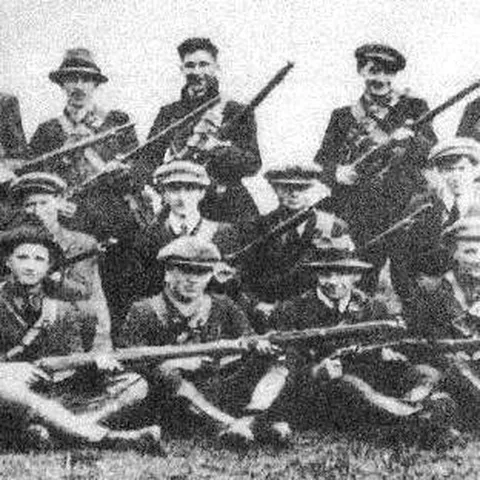
In this episode we study the structure of the Irish Volunteers, charting how their increase aggression in 1918 and 1919 eventually led to a war finally kicking off.
Support The History of Ireland by donating to their Tip Jar: https://tips.pinecast.com/jar/historyofireland
Transcript
Welcome to the History of Ireland. We are 10 episodes in people. This is exciting. Did you think we were going to get this far? I didn’t. 10 episodes. It’s a good time to say thanks and do a little bit of housekeeping. So first off, I’m back from Japan. So we’ll be going back to weekly episodes. Thanks for bearing with me while I was away.
Secondly, I just want to say a big thanks in general. I’ve been blown away by the interest in the podcast and the amount of you who keep tuning in. It’s freaking awesome. However, it does kind of mean I have to upgrade my hosting service. Good problem to have, I suppose. So this is going to cost me a little bit, which I don’t mind because this is a hobby and it’s still cheaper and infinitely more fun than golf. But I also figure I might approach you guys and see if you wanted to help.
Yeah, look, sorry. This is the part where I join all the other podcasts and ask for money. But I ain’t asking for much. If each of you faithful listeners gave between like 2 and 5 bucks, my hosting fees would be sorted in no time. I’m doing this for the love of it, so I don’t mind chipping in money to keep it going. But any help would be great. To chip in, all you have to do is visit thehistoryofireland.com. Click help pay for hosting and then give a one-off payment. The system will give you the option to subscribe, but don’t stress about that. Just hit one-time tip and I’ll be forever grateful. That’s thehistoryofireland.com. Thehistoryofireland.com. Easy. Go raibh míle maith agat. And thanks so much for listening.
But okay, enough of the boring stuff. Let’s get on with the show. So in the last few episodes, we’ve covered the early life of two heavyweights of Irish history, as well as the political rise of Sinn Féin up to the founding of the First Dáil. And I think, people, this is very exciting. We’re finally, maybe, actually, getting to the start of the Irish War of Independence. Or the Anglo-Irish War, if you prefer. Hooray!
Though, wait, there’s a slight hiccup. The start of the war is not particularly clear-cut. There’s no real before-there-was-peace, now-we’re-at-war moment. No handy Franz Ferdinand event or anything. Not really, anyway. Some might say that that moment was Soloheadbeg. And we’ll explore it. But really, it was more a slow bubbling of aggression that turned into a war than one big moment. It’s messy, hard to define, and a bit complicated. But hey, that’s what makes it interesting.
With all that in mind, I want to spend this episode exploring the nitty-gritty of the military side of the Republican movement. Which means it’s time to delve back into the Irish Volunteers. So first off, let’s talk about the name. We know the Irish Volunteers. They’re old friends who’ve been bouncing around since 1913. But from 1918-ish, we’re going to start hearing about the Irish Republican Army, or the IRA. The two names refer to the same group, which can be confusing. But generally, pre-1919, they were the Irish Volunteers. And post-1919, once the Dáil was formed, they became known as the IRA.
But that’s more of a convenient history book version of what happened. In reality, the names overlap, and some companies would refer to themselves as Volunteers, while others used the IRA. For the sake of our sanity, though, I’m going to run with the simplification. For January 1919, I’m calling them the Volunteers, and after that date, we’ll refer to the IRA. But remember, it’s the same army, just a different point, and the soldiers never really created such a clear distinction. On top of all this, it’s important to point out that the IRA of this period should be considered as a different body than the provisional IRA you’re familiar with from the Troubles in the 80s, or that film, The Jackal. That’s a whole other kettle of fish, and we shan’t get into it.
But okay, with all that cleared up, let’s get cracking. After the Rising, Cahill Brewer had worked hard to reorganise the then Volunteers back into a fighting force. In 1917, he was voted Chief of Staff, with De Valera voted as President. Collins became Director for Organisation, and Richard Mulcahy was put in charge of training. There are a bunch of others in this national executive, but they’re the four that matter to us right now, Mulcahy especially.
From Waterford, Mulcahy had joined the Volunteers when it was formed in 1913, and was a fairly senior Rising Commander. He often gets overlooked, with Collins unfortunately overshadowing him a little bit. And though they didn’t always agree, he and Collins worked very closely together throughout the war. As well as a member of the Volunteers, Mulcahy was also very much a man of the IRB.
While Brewer had been rebuilding the Volunteers, we know Collins was doing the exact same thing with the Irish Republican Brotherhood. Its influence in the war to come cannot be understated. Dev hated secret organisations, and was not in any way fond of the IRB or Collins. He had reluctantly joined before the Rising, but never wanted anything to do with them. Brewer, on the other hand, had been an active member pre-Rising, but had left the group believing they were no longer necessary. This seems to have been a bit of a miscalculation. The IRB had men in most branches of both Sinn Féin and the Volunteers, and this network allowed Collins, who became President of the Supreme Council, to hold quite a lot of power, both at a leadership and grassroots level. He and Mulcahy pretty much took charge of the military, which Dev was never particularly happy about.
Initially, the Volunteers were organised along the lines of the British Army. Brewer and Dev believed the country needed a proper force, ready to fight out in the open, like a good, respectable army. Though Collins and Mulcahy completely disagreed. It was not the first disagreement between the men, and it wouldn’t be the last. The Volunteers were broken into 50 or so brigades, which was further broken down into local battalions and companies. As we’ve seen, a unique quirk of the army was that leaders were mostly elected, right from President down to company commanders. It’s a great example of how deeply rooted democratic ideals were in Ireland.
This was in part thanks to the Irish Parliamentary Party. For almost a century, they’d been driving home the ideas of democracy, and many of the Volunteers and Sinn Féin would have been ex-IPP. So even though they’ve imploded and kind of exited stage left, their influence is still felt on how Sinn Féin and the Volunteers approached things. The strength of the democratic process will be vital in the future, and a rare thing to find in a revolutionary movement.
The Volunteers were weirdly well-documented, and from the paper trail, we know the membership of the group fluctuated constantly, reaching its height during the conscription crisis at about 100,000. But, like with any good social sports team, there’s a big difference between the people who’ve signed up and those who actually show up. Just ask my mixed-touch rugby team. Even among the more engaged members, the leadership created two categories. Reliable and active. Reliable members were those who’d helped out now and again, while those who were considered to be active men were regularly engaged in operations. This active core probably only made up about 5,000 men.
Who these guys were is also pretty interesting. I think people picture the Volunteers slash IRA as a very rural force, one made up of poor, lower-class farmers who turned soldier. But, in fact, less than half the lads were farmers, despite Ireland’s huge agricultural population. The majority were skilled tradesmen and office clerks. As Peter Hart of Queen’s University Belfast explains, the guerrillas were disproportionately skilled, trained, and urban. And he argues that, at any point in the Revolution, the typical Volunteer would have been better off than many of his neighbours. It’s also important to note how bloody young the whole army was. With most people in their late teens or early twenties, it’s actually kind of shocking. We’ve mythologised the likes of Michael Collins, to the point that it’s crazy to think he was only 29 when elected to the first Dáil.
As things ramped up between 1917 and 1919, the Volunteers restructured a little bit. The National Executive, which had been in charge, was replaced by the General Headquarters, or GHQ, in March of 1918. Just to confuse things, the Executive did remain active and worked as sort of an advisory board until 1921. But, for all intents and purposes, the GHQ was in control, and the chief of staff at the GHQ was Richard Mulcahy.
To help distribute the GHQ’s vision, they published a journal called Ant Uglach in August. Edited by Pieris Baisley, Sinn Féin’s communication maestro, it acted as a means of providing the disparate Volunteer forces with guidance from the leadership. It was kind of a one-part training manual, one-part propaganda, and one-part manifesto. It described the Volunteers as The army of the Irish Republic, the agents of the national will, an instrument framed by Irishmen to further Ireland’s determination to be free, dating, This was all down to Mulcahy’s view that a nation’s army should be separate from any one political party. He wanted to ensure that, though it would listen to the Dáil once formed, it was not controlled by Sinn Féin.
The distinction looked kind of theoretical at that point, as Sinn Féin would make up the entirety of the Dáil, but I reckon Mulcahy had the big picture in mind. And he was right. It’s important that an army isn’t in the pocket of one political party, and instead answers to the political will of the people. Otherwise, you start getting coups. Just ask Bolivia, Egypt, Turkey, and nearly every other country that’s had a similar revolution as the Irish.
But this is where things get complicated, though. We know from 1916 that the Fenians were happy to act without the public’s backing. As we’ve discussed, they fought for an idolised version of Ireland, rather than the people itself. A lot of Sinn Féin and the core of the Volunteers believed they knew what was best for the country. As Antuglock stated, their allegiance was to the Irish nation, not the Irish people, not the Irish parliament, but rather the Irish nation. Whatever that was. Remember that wording. It will be on the test, and it will make things difficult moving forward.
Next week, we’re going to follow the Volunteers’ increased aggression, and look at the moment that went down in history as the symbolic start to the War of Independence. And we’ll question whether you can even define one moment that started the whole war. No prize for guessing. The answer is, you probably can’t. But that’s for next time. Sovereignty was never ceded.