Episodes Irish Revolution Season 1 — The Revolution
The Big Fellow
Transcript
Welcome to the History of Ireland. Last time we explored the early life and formative years of Éamon de Valera, who, when we left him, was the president of Sinn Féin and locked up in an English prison. Next, we’re going to look at the guy who broke him out. But before we do, I need to make a quick correction.
So last episode, I mentioned that the reason Dev wasn’t executed in the Rising was because of his American citizenship. Now, this is often cited as the case, and Dev himself told JFK that this was why he was spared. But faithful listener Adam Ladd has pointed out that it’s since proven to be untrue. Really, the main reason Dev wasn’t executed was down to the fact that British forces had no idea who he was.
W.E. Wiley writes about the decision in his unpublished memoir. Wiley was a barrister helping Maxwell, who you’ll remember was in charge of the executions. When Maxwell saw Dev’s name on the list, he asked, Who is he? I haven’t heard of him. And asked Wiley whether he’d cause trouble in the future. Wiley replied saying, I wouldn’t think so, sir. I don’t think he’s important enough. From all I can hear, he’s not one of the leaders. And so, as the Prime Minister wanted the executions stopped, it seemed safe to spare Dev. Hindsight’s a beautiful thing, I suppose.
So yeah, my sincerest apologies. In my haste not to get bogged down in the Rising, I skipped over quite an interesting little quirk in the historical narrative of Dev’s life. Thanks to Adam for pulling me up on it. If we had history of Ireland t-shirts, I’d be sending one your way. But we don’t, so instead you’ll just be getting my undying gratitude. If I make a mistake again in the future, which I’m sure I will, anyone feel free to get in touch and let me know.
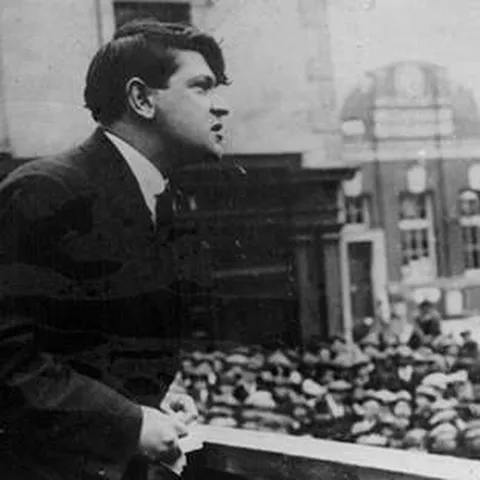
Anyway, it’s time to finally introduce the man that helped Delair escape from prison, Michael Collins. If there’s anyone who could challenge Dev for the title of most influential Irishman, it’d be Collins. He and Dev could not have been more different. Their upbringing, their mannerisms, their approach, all pulls apart. If Dev was the fledgling state’s most esteemed statesman, Collins was its foremost backroom organiser, spy and soldier. Though how much of a soldier he actually was is something we’ll debate at a later date.
So far, I’ve unceremoniously kind of let Collins out of the narrative. But that’s purely because I wanted to give him a proper introduction. Plus, though definitely a key figure in Sinn Féin by the time of the 1918 election, it’s post-election that Collins really starts making waves. But yeah, let’s see how he got there.
Michael Collins was born on October 16th 1890 in West Cork. The youngest of 8 kids, Collins’ upbringing was very different from Dev’s, and arguably much easier. His father, also Michael, was the 7th son of a 7th son. He spoke French, Greek and Latin and was up by all accounts a gifted mathematician. But he didn’t marry until he was 60 and was 74 when Michael Jr. was born. 74!
Michael’s mother was Marion O’Brien. She was 23 when she married the 60-year-old Collins Sr. Apparently, she wasn’t all that put off by the age difference and was pretty happy with the 90 acres of farmland she married into. She’s described as a friendly and hard-working Cork woman and apparently also learned Latin and Greek, because it seems that was just a fun thing to do in Cork in the 1890s.
The typical youngest child, Michael was happy to be the centre of attention and very quickly received the nickname, The Big Fellow, a name he’d be known by throughout his life. Initially, it was a joke for the youngest in the family, a little kid with a huge personality, but the boy grew into the name and it well suited him by 1920.
Though his family would have been Fenians and his father was a member of the IRB, it was James Santry, a local blacksmith, and Dennis Lyons, a schoolteacher, that really sparked the young Collins’ nationalism. They both tell tales of Fenian uprisings and their stories instilled a great sense of patriotism. As Collins himself later put it, In Dennis Lyons and James Santry I had my first tutors capable of, because of their personalities alone, infusing into me a pride of the Irish as a race. It’s interesting to note how influential it seems these Fenian schoolteachers had on this generation of rebels.
Collins grew into a strong, athletic and intelligent teenager. He was an avid reader, fond of Shakespeare, but also devoured Irish literature and the philosophies of the Fenian writers. It’s said that by the age of 12 he was reading Arthur Griffith’s newspaper, The United Irishman, and very early on had a dim view of Home Rule and the IPP, describing them as slaves of England.
Though he was clever, he was also a bit of a wild kid, and his mother worried that this would get him into trouble, so in 1906, aged 15, she sent him off to London to work for the post office. That plan most definitely kind of failed. Once there, he dove into the Irish Republican movement, first joining the local Gaelic Athletics Association. He quickly gained a reputation as a good hurler, but one with a fierce temper. He’d get into fights with other players over them playing soccer, a sport he dubbed a garrison game, used to aid the peaceful penetration of Ireland. So yeah, pretty nationalistic from the get-go, even while in London.
It was through the GAA that Collins was introduced to the Irish Volunteers, and later the IRB. He was sworn in by Sam Maguire, for whom, as you probably know, the All-Ireland Gaelic Football Cup is named. As well as joining the IRB and the Irish Volunteers, during his time in London he worked for the post office, a bank, and even as a stockbroker. Though he goes down in history as kind of a soldier, these number-crunchy jobs were Collins’ true calling. As he put it himself, the trade I know best is the financial trade, and all of this organisational and financial experience would be invaluable moving forward. And it’s no surprise his first job for the IRB was that of a treasurer for the London branch. If he’d been born at any other time, he probably would have been an accountant.
As well as his work and his commitment to the IRB, he also studied and read voraciously, often loudly reciting from the likes of Yates, Singh, and Wilde. As Frank O’Connor described it, to whom culture remained a mysterious and all-powerful magic, though not one for everyday use. But at the same time, the move to London had done nothing to rig Collins of the wildness that had worried his mother. One contemporary described him saying, When he came to London a mere boy, he fell into spasmodic association with a hard-drinking, hard-living crowd and was regarded as a wild youth with plenty of ability spoiled by his wildness. Stories of Collins are full of these contradictions. Wild, studious, angry, playful, friendly, violent. It seems he did nothing by half.
And like many immigrants present company included, it seems Collins’ time in London just made him even more patriotic. There’s a quote I love where he explains what he’s fighting for with a story from his time in London. He said, Based on the people and embodying and maintaining the things, their habits, ways of thoughts, customs that make them different. The sort of Ireland I was brought up in. Once, years ago, a crowd of us were going along the Shepherd’s Bush Road when out of a lane came a chap with a donkey. Just the sort of donkey and just the sort of cat they have at home. In Ireland he means. He came out quite suddenly and abruptly. We all cheered him. Nobody who has not been in exile will understand me. But I stand for that.
Now he’s right. Maybe no one who is an Irish will get that quote. And maybe even the Irish who aren’t living abroad won’t get it. But man, some lads randomly cheering because they’re reminded of home doesn’t really get any more Irish than that. So I totally get what he means.
Collins stayed in London until 1916. Then with plans for the Rising underway, he moved to Dublin and at the age of 25 was made financial advisor to Count George Plunkett, who you’ll remember would go on to open the first stall. Count Plunkett’s son Joseph Plunkett was a leader of the Rising and so this put Collins very close to everything that was going on.
Collins also quickly joined the Dublin branch of the Gaelic League. The Irish language was of vital importance to Collins. He viewed it as the only way to shake off the British and create a distinct Ireland. In fact, he even went as far as saying the formation of the League was the most important event. Quote, not only of the 19th century, but of the whole history of the nation. Like a lot of contemporaries, he started signing his name in Irish. Mícheál Ó Cuíleann. He’d probably be pretty disgusted by how I just mangled the Irish translation of his name and be pretty pissed that he’s being referred to as Collins throughout this episode and probably even more angry that the whole thing is in English. Sorry.
It actually does make me feel pretty bad. I hated Irish in school and can barely hold a conversation. And I’m not the only one. The distinct, wholly Irish-speaking nation that Collins dreamed of has yet to emerge. And look, the Irish language situation is a multifaceted, systematic and historical problem that’s very complicated. But that doesn’t stop me thinking that I should have studied harder. The education system should be better and we should all be speaking Irish. But hey, maybe there’s still hope. Irish schools are on the rise and I’m using Duolingo every day. I promise, Mr O’Keeffe-Holland. I promise.
Anywho, back to the story. With his IRB connections, it’s no surprise that Collins was very much in the thick of it come the Rising. Still too junior to be commanding anyone, Collins was found at the GPO in amongst the operations room. Described as being the most active and efficient officer in the place, he was there first-hand to see how the unrealistic plans of the Rising fell apart.
Afterwards, Collins was sent to Frongrook, Wales. Here is where he really came into his own. He was elected leader of the IRB group within the prison and used his period of incarceration making connections and planning. Unsurprisingly, the prisoners spent a lot of their time discussing what had gone wrong in the Rising, with Collins noting that it was bungled terribly, costing many a good life. It was within the walls of Frongrook that the more guerrilla tactics that would go on to define the Irish War of Independence were developed and latched onto. These prisoners eschewed the poetics of Pearse and were determined to push forward with a more realistic approach.
And then by the end of 1916, the British government released the prisoners as a sign of goodwill. Collins got out in time for Christmas in early 1917 and began working for Kathleen Clark. Kathleen Clark was a pretty impressive figure. A founding member of Cumann na mBan, she had been heavily involved in the 1916 Rising, along with her husband Tom Clark. After the Rising, with the leaders executed, including her husband, Kathleen Clark would have been one of the most connected people in the movement.
She had an intricate knowledge of IRB membership and the Republican movement in general. She was instrumental to rebuilding the IRB after the Rising, and in mid-1916 reached out to the IRB members, including Collins. She had started a group to ensure the Widows of the Rising were taken care of, and once he was released, she brought Collins on board as secretary. This was a job that suited him down to the ground. As an accountant, Collins worked hard to make funds stretch as far as possible, and used the position to endear himself to, and connect with, Republicans around the country. The network Collins helped develop would be of huge importance to Sinn Féin going forward. We’re going to have a whole episode dedicated to his badass bi-network soon.
Collins quickly rose the ranks in the new, post-Rising Sinn Féin, and by 1918, with other leading IRB figures like Cahill Brewer, led a contingency of more radical, militaristic members within the party, who were kind of the opposite of Dev’s more moderate stake at this point. He worked hard helping run by-elections all through 1917, as well as slowly increasing his spy network and infiltrating the British. Unlike Dev, he avoided arrest, and successfully ran for election in West Cork. Though, just like Dev, he missed the first stall. Why? Well, as we said, he was about to break Dev out.
As Sinn Féin’s de facto spy leader, it was Collins who was tasked with breaking Dev out of prison. There’s lots of stories of how this went down, and the movie Michael Collins muddies the water a little bit. It’s a pretty bloody inaccurate film, but also a good watch, and people say Liam Neeson really captures Michael Collins’ essence, so take that what you will. Plus, with stuff like this, it’s hard to get a definitive account. But let’s do our best, because even if it’s not all 100% true, the story itself is great.
First off, Dev and his other inmates needed to get a copy of the Master Key. It’s said Dev did this by using candle wax to make an imprint. From there, Sean Milroy, an illustrator imprisoned with Dev, sent a Christmas card back home. In it, he drew a cartoon depicting an exact replica of the key. How the guards didn’t check this, I don’t know. I’ll throw a picture of the cartoon up on Facebook. It’s kind of fun. A copy of the key was then made and snuck into the prison with a cake. Apparently three cakes had to be sent before they landed on a key that worked. Nothing suspicious going on here, guards. We just love cake.
Once the keys were working, the breakout was planned. Collins rocked up on one side with a copy of the key. Dev worked from the other with his copy, unlocking door after door until he got to the entrance. The story goes that Dev snuck all the way out to the main entrance where Collins was waiting for him. Then, with only one door between Dev and Freedom, Collins placed the key in the lock, turned it, and felt it break.
It broke. Middle of the night. Guards everywhere. Think about it. You’re almost out, and the bloody key breaks in the door. God damn it. Really wouldn’t have gone down well if Dev had been caught breaking out. But luckily, Dev managed to use his key to wiggle the other broken key out of the lock. Can you imagine? Frantically trying to wiggle the key out of the lock hoping the guards won’t find you. Talk about a close call. But once the key was out, it was plain sailing. Dev was whisked away to a safe house and within a week was back on Irish soil.
From then on, the two men were best buds. Dev and Collins, working together to thwart the British. Well, no, not actually. Kind of the opposite. But we’ll dive into the complex relationship between the two men and how their approaches differed significantly next time. Music by Liam Doyle and production help from Aoife Murphy. This podcast was recorded on the lands of the Wurundjeri people of the Kulin Nation. Sovereignty was never ceded.