Episodes Irish Revolution Season 1 — The Revolution
Back In The USS Limerick
This is the second part of our two part episode on the Limerick Soviet. After the death of Bobby Byrne things really kicked off, with Limerick creating it's own strange little socialist mini-state.
There's one mess up of a sentence in there, 10 points to Gryffindor if you can spot it.
Support The History of Ireland by donating to their Tip Jar: https://tips.pinecast.com/jar/historyofireland
Transcript
Welcome to the History of Ireland Last week we told the story of the death of poor Bobby Byrne, an IRA man in Limerick Byrne’s breakout and death is a great example of how things were heating up after a solo headbag But really it’s what comes next that’s especially interesting So let’s get cracking and see how Postman’s death led to the development of a mini-Soviet state in Limerick
Limerick! I grew up half an hour from there and I never knew this was a thing It’s the last place you’d expect to have a secret socialist history It’s where I did all my Christmas shopping for Christ’s sake But okay, it’s at Byrne’s funeral where things really start to get iffy 15,000 people gathered for the funeral And that freaked the British out enough to send armoured cars and two bloody planes to follow the procession This is 1919, planes were not used lightly
On top of this, they then cracked down even harder following the funeral On April 9th, three days after Byrne’s death, the city of Limerick was declared a special military area And from the 15th on, everyone coming and going in the city would need permits This pissed off the workers no end Like really pissed off the workers
Especially those who worked on the other side of the River Shannon Which acted as kind of an arbitrary border for the area They would have to be checked by military personnel four times a day And like any arbitrary land border, Brexit, this just wasn’t feasible
So on April 13th, a meeting was called and was attended by representatives from 35 trade unions They all agreed not to work under the crazy conditions being imposed by the British And declared a general strike against British militarism Again, around 15,000 people striked It was pretty much every business in Limerick A committee was formed and took over the running of the city
They closed all the shops and even closed the pubs, which is how you know things were serious Only the essentials were allowed to remain open Things like the bakery and electricity works and stuff But anyone working, or even just driving around the area Had to have signs stating they were working under the authority of the strike committee
Patrols were even set up And it was announced that any business operating without the committee’s approval And anyone, quote, engaged in profiteering would be immediately shut down
It was this committee and how it began organizing and running the city That really set the whole thing apart from your regular old strike Led by John Cronin, a carpenter, the committee knew what they were doing Comparing themselves to the Bolsheviks and referring to the whole thing as the Limerick Soviet
Now, Soviet is a Russian term for committee By 1919, it had been synonymous with socialism and the workers’ revolution It was a charged term, designed to demonstrate that the workers were doing something more than a simple strike They wanted to make people stop and listen And listen they did
Luckily for the, quote, baby Soviet, as they were referred to There happened to be a huge number of journalists randomly staying in Limerick at the time They’d been sent over to cover solo transatlantic flight But found the development of a strange mini workers’ state much more interesting The whole thing was extensively reported And news of the Limerick Soviet spread like wildfire
There’s a great excerpt written by Ruth Russell, a journalist from the Chicago Tribune Describing a meeting with Cronin She writes Yes, this is a Soviet, said John Cronin Why did we form it? Why do we pit people’s rule against military rule? Of course, as workers, we are against all military You’ve seen how we have thrown the crank into production
And the British were no happy with this crank in production And kept up a blockade of the entire city Interestingly, the strikers didn’t seem to have as much animosity towards the British forces As a lot of Sinn Féin would have
In that same excerpt, Russell describes Cronin’s views of the army We have, by the way, got the sympathy of the Union men in the army sent to guard us A whole Scotch regiment had to be sent home because it was letting workers go back and forth without passes To the strikers, it seemed, it was more about the working class against the capitalists Rather than the Irish against the English
As well as give interviews to every newspaper that would listen The Soviet also created their own daily publication As they saw it, the kept press is killed And so to spread their views, they created the Workers’ Bulletin Issued by the Limerick Proletariat The idea of, quote, kept press is pretty interesting It sounds an awful lot like how modern populist movements refer to the media now
So this was the Limerick Soviet Various committees were set up to run everything in the town And men patrolled wearing red badges to make sure the peace was kept Notices were put up with standard prices for everything And even the cinemas were opened back up With the strike committee’s permission, of course
It was said that Limerick was a much safer and better organised city during the strike Than it had ever been previously But also, ironically, due to all the committees and the Soviet-style rhetoric There were more rules and hoops to jump through than when the British were running things They literally were setting up this weird mini-state
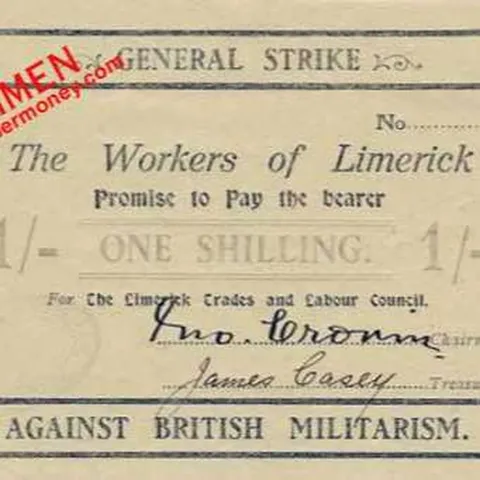
For example, in the second week of the strike There arose a shortage of money due to the fact that, well, everyone was on strike To solve the problem, the committee began printing its own currency Its own bloody currency! In denominations of 10, 5 and 1 notes People were paid for their work and could buy and sell goods with the new currency It’s mental! I’ll put a photo up online
So they had their own committee, police force, currency By all accounts, Limerick was ticking away along relatively well But the Soviet was just simply not sustainable The local IRA were helping sneak supplies into the city But it wasn’t enough The Soviet needed the entire Irish labour movement to get behind them
They had envisioned a scenario where they would not only receive their support of the wider Irish labour movement But also have, quote, millions of supporters from all over the world But unfortunately for the little Soviets, it just never happened This was because it just wasn’t supported by the upper echelons of the Irish labour movement
Much like the attack on Soloheadbeg, the Soviet was an example of local forces gone rogue Despite the fact that throughout the strike, the committee was in touch with Tom Johnson, the Irish labour leader At no point did labour offer anything other than written support This is down to a bunch of reasons
Some argue that the upper echelons of Sinn Féin were just as worried by a socialist revolution as the British were And so labour didn’t want to piss them off Others say it’s purely because labour knew a countrywide strike would lead to an armed rebellion And the IRA just couldn’t win fighting like that
And it’s true, Sinn Féin worked hard to keep the nationalist movement together And not have it splintered down class lines This kind of Soviet rebellion was just beside the point for Sinn Féin And it would just muddy the waters And potentially cause Sinn Féin members to start fighting among themselves And that’s not what they wanted Sinn Féin wanted everyone focused on the British That was for after the British were kicked out
But whatever the reason, by week two, the Limerick Soviet was struggling to maintain itself And a pretty ridiculous plan to evacuate the city was concocted But things would all change on Thursday April 24th
The Mayor and the Bishop of Limerick sat with the strike committee for one hell of a long meeting The strike committee was by all accounts under quite a bit of pressure And Cronin came out of the meeting and announced to the strikers That all workers who could resume work without military permits were to do so
This is interesting because unlike in Russia, you can see the church’s influence was still super strong When the Bishop asked them to stop, they did Now this is because they knew their position was totally untenable But we can’t underestimate the Bishop’s influence in the whole thing
So soon after, Limerick’s designation as a militarised zone was abolished And so technically the strike had been a success But it does feel like the baby Soviets were angling for something more Some strikers were angry that the committee had caved And even angrier that Labour hadn’t supported them
And it’s interesting to imagine what could have happened if the Labour movement had thrown their full weight behind it all Would they have managed to create a more socialist, independent Ireland? Personally, I kind of doubt it
The British, still terrified of communism like nearly every country in the world at this point Would have been swift to crush anything that looked like a socialist revolution in Ireland Irish nationalists were bad enough, but Irish communists? That would probably have been a step too much for the British
As Dev had stated, Labour can wait Independence was all that mattered And there was no time for a Labour movement while Sinn Féin was fighting for independence Some would argue that this Labour can wait mentality is what led to such a weakening of left wing politics in Ireland But that’s out of our ream here a little bit
And I guess Sinn Féin and the IRA were fighting for an independent Ireland first and foremost For better or for worse, anything else was a waste of time and a needless diversion But hey, what a diversion The Limerick Soviet is just this cool little experiment and a weird historical detour
Next time, we’re going to get back on the main track of things And look at something that definitely wasn’t a diversion Something that would further erode the practical day-to-day control of the British in Ireland Next time, we’re going to delve into the developments of the Dáil Courts
Additional research and fact-checking by Robert Babington Music by Liam Doyle And production help from Aoife Murphy This podcast was recorded on the lands of the Wurundjeri people of the Kulin Nation Sovereignty was never ceded