Episodes Irish Revolution Season 1 — The Revolution
Courts, Loans and the Counter State
In this episode we explore the nitty gritty of getting a government off the ground. You need propaganda, money and proof that you can run things smoothly.
In 1919 the Dáil was working on all three. So strap in and get excited for government loans, court systems and more. Don't worry it's fascinating, trust me.
Support The History of Ireland by donating to their Tip Jar: https://tips.pinecast.com/jar/historyofireland
Transcript
Welcome to the History of Ireland. It’s mid-1919. There’s been an increase in IRA attacks, the boycott of the police is well underway, and a mini-Soviet has even popped up in Limerick and quickly folded in on itself. It’s safe to say British control in Ireland really is slowly but surely beginning to unravel.
Now, during our episode on Dev’s American Adventure, I’d introduced the ministry of the New Dáil, and promptly moved on, saying we’d return to them at a later date. Well, today is that later date. We’re going to look at the Dáil and how they were helping mastermind this slow unraveling of British control in Ireland.
As we’ve said, the Dáil was seen by the British as a bit of a joke. Even the Manchester Guardian, one of the only British newspapers that was actually sympathetic to the Irish cause, stated that the ministers would, quote, be hard put to find an outlet for any executive capacity they may possess. Basically, they were asking what the hell are these Dáil ministers going to do?
And look, it was a fair question. The Dáil was a government cabinet without an actual government to run. They didn’t have a civil service, they didn’t have any state apparatus, and they hadn’t even officially taken control of the IRA. But the British were underestimating the whole endeavour by thinking the Dáil was useless. So this episode, we’re going to investigate what the Dáil was doing throughout 1919 to prove the British wrong.
First off, the Dáil was an amazing piece of propaganda. It was the most consistent institution of the new Irish Republic and gave everyone something to fight for. One Dáil member, Robert Barton, had a wonderfully weird analogy for the whole thing. He viewed the independence movement as an egg. Yep, an egg.
So long as the shell was intact, he said, compromise and disruption were impossible. The army and political leaders were the shell, the people were the fluid contents. And even though to the outside observer their demand for complete independence may have appeared to spring from the people, in reality the people were influenced by the leaders. End quote.
Which is something we’ve spoken of before. As Mulcahy had said, the people of Ireland needed to be gently led into war, which is pretty much what Barton is talking about here. The Dáil was the shell that gave the whole nationalist movement shape.
Disparate events like the Limerick Soviet and Solohead Beg were the eggy yolk. They could occur and as long as the Dáil was leading the movement, it felt like everyone was pushing for the same goal. If the Dáil cracked, everything would leak out and turn into goo. Or something, I don’t know, it’s not my metaphor. So yeah, giving the movement purpose and providing a serious amount of propaganda value. That was the Dáil’s first job.
The next was raising funds. This was done by a national loan system, launched in September 1919. We briefly mentioned this when discussing devs tour of the states because the Americans raised about half the loan needed. The other half though was raised at home in Ireland and was by all accounts a pretty difficult endeavour.
Michael Collins, as Minister for Finance, was in charge of the loan. Basically the idea was to ask members of the public for money. That would then be used to help run the fledgling state and then be returned once the country was up and running. It’s generally said that Collins was the most effective member of the Dáil and this is a prime example of this.
As well as his military and intelligence campaign, which we’ll dive into soon, don’t worry. He also worked tirelessly to raise funds for the fledgling government. He was the kind of guy who dove into problems and took on jobs no one else wanted to do. But this was a bitch of a job, even for Collins.
He wrote that, This enterprise will certainly break my heart if anything will. I never imagined there was so much cowardice, dishonesty, hedging, insincerity and meanness in the world. And what was this meanness he was talking about?
Well basically some local Sinn Féin leaders were siphoning off money and Collins had to blacklist them, banning them from collecting any money at all. And then the newspapers eventually refused to run ads for the loan as they were kind of scared of the British. Both these things were kind of a real pain in the ass.
Collins knew the power of the press and propaganda and that’s something we’re going to explore later because his legend and the whole cult of personality that builds around Collins is fascinating. Especially because he kind of knew what he was doing when he cultivated it. So despite the newspaper’s reluctance, he still managed to run a fairly solid ad campaign.
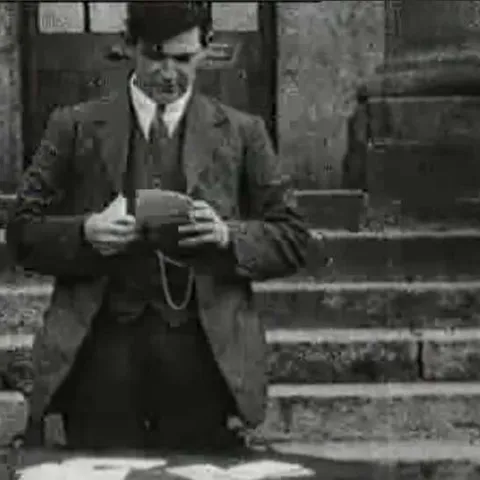
In fact, he even had a cinema ad created to spread word of the loan. In it, a block on which a famous Republican had been beheaded is used as a table at which Collins sits issuing loans to famous Republicans. The IRA then persuaded cinema owners across the country to run the ad. Or else.
It’s legit up on YouTube. Collins is just sitting at this big concrete block thing writing notes. I’ll post it online, it’s so worth watching. Like, it’s no Super Bowl ad, but you get to see the likes of Arthur Griffith, Count Plunkett, Hannah Sheehy-Skeffington and a bunch of other super important Republican folk all walking around in a weird early cinema style silent movie. It’s worth checking out.
And in the end, the public did eventually come through with the goods. Over the course of the war, the public would raise over £500,000. Which is about £21 million in today’s money, if my maths is right. Let’s take a moment to let that sink in.
The majority of that money was raised by normal everyday folk. £500,000 raised by a country that was not wealthy by any stretch of the imagination. It makes the War of Independence pretty much a crowdsourced endeavour. It really does just reaffirm the popularity of the movement and show how much ground support the Dáil had at this point.
I know I spent a lot of time talking about Collins and Dev and all those big famous people. But it’s important to remember how all of this wouldn’t have worked without the support of the public. This trickling in of funds throughout 1919 and 1920 allowed the state to actually start functioning as a state.
The value of the loan system cannot be understated. Griffith described Collins’ success with the loan as quote, one of the most extraordinary feats in the country’s history. And I don’t reckon he was over-exaggerating. The author Charles Townsend also points out that it’s kind of impressive slash a little interesting that Collins managed to raise all this money without resorting to bank robberies like those of the later IRA. I’ve said it once and I’ll say it again. Collins was an accountant above all else.
So with these funds the Dáil began being able to run what’s known as the counter state. And one of the most important parts of this counter state were the Dáil courts which also began in 1919. Though not officially sanctioned until 1920 the plan for courts that would run parallel to the British system were an idea proposed by Griffith as far back as 1913.
Griffith had proposed the idea of arbitration courts to run alongside the British system. And it was classic Griffith style passive resistance. Yeah, that’s some OG Sinn Féin thinking. This is because arbitration, a system where two people approach a third to solve a dispute was totally legal.
There was nothing the British system could do if two people decided to solve a dispute outside of the courts. The fact that they were solving it in another court was just kind of a handy loophole for the Irish counter state. So on June 17th 1919 Griffith called for the establishment of these arbitration courts.
And by this time the courts were very much needed. Mostly for two big reasons. One was to show the Dáil was actually doing something and the other was to help maintain unity. Author and Sinn Féin member Daryl Figgis writing in 1927 had this to say on the subject.
Quote The Republican government in the first place had to either be a government or not be a government. And in the second place it had to keep the national demand for freedom clear from class issues or be caught in the snare of a class war. Dublin Castle, i.e. the British, would have been well content to see the larger pretensions of the Republican government crumble into the general disorder of an agrarian war especially as such war would be eternal and might split the ranks of the IRA. End quote.
His second point is what I want to focus on. Without getting too deeply into it the British had largely solved the agrarian issues that had been plaguing Ireland throughout the 1800s with a land purchase scheme. This provided loans to tenant farmers so they could buy their land from the landlords.
But World War I had put a spanner in the works and the British had suspended the very popular scheme. Once the war ended agrarian unrest increased as farmers demanded that the scheme be reinstated and when it wasn’t they started taking matters into their own hands. Someone needed to calm the agricultural tensions and the RIC were busy being ignored and shot at. So enter the Dáil courts.
They were slow to set up initially with County Clare being the first to get going in August 1919. But they did become highly popular. The courts slowly spread across the country from 1919 through into 1920. They were informal people’s courts generally set up along parish lines. Judges were chosen from the public and the IRA enforced any decisions.
Though Griffith had been the one calling for these arbitration courts it wasn’t until May 1920 that the Dáil actually officially laid out a system. Part of this is just simply down to the fact that it wasn’t until then that the state had enough money to set up a proper system. But by 1920 there were three different levels. A parish court, a district court and a supreme court.
The judiciaries of the supreme courts and district courts were generally lawyers. While the parish courts were a mixed bag of farmers, IRA commanders, representatives of Cumann na mBan, trade union members and of course the clergy. It’s worth pointing out that women served as judges and lawyers throughout the system which was far from the norm at the time. Cumann na mBan were hugely important in the organisation of the courts and dedicated quite a bit of time to making sure they ran smoothly.
The proceedings themselves were relatively simple affairs and very different from the British system. There was no pomp or grandeur, no wigs or gowns and very little legal jargon. The whole thing was kept fairly down to earth.
Ken Loach’s amazing film The Wind That Shakes the Barley had an awesome depiction of a court hearing. It really gives a great sense for how they went down. In fact, actually, if you’re looking to get a feeling for the War of Independence, The Wind That Shakes the Barley is a great place to start. It’s historically accurate as you can expect any film to be and really throws you into the period. Be warned though, it is pretty grim. But these were pretty grim times.
The movie spends a little bit of time delving into the tensions that arose from the courts when a landowner comes into conflict with a farmer. We’ve mentioned it before but there was a class split amongst Sinn Féin and issues like this did arise. People complain that the film is a little too focused on class but hey, what do you expect from a Ken Loach film? And class did affect the movement.
Interestingly though, the courts didn’t always side with the landless farmers. In fact, they didn’t even always side with nationalists. As the RSC lost control of the country, landowners who would traditionally have been unionists actually turned to the Dáil courts.
In Connacht especially, landowners were being increasingly harassed by farmers. Cattle was being driven off the land, farms were being seized and the landowners were increasingly pressured. As the RSC had been rendered pretty much useless by Sinn Féin, these unionist landlords went to the Dáil courts to get things sorted. I suppose they just didn’t really have a choice.
But what was a surprise to pretty much everyone was that oftentimes the Dáils sided with these landowners. This is down to a combination of the arbitrators’ barely solid legal training and the fact that a lot of influential republicans came from the upper landowning class. They were sensitive to the issues of landowning and wanted the courts to seem impartial. It also helped that it was a nice bit of PR for the Dáil. While the British became increasingly harsh on Ireland, the Dáil was able to paint these courts as fair, just and efficient.
So yeah, the Dáil courts were kind of hugely successful. They further weakened the British claim on Ireland, they were a great piece of PR and they proved to the public that Sinn Féin could actually solve practical problems. For centuries the British had argued that the Irish could not be trusted to rule themselves and wouldn’t be able to maintain law and order without them. The Dáil courts proved the opposite and it’s said they quote impressed all strangers who witnessed them.
Eventually the British would try and crack down on these courts. But we’ve already skipped further ahead in our narrative than I would have liked and so we’ll look at all that in a future episode. For now we’re going to leave it there. Tune in next time when we’ll explore the remainder of 1919 and the formation of Michael Collins’ team of assassins, known simply as The Squad. Sovereignty was never ceded.