Episodes Irish Revolution Season 1 — The Revolution
Spying Secretaries
How does a small island go about defeating one of the biggest empires in the world? By outsmarting them, over and over again. In this episode, the first of three parts, we explore the the intelligence warfare of The War of Independence and the amazing women who were perfectly placed to spy on the British.
Support The History of Ireland by donating to their Tip Jar: https://tips.pinecast.com/jar/historyofireland
Transcript
Welcome to the History of Ireland. One evening, shortly after the War of Independence had ended, Michael Collins was sitting on a train enjoying a bottle of whisky with a friend. I guess even revolutionary leaders need a night off every now and again.
However, also on the train was Major Shaw, a high-ranking member of the British military who’d been fighting against the IRA. Shaw decided he wanted to meet Collins. When he was told that no one was to see Collins, he simply replied saying, Oh, he’ll see me alright. And Shaw was not wrong.
Collins invited him into his cabin and the two spent the evening drinking together. Because sure, look, why not? Who doesn’t love a drink with a mortal enemy? While chatting, the topic of a man who both sides had used as a double agent cropped up. Both Collins and Shaw admitted they never really trusted the guy and argued over who the lad was actually working for. He was yours. He didn’t work for us. He worked for you guys. No, he was definitely one of your lads.
Shaw argued that the informer had tried to lead the British into an ambush. He’d concocted a story saying he knew the location where the entirety of the Sinn Féin cabinet would be gathered. Shaw, believing the informer to be a double agent, had ignored him.
After hearing this though, Collins asked for the date of the meeting. He checked his diary, chuckled to himself, and concluded that Shaw would have, quote, collared the whole cabinet and the IRA chiefs as well. Oh God, Shaw replied, I’d be Sir Shaw by now. Yep, you’d have been Sir Shaw. Instead, you allowed the largest empire in the world to be outsmarted by a ragtag group of rebels led by an accountant from West Cork. Good work, Shaw.
Now, this is a story from Tim Pak Coogan’s biography of Michael Collins. I’ll warn you now, a lot of historians are not the biggest fans of Coogan. He takes much more of a storyteller’s approach than that of a critical historian. He’s a little loose with sources and does not shy away from his biases. Some would say he even has a bit of the Rita Skeeter about him.
But if you go in well aware that you’re getting, sort of, Michael Collins the myth, the book is fascinating and full of letters from Collins and stories told by friends of his. This is one of those examples. It was relayed to Coogan by Kevin O’Sheal, an associate who’d worked with Collins at the time.
Now, is a story told years after the fact by a friend of Collins a totally unbiased and perfect historical source? Look, no, of course not. Is it a great little microcosm that demonstrates the importance of intelligence gathering in the War of Independence? Well, yeah, I think so.
Because I know I had said last episode we’d introduce the squad, the team of IRA assassins who began operation in 1919. But as I sat down to write, I realized we’d first have to explore the importance of intelligence to the War of Independence. Because frankly, a huge part of the squad’s effectiveness was down to the intelligence they were working with.
And that story is a prime example of how Collins and the Irish movement was always just one step ahead in the intelligence war. So for the next two episodes, we’re going to look at the intelligence network Collins ran and look at how it radically evened the playing field against the British.
So in January 1919, Collins was made Director of Intelligence for the IRA. He’d been building a network of contacts since getting out of Frongirk. His work with Kathleen Clark was vital to this, as was the IRB. Nearly every Sinn Féin or IRA group had a secret group of IRB men within them and they all would send reports back to Collins.
By 1919, he and his men had contacts all over Ireland and England. In the ports, at the railways, and pretty much anywhere else you could think of. All these sources would inundate Collins with reports, notes, and messages. He was constantly writing letters, organizing things, and dealing with the paperwork. Remember, as well as heading this intelligence network, he was also setting up the Dáil Loan.
It’s said that his organizational skills were unparalleled and he would spend his days sending letter after letter after letter. There’s one very short little note that I want to mention, just because it’s kind of fun and sheds a bit of light on how Collins operated. It was found by a historian and they’ve no idea who it was sent to, but it simply said, I told you so, Mick.
It’s classic Collins. How does it help anyone? It’s so needless. But it showcases both how connected he was and how he was prone to pissing some people off. Which he was, he could really rub people up the wrong way. A weird little aside, but kind of interesting. Basically, if he was around today, he’d be one of those guys who was always on his bloody phone.
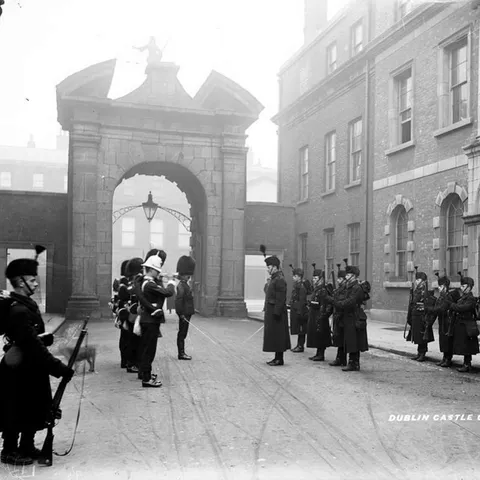
Now the aim of all this was to create a network that could combat the ominously named G Division. If they sound like a spy group, it’s because that’s pretty much what they were. The G Division was the Dublin Metropolitan Police’s intelligence department, working out of Dublin Castle.
Dublin Castle was literally the bastion of British rule in Ireland and as we’ve discussed in our RIC episode, reports were sent back to Dublin Castle each week by police with notes on any suspicious activity around the country. The G Division would then sort through this and make sure anyone dangerous was watched or apprehended. For a very long time the G Division had been extremely successful in Ireland and very well informed.
One magistrate in 1848 had this to say on the matter. Quote, I’ve heard it asserted that all informers should be shot. I can truly and deliberately declare it to be my own firm conviction that if all the informers of 1848 were so disposed of, Dublin would have been decimated. Which is kind of hilarious if you think about it, despite the talk of decimation.
But the G Division’s funds had been cut back throughout the early 1900s, just as Irish republicanism was becoming more of a threat. By 1919 the Nationalist movement had tightened up, while Dublin Castle had let itself go a little bit. But that didn’t mean they weren’t a thorn in Sinn Féin’s side.
The G Division literally had a huge book of information on the entire Nationalist movement. They were arresting people like poor Bobby Byrne in Limerick and they were chasing republican leaders like both Collins and Dev. The Irish needed people on the inside, and by 1919 they had more than a few. So in this episode and the next episode I’m going to look at a few of these double agents and explore how they managed to undermine Dublin Castle so well.
First off I want to introduce some of the women that were instrumental in the Irish intelligence network. As typists, secretaries, waitresses and the like, women were perfectly placed to gather information, as well as transport documents and guns. The British were slow to consider women as rebels or spies and they were rarely if ever searched. So here are just three quick stories about some awesome women who were gathering information for the IRA.
First was Lily Merrin, a typist turned spy who literally worked inside Dublin Castle. She would place carbon paper into her typewriter, allowing her to make sneaky copies of reports she was writing for the G Division. She was then given keys to a house in Dublin where she would sneak in, write up further reports and leave them in a sealed envelope for Collins.
The story goes that she never met the people living in the house and they never met her. Only Collins and a few other IRA men knew she was dropping by. On top of this, she would stroll through the streets arm in arm with leading IRA men and while appearing to be out window shopping would slyly point out British army intelligence officers. This kind of identification was vital for the assassination attempts that would come.
Next was Molly O’Reilly. O’Reilly was heavily involved in the independence movement and as a teenager had even hoisted the flag over Liberty Hall in 1916. By 1919 she was a waitress at the Hibernian United Services Club which was often frequented by British officers.
While the officers danced and drank and talked shop after work she would be there serving them drinks and taking their coats. By doing this she could collect names, the officers’ private addresses and would eavesdrop on important information. O’Reilly’s intelligence gathering was so effective she literally followed the officers from pub to pub. Geyer transferred from the Hibernian to the Bonnyboucher as the latter became more popular with the officers. You can only assume that the officers just thought it was fantastic that their favourite barmaid was coming along to their new haunt.
Then, last but not least, you have Nancy O’Brien. This is one of my favourite stories. O’Brien was working in the General Post Office when she was approached by the director, Sir James McMahon. He believed, rightly, that the British’s messages were being leaked to the IRA. They needed to be encrypted and so O’Brien was hired to decode messages in McMahon’s office.
Just like in World War I and World War II later on encryption and decoding was left to women. If you’ll allow me the digression, it’s a similar situation that led to women creating so much of early computer coding. Just like encrypting and decoding messages, computing was seen as kind of just beneath men. So yeah, don’t ever let the rogue coders of this world make you forget women invented coding.
Anyway, Nancy O’Brien was hired to decode messages for Sir James McMahon. But get this, not only was O’Brien a staunch nationalist, she was also Michael Collins’ cousin. This meant that Collins had an inside line into the encrypted messages sent all over Ireland.
Can you imagine it? O’Brien would spend her days decoding messages and then at lunch have to sneak off and lock herself in the bathroom. There she was furiously and quietly writing out extensive notes for Collins. O’Brien would then stuff them down her top and sneak them home. On top of this, during the day Collins would send her messages to sneak through the GPO to find letters or investigate intel.
Coogan describes O’Brien as having all Collins’ intelligence and daring, without the temper. And that’s pretty high praise considering Coogan sees Collins as some West Cork messiah. But man, it must have been nerve-wracking for O’Brien.
She apparently once complained to Collins about having to miss lunch and sneak upstairs in the GPO. He replied by pinching her and saying, Yeah, you could afford to lose a little bit of that. I’m gonna give Collins the benefit of the doubt and say it was just some friendly teasing. But hey, still a harsh way to treat one of your top spies.
There’s another story where Collins exploded at O’Brien after she missed an important message. O’Brien broke down as Collins stormed off. But later that night, Collins seemingly having realised how much stress she must have been under, he returned to her home to apologise.
She awoke to pebbles clacking against her window. She opened it up and he was standing in her front garden. He said up to her, I’m sorry for what happened. I shouldn’t have said it. I’m under the most terrible strain. Here’s a little present for you. He then turned to leave and left a bag of bullseyes by her gate.
Now, this is one of those stories that’s meant to showcase Collins’ lovely human side. But come on, bloody sweets? That’s all she got, a bag of sweets? That and a dig about her weight? 007 wouldn’t have had to put up with that kind of nonsense. But in fairness to Collins, I think he knew how lucky he was to have been handed this awesome familial advantage. When he first heard the British had hired his cousin of all people, Collins’ only response was, quote, in the name of Jesus, how do these people ever get an empire?
So again, we hear a lot about how it was Collins’ genius that won the intelligence war. But really it was these women and others like them on the front lines who were instrumental in making the whole thing work. They were vital and deserved so much more than a bag of sweets. But however great these women were, it was the detectives inside the G Unit itself who, when they turned against the British, really gave Collins the edge. We’ll introduce them next time.
Thanks for listening. Subscribe wherever you get your podcasts and if you’re enjoying it, tell your friends. It’ll really help. You can also get in touch with us through thehistoryofireland.com or follow us on Facebook. If I made a mistake, let me know.
The History of Ireland was written and produced by me, Kevin Dolan. Additional research and fact-checking by Robert Babington, music by Liam Doyle and production help from Aoife Murphy. This podcast was recorded on the lands of the Wurundjeri people of the Kulin Nation. Sovereignty was never ceded.