Episodes Irish Revolution Season 1 — The Revolution
Librarians & G Men
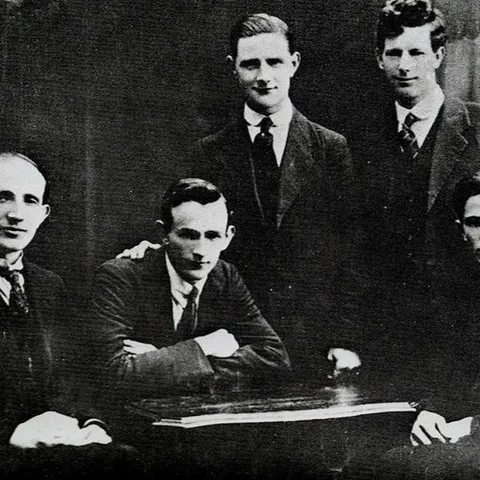
In this, the second episode on the the Irish intelligence network we meet the men who became undercover operatives inside the G Division, as well as the amazing librarian who helped introduce them to Collins and his team.
Support The History of Ireland by donating to their Tip Jar: https://tips.pinecast.com/jar/historyofireland
Transcript
Welcome to the history of Ireland. After the war Collins was having a biography written and this is what he had to say when he looked back at his plan for the Irish Intelligence Network. Now the time had come to turn our attention to the most important part of our job, the smashing of the English Secret Service. My final goal was not to be reached merely by beating it out of existence. I wanted to replace it with a better, an Irish Secret Service.
He saw the whole thing as vitally important, having also said, Without her spies, England was helpless. It was only by means of their accumulated knowledge that the British machine could operate. Without their police throughout the country, how could they find the men they wanted? Without their criminal agents in the capital, how could they carry out the removal of the leaders that they considered essential for their victory?
This was all written after the fact, but it’s clear that Collins knew the importance of intelligence to the British occupation of Ireland. And it was the G Division who were the source of so much of Britain’s information. And in 1919 he set about completely and utterly undermining them.
We introduced the G Division last week, but let’s go into a little bit more detail now. They had about 40 detectives, split into two branches. One focused on murder and large-scale robberies, the other on political crimes. This second branch kept tabs on subversives and revolutionaries, and pretty much acted like a secret police.
Over the course of the war, Collins would recruit four of these G men to act as spies for the Irish. The four men were vital to the Irish war effort, but initially they were pretty much all deemed untrustworthy. This is fair enough. For 60 years the unit worked hard, diligently and successfully suppressing nearly all Republican activities. The Rising being one teeny weeny little exception. And even that they knew was coming, they were just ignored.
They were a force carefully vetted, generally Protestant and exceedingly competent. So both the British and the Irish thought it very unlikely that any of them would turn against king and country. Repeatedly it would happen that a detective would try to help Sinn Féin and be turned away.
First there was Joe Cavanagh. Cavanagh was a cop with an impeccable record, but he was also a bit of a Sinn Féin sympathiser. Now this might seem like an oxymoron, but you’ve got to remember that a lot of the police didn’t view themselves as slaves to the British, but rather as nationalists helping keep order in Ireland. So when the Republicans began acting up, more than a few cops could see where the lads were coming from.
As far back as 1916 Cavanagh had offered to deliver notes for prisoners of the Rising, but they had spurned his help believing it to be a ploy by the G Division to gain information. This didn’t deter Cavanagh though and he persisted over the next few years trying to get information to Sinn Féin. It wasn’t until 1918 that he finally met Thomas Gay, a man who both actually believed Cavanagh wanted to help and had direct line to Michael Collins and the Irish Intelligence Network.
Thomas Gay was integral to the whole Irish intelligence effort and he’s another guy who kind of gets completely overshadowed by the big fellas mythology. Without him the counterintelligence movement would not have been nearly as successful as it ended up being. Gay was a librarian at Cable Street Public Library. To most people he would have appeared as a spectacled, mild-mannered bookworm. Pretty much the textbook definition of a librarian.
But never judge a librarian by his colour. Gay had fought in 1916, had been locked up in Frongrook where he’d met Collins and was a key member of the IRB. Collins even used Gay’s home as a safe house. His position as a librarian meant he was easily accessible by those looking to pass on information to the Irish Intelligence Network and he became the perfect courier for Collins. It was through Gay that Cavanagh finally managed to gain the trust of Collins at Sinn Féin. You can imagine the library being the perfect place for tense, whispered conversations as Cavanagh took the huge risk of divulging classified information.
This is as good a time as any to make what should be a relatively obvious point. We’ve been talking a lot about Collins and, to be clear, he was a driving force of a man who was constantly working. As one contemporary put it, Michael Collins was a man with a determination to make a complete success of everything he put his hands to. He was full of exuberance of life and full of vitality and expected from those who were serving under him the same amount of enthusiasm and constructive energy that he himself was putting into the job. But it should go without saying that he didn’t work alone.
Like Gay there are so many people who get overshadowed by Collins. Namely the entire intelligence team he had working for him. They were known as GHQ’s Intelligence Department and had offices on 3 Crow Street, amazingly less than 200 metres from Dublin Castle. The department was run by a full time paid staff of about 12 men led by Liam Tobin.
Unlike Collins, Tobin was a man of few words. But just like Collins he was extremely well organised and was perfectly suited to sifting through all the intelligence that was being gathered. Collins himself never actually visited Crow Street and instead maintained contact through his assistant Joe O’Reilly who would drop into the office twice a day to collect reports and deliver Collins’ instructions.
How did they hide a secret intelligence office 200 metres from Dublin Castle? Well, the office was above a printers and ingeniously disguised as the Irish Products Company. Yep, the Irish Products Company. It has to be the laziest and most generic name going. Of course the Irish Products Company was up front, come on!
Anyway, this is where Gay would have delivered the information gathered from Kavanagh. Kavanagh was in his late 60s at this point. At a wife and kids he could very easily have just waited out his time and settled for a nice retirement package. Instead he risked everything to pass information about the German plot on to Sinn Féin.
Remember the German plot? This was the fake accusations that Sinn Féiners were working with the Germans, which the British used as an excuse to arrest the leaders. Gay relayed the info on to Tobin and the lads at Crow Street. Though they all remained pretty sceptical. But despite this Collins gave Gay £5 to pass on to Kavanagh as a thank you.
Kavanagh refused it, with what I imagine was a very Irish Oh no, I couldn’t be taking that! This gives you a good sense of the kind of man he was. I can imagine him, dressed in a perfectly pressed uniform, an old Protestant gent being insulted for the idea of being paid for what he saw as service to his country.
The refusal seemed to have painted a similar picture in Collins’ mind. Ignoring the better judgement of his intelligence officers, Collins decided to meet with Kavanagh in Gay’s home. The two men hit it off immediately, and by the end of the meeting Collins had his first real foothold in the G Division.
Kavanagh would go on diligently spying on the British, right up until he died of an embolism caused by a gastric ulcer in October 1920. Now this is only wild speculation on my part, but the task of double agent makes for a freaking stressful job, and I wouldn’t be surprised if the stress of it all is what led to the ulcer. Remember he was like 68 by this point, that’s well past generally accepted spying age. Sean Connery only lasted until like 53.
But even though Kavanagh was dying, he wanted to make sure the Republicans were not left high and dry. So what did the awesome old copper do? He hired his own bloody replacement. Yeah, once he knew he was on the way out, he convinced a young detective known as James McNamara to double cross the British. This was a big blow to the British, and one they were not expecting at all.
McNamara, like all the G men, had been heavily vetted. He came from a strong loyalist Protestant family and was seen as one of the G Division’s most trusted men. Described as brave, tough and a dead shot, McNamara came on board at a critical time for the Irish. You’ll understand why when we get into 1920, but just rest assured his decision to go turncoat was very well timed.
Why he turned, I’m not quite sure. But he worked for Collins right up until the end of the war, when he was abruptly fired. Dublin Castle gave him no reason for the sacking, but as Collins pointed out, quote, you were lucky. If they had anything on you, you’d have been shot outright.
So that’s Joe Kavanagh and his protege James McNamara. I had thought the Irish Intelligence Network would be interesting enough for two episodes, but it seems the more I write, the more there is to talk about. So I’m going to leave it there for now and continue on with a third episode on the Intelligence Network next week. I hope you’ll forgive me the indulgence.
So next week, we’ll meet two more G-men turned spies. First, Eamon Brough, or Edward Brough if you were English, or Ned Brough if you were a friend, as well as the self-dubbed spy in the castle, the fascinating David Nelligan.
If I made a mistake, let me know. The History of Ireland was written and produced by me, Kevin Dolan. Additional research and fact-checking by Robert Bavington, music by Liam Doyle, and production help from Aoife Murphy. This podcast was recorded on the lands of the Wurundjeri people of the Kulin Nation. Sovereignty was never ceded.