Episodes Irish Revolution Season 1 — The Revolution
Poorly Managed Mayhem
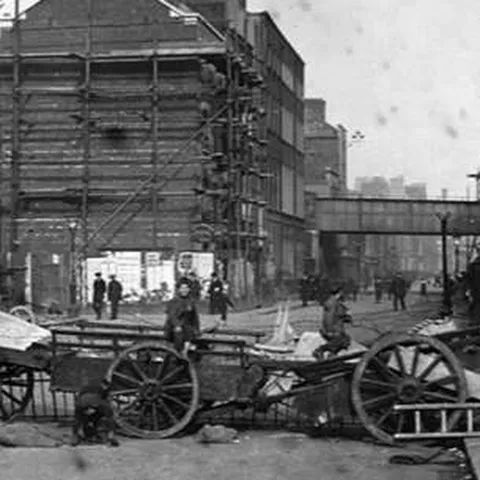
Cartoonists in love, tricksy Welsh wizards and a fickle public. In this episode we look at how the plucky little 1916 Rising went from being a haphazard mess to one of Ireland's most important historic events, and how this changed the radical fringe group Sinn Fein into a political heavyweight.
Support the show through Patreon for bonus content and ad free listening!
Transcript
ACAST recommends…
How are you doing there? This is David from the David McWilliams podcast, the podcast that makes economics as comprehensible as possible. We are going to look at economics through the lens of the World Cup and a special World Cup economics series. We’re going to look at countries, we’re going to look at players, we’re going to look at culture, but we’re also going to look at the economies of the countries involved in this World Cup as it unfolds. So, this is one for economics fans who happen to be into football, football fans who happen to be into economics. That’s all on the David McWilliams podcast.
ACAST is home to the world’s best podcasts, including Crime World, The Other Hand, and the one you’re listening to right now. I bring you a message today from the people of Ireland. The Irish desire peace with England as with the rest of the world. It is a question of our republic. We want the creation of a new Ireland. I wish to talk to you this evening about the state of the nation’s affairs. Welcome to the history of Ireland.
So, last time the Easter Rising had occurred and we kind of unceremoniously skipped over the nitty gritty of it. Sorry. We’re more interested in the aftermath and how it completely changed the Irish political landscape. At first, the majority of people were definitely against the Rising. It’s kind of important to remember how very much on the fringes the Nationalists and Republicans were. Even as late as 1916, most people were still pro-home rule. And then the Rising leaders were on the fringes of those fringe Nationalist groups.
To put it in context, over 140,000 men fought for the British in World War I, while only about 1,500 men and women fought against the British in the Rising. They were in no way representative of the Irish people. But this was fine by them. They were fighting more for a romanticised concept of Ireland, rather than the Irish people themselves. So it’s no surprise that most people were against the Rising. They couldn’t even agree about it among the Nationalists.
Our old Sinn Féin friend, Bulmer Hobson, though also a member of the IRB, disagreed so much that he was actually kidnapped by Pearce and the others. Then, Eoghan McNeill, the Irish volunteer leader, well, he’d flip-flopped on the issue repeatedly. He’d been against it, for it, and then finally tried to cancel the whole thing, after vital weapons never materialised. And John McBride, the most experienced military man of the Volunteers, he wasn’t even told about the Rising and only stumbled across it on his way home from a nice little trip to Paris.
But none of this stopped the IRB, who went ahead regardless. The public saw the whole thing as a nuisance and a waste of time, and pelted the rebels with all kinds of shit after the British defeated them. But things changed pretty quickly. The Rising could very easily have gone down in the history books as another Féinian failure, had it not been for the reaction of the British. They were swift and brutal in their response, interning a huge number of people without trial and executing the rebel leaders.
But, in fairness to the British, which is not something I’m really meant to say as an Irishman, they actually weren’t any more brutal than anyone else would have been at the time. Of the 90 sentenced to death, only 16 were actually killed. But it was the long, drawn-out and kind of random manner of the whole thing that led to the shift in public opinion. Plus, the Republicans knew how to spin a good story and turn the whole thing to their advantage.
For example, there’s the often-told romantic story of Grace Gifford and Joseph Plunkett’s marriage. The two had enjoyed a whirlwind romance and had been engaged the year before. Grace had suggested an Easter wedding, but Plunkett responded, saying, I think we’ll be running a revolution then. How inconvenient. So, the Rising interrupted the lovebirds and, as a signatory of the proclamation, Plunkett was sentenced to death. The day before his execution, Grace begged for the two to be married and the jailers allowed it. They were given 10 minutes together and the next day he was shot.
It’s a beautiful, poignant story of doomed romance. And Grace knew it. Grace was a talented Republican cartoonist who knew how to use propaganda. And she knew the value of her doomed romance. In fact, some suggest the whole reason she went ahead with the wedding was because of how well it would play with the public. She wasn’t wrong. The story traveled quickly, appearing in the New York Times the next week. It humanized the rising leaders and helped bring worldwide recognition to the cause.
Then there was the story of James Connolly, our old socialist friend, who was shot sitting down because he was too injured to stand after the fighting. It’s an image that always sticks in my head and it stuck in the minds of the Irish public as well. It just seemed a bit of a dick move on the part of the British and further brought people over to the rebel’s cause. All these stories and more were pushed by Cumann na mBan who were vital in changing public opinion.
The executions really were a shame. So many intelligent and charismatic leaders had their lives cut short. The fact that it’s pretty much exactly what they were aiming for doesn’t make it any less of a stupid waste of human life. The rising leaders wanted to create a blood sacrifice to galvanize the Irish people and the British played right into their hands. It seems the only one to recognize this was General Sir John Maxwell, the guy who actually ordered the executions.
He warned Asquith, who was still Prime Minister, though not for long, that the younger generation is likely to be more revolutionary than their predecessors and though the rebellion was condemned it is now being used as a lever to bring on Home Rule or an Irish Republic. But Maxwell was ignored and after the rising was put to bed the British left everything be, thinking that the public were still committed to Home Rule and that the rising was a mere wartime blip.
On top of this the British blamed Sinn Féin for the rising. This was complete nonsense as Sinn Féin had nothing to do with it. At this point Sinn Féin under Arthur Griffith believed staunchly in passive resistance and were against the use of force, especially force that stood no chance of winning. But in fairness, like many a confused Irish student after them, I think the British simply got lost in a sea of different republican groups. The British press ended up just describing anyone who wasn’t a Home Ruler as a Sinn Féiner.
It ended up being a huge boon for Sinn Féin. As the British made martyrs of the rising leaders public opinion turned in favour of them, which combined with the British blaming Sinn Féin meant Sinn Féin saw a huge boost in popularity. Kind of mental right? The British continued to make a right old mess of things after the rising by locking people up in internment camps like Fongrook in Wales. Estimates put the rising forces at about 1,200 but reports put Fongrook, just one of a few prisons, as having around 1,800 prisoners.
With these internment camps the British had taken rebels, sympathisers and innocent men and put them all in one place. Basically a big old republican summer camp. This is actually super interesting as the Fenian forces were usually spread all over the country and with the IRB being a relatively secretive organisation they were rarely able to get so many potential rebels in one space. These internment camps became a breeding ground for Irish nationalism and helped both solidify republican forces and create the next generation of leaders. Fongrook was dubbed Ulsgol na Raibhlaidh, the University of Revolution.
So yeah, the British government of 1916 giving a perfect guide on how not to deal with rebel forces. On top of all this, after the rising, home rule, which had been delayed by World War I, slid to a complete halt. In May 1916 both John Redmond, who led the home rulers, and Edward Carson, who led the unionists, received plans for how home rule would be brought in. And, as previously mentioned, partition was now very much on the table.
The idea, which had been brought in in 1914, was for home rule and an independent Irish government, but with six northern counties in Ulster initially kept within the United Kingdom. And despite the fact that it wasn’t quite a full Ireland, Redmond was in favour of the proposal. His interpretation of the bill was that it clearly stated that this partition would only remain for a short transitional period. By backing the bill he put his trust in the new Prime Minister David Lloyd George, known as the Welsh Wizard, Lloyd George was nothing short of a political mastermind.
Said to be the best negotiator of his day, he’ll feature heavily in the episodes to come. And unfortunately for Redmond, a temporary partition was never Lloyd George’s intention. He had written to Edward Carson saying, we must make it clear that at the end of the provisional period Ulster must not, whether she wills it or not, merge in the rest of Ireland. Once this came out, Redmond pulled his support and home rule came to a standstill.
This hugely hurt Redmond and the IPP, at the very same time that Sinn Féin’s popularity was rising. As William O’Brien, an old Irish party leader said, the idea of partition put forward by Lloyd George and Carson was an unhappy instrument, to which you would be able to trace the responsibilities for all the years of disappointment, bloodshed and devastation that were to follow. And he’s not wrong. Whatever your views on Northern Ireland and what would follow, at this point the Irish had voted in favour of home rule, repeatedly and overwhelmingly.
To stand in the way like this was arguably undemocratic and pushed people who otherwise would have been moderates into Sinn Féin’s arms. And Sinn Féin came out of the whole thing looking way better than Redmond and the IPP. They’d recused themselves from the discussion, stating that unless full Irish independence was on the table, and unless prisoners from the rising were treated as political prisoners, they had nothing to discuss.
This made very little difference, as they only had like three MPs at the time. But it shored up their image as uncompromising and determined. To further confuse things, the surviving leaders of the rebellion, led by Éamon de Valera, then took control of Sinn Féin. Dev is an intriguing character, someone who arguably would have more influence on Irish history in the 20th century than anyone else. We’re going to dedicate a whole episode to him soon.
He joined the Irish Volunteers in 1913 and very quickly rose through the ranks, getting reluctantly sworn into the IRB somewhere between 1914 and 1916. He then led a contingent of men in the Rising, capturing Boland Mills. Though he was sentenced to death, he managed to get out of it and he and Countess Markievicz were the only leaders of the Rising to survive. This was because Dev was from the States and, well, Countess Markievicz was a badass bitch and the British didn’t want to kill any women.
Dev was a relative unknown before the Rising, but he used his involvement and the Rising’s newfound support to become a huge figure in the Republican movement, winning a by-election in East Clare in June 1917. So Sinn Féin didn’t really want these new upstarts from the Rising taking over their party. In fact, the whole thing nearly split in 1917 over the Rising leader’s pure republicanisms and the original Sinn Féin doctrine of dual monarchy.
Basically, de Valera and Arthur Griffith disagreed on what they should be aiming for. The two lads went for coffee and Dev made his case to Griffith. Their meeting is a great example of Dev’s persuasive charm and Griffith’s good character. Griffith held the man in very high esteem and agreed to not only step down but also support Dev’s leadership claim. Griffith declared for the first time since the time of Parnell we have a statesman and in addition a soldier.
Griffith was a rare kind of politician. He was more interested in ideas than power and knew that he was a better backroom guy than a political leader. It seems he knew that Dev would do a better job than he ever could. The compromise they ended up reaching was to agree to let the people decide what they wanted, whether to instill a monarch, a republic or something else once independence was won.
So you see a trend developing? With so many different views of how to run an independent Ireland it was always easier to kick the can down the road and figure out what the island of Ireland would look like after all this independence stuff was won. Not ideal and something a certain modern Tory leader could probably learn from.
So all this accumulated in a huge rise in Sinn Féin’s popularity. Suddenly the political party that had been largely ignored since its inception in 1907 was now at the forefront of Irish politics but led by a completely new cohort of leaders. The last nail in the coffin, the straw that broke the camel’s back, the extra unnecessary metaphor that confused the message and drove the population towards Sinn Féin, guaranteeing that they’d win the next election was another British blunder.
The conscription crisis of 1918. But that’s for next time. Thanks for listening. Subscribe wherever you get your podcasts and if you’re enjoying it, tell your friends. It’ll really help. You can also get in touch with us through thehistoryofireland.com or follow us on Facebook. If I made a mistake, let me know.
The History of Ireland was written and produced by me, Kevin Dolan. Additional research and fact checking by Robert Babington, music by Liam Doyle and production help from Aoife Murphy. This podcast was recorded on the lands of the Wurundjeri people of the Kulin Nation. Sovereignty was never ceded.