Episodes Irish Revolution Season 1 — The Revolution
The Squad & The Dog
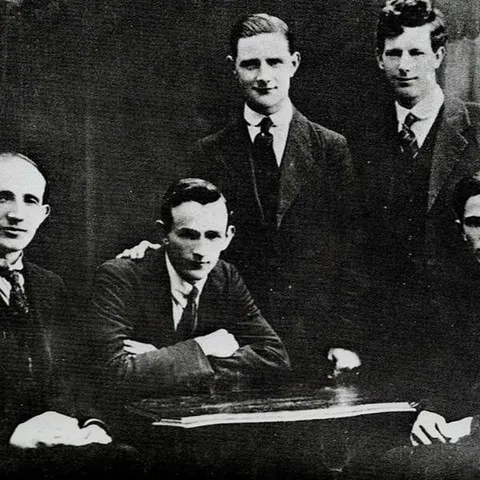
In this episode we discuss the founding of The Squad, the IRA's team of professional assassins, and look at how they botched their very fist mission.
Support The History of Ireland by donating to their Tip Jar: https://tips.pinecast.com/jar/historyofireland
Transcript
Welcome to the History of Ireland. We’re 20 episodes in people. How exciting. Way back in episode 10, I approached you about helping support the show. And you’ve been amazing. I’ve been blown away by the generosity. And, yeah, really appreciate it. Now, for episode 20, I’ll be asking for reviews. Yep, if you’re listening through Apple Podcasts or whatever other podcast app you use, an old quick review is super helpful. It really helps with others finding the podcast. And, of course, you can still support the show with hard-cold cash if you’re so inclined at thehistoryofireland.com It all helps keep this fun little project going. Thanks. Onwards to this week’s episode.
When I was a kid, the Squad, or the Twelve Apostles, as they were sometimes known, were simply the coolest thing in the world. A team of crack squad assassins, who are Irish, fighting the British, led by Michael Collins, the spy leader on the run. As Irish people go, in my young mind, only Thin Lizzy’s bass-playing lead singer filled in it gets cooler than that. So let’s dive in and investigate whether the Squad were as uncomplicatedly cool as I remember. No prizes for guessing where this is going.
The Squad was the brainchild of the GHQ Chief of Staff Richard Mulcahy, Michael Collins, and a man named Dick McGee. The idea was to create a team of full-time employed assassins who’d use hit-and-run tactics to strike at important British targets. Collins, Mulcahy and McGee, as we know, were all hardline Republicans who’d fought in 1916. At this point, 1919, they believed violence was the only way forward for the Irish Republican movement. But they’d seen how futile an all-out attack on the British could be, and instead wanted to focus on guerrilla tactics. The Squad was an integral part of this approach, especially when it came to targeting high-ranking members of the British forces in Ireland.
A quote from Collins we’ve mentioned before is important to remember when thinking about the Squad. From what he’d learned from Broy and his other G Division spies, Collins believed that And so by removing this institutional knowledge, the IRA could drastically reduce British control in Ireland. On top of this, Collins and Mulcahy apparently hoped these targeted attacks would lead the British to retaliate. The idea was that this retaliation, as it had done in 1916, would convince more of the Irish to support a violent approach to kicking out the British. As one British official put it, sounding rather frustrated, He seemed to have a paradoxical belief that England could not injure them without terribly injuring herself.
And so Collins and Mulcahy asked McKee to round up some lads who’d be willing to join this kind of new assassin squad. McKee had followed a similar trajectory to Collins, having fought in 1916, been interned in Frong Brook, and then coming out more radicalised than ever. From Dublin, McKee worked as a compositor, basically someone who would lay out type for publishing companies. He was chosen by Collins as one, they were friends, and two, McKee was one of the leaders of the IRA’s Dublin Brigade.
He asked men if they had objections to shooting enemy agents. And surprisingly, a lot of them did. Many saw a marked difference between fighting against soldiers in a battle and cold-blooded assassination. But at least six men said they were interested, and they formed the beginnings of the squad.
Their first target was a G-man called Detective Sergeant Patrick the Dog Smith. From Cavan, Smith was firmly anti-Republican. When he had passed his detective inspector’s exam, he was offered a job with the Met in London, which would have been a bit of an upgrade. But he was having none of it, and refused to be driven out of Ireland by what he described as young Scots. Instead, he stayed in Dublin and proved to be a huge thorn in Sinn Féin’s side.
The reason he was singled out for the squad’s first strike was his arrest of a prominent Sinn Féin TD, Pierish Baisley. Remember Baisley? He was the one who had organised the staging of the first doll. Smith had caught Baisley with incriminating documents. The IRA warned Smith not to produce the documents at trial. But come on, anyone named the Dog is not going to be silenced by simple threats. He rocked up and handed over the documents to the judge, who promptly locked Baisley up. And that was that. Smith’s doggedness had sealed his fate.
Collins once said to Ned Roy that, quote, I am a builder, not a destroyer. I get rid of people only when they hinder my work. And Smith now firmly fell into the category of a hindrance. And so Collins sought authorisation from Richard Mulcahy and the GHQ to have Smith assassinated. Mulcahy agreed and the operation was put into motion.
Four men were chosen for the job. Tom Ennis, Mick Kennedy, Tom Keogh and Jim Slattery. Don’t worry, the names won’t be on the test. On Wednesday, July 30th, 1919, they struck. Smith was heading home on the tram and he got off at Drumcondra Bridge. The lads were waiting for him armed with 38 revolvers. They stepped out of the crowd, maybe pulling balaclavas up at the last minute and emptied their revolvers. Chaos ensued. The people getting off the tram scattered with the four lads following suit. This was the squad’s modus operandi. Hit hard, run and hand off the pistols to friendly civilians.
But the four lads were just four lads. Not really the crack squad of assassins I’d imagined as a kid. Only four bullets found their mark and they weren’t nearly enough to kill the dog. Determined as ever, he ran the 200 or so metres to his home. Bleeding profusely, he stumbled into the front garden. Smith had something like seven kids and they had to deal with the situation on their own. His wife was on holidays of all things. The eldest, a 17-year-old boy, dragged his father into the house. Smith’s other son ran after the shooters. He was only six. The kids managed to rush Smith to the madder hospital and the man simply refused to die.
Meanwhile, the four shooters would have gone to meet Collins at Kerwin’s pub on Parnell Street. This or one of the other pubs in the area was where Collins would meet the squad after every hit. When Collins heard Smith hadn’t been killed, he was worried the copper would be able to recognise the gunman. But it never happened and eventually, after five long weeks and multiple organ failures, Smith died.
The squad had succeeded. But what an absolute mess! Screaming children and a long, slow death? That was never the plan. Collins didn’t blame the four lads though and instead just decided that .38s would never be used again. From then on, the squad were armed with .45 revolvers. More powerful, more deadly, more likely to kill outright.
The history books rarely give Smith or his family much time. But I do think it’s important to hear from the victims. The family moved to Blackpool where Smith’s wife Anne opened a boarding house. Smith’s great-grandchildren had this to say about why they moved. Quote My grandmother always said that the family were hounded out of Dublin who returned to the house in Millmont Avenue on a number of occasions and lined up my great-grandmother and her children against a wall and threatened them until they left the country. The younger children also found it difficult in school as they were ostracised and victimised by the pro-Republican teachers. There are many family stories surrounding Patrick’s death such as the doctors failing to remove the last bullet from the body on purpose knowing that it would kill him.
Now I’m not sure I buy the last bit about the doctors failing to remove bullets. That sounds a little bit like a family myth. But everything else is a prime example of the effects the IRA’s tactics had. They shattered a whole family and forced them to flee the country. It’s just sad. Don’t get me wrong. I do believe the squad’s actions were necessary. As we’ll see they were vital in forcing the British to the negotiation table. But that doesn’t mean it’s not a tragedy. Smith was an Irishman believing he was doing what was best. He wasn’t the first victim of the war and he wouldn’t be the last.
After their first hit the squad was made more formalised. More members were added including Dan Breen who’d led the Solihead Beg Attacks and the core force was brought up to about 12 men. Hence the nickname 12 Apostles. Though there was a wider force of men who would kind of come and go. Initially they were led by a man named Mick Macdonald. Though the squad also had various different commanders over the course of the war.
They took offices in Upper Abbey Street and disguised themselves as Moorlands cabin makers, upholsters and builders. Collins would drop in twice a week to discuss plans and give orders. Disguised as carpenters they were even given a wage. Making £4.10 a week. That’s about €225 in today’s money. Nothing amazing but not a bad little salary.
As well as swapping .38s for .45s the squad also refined their methods. For each attack they split into two teams, the shooters and backup. Shooters would shoot, while the backup team would make sure no civilians or police interfered. And the men from the intelligence team would often come along as well, ready to point out targets.
But however organised and professional they made it, it was not an easy job for any of the men involved. They were constantly on the run from British intelligence. And as one source puts it, these men carried out the most objectionable work side of the pre-truce operations, which left them anything but normal. If shell shock existed in the IRA prior to the truce, the place to look for it was among these men. To back this idea up, Mick Macdonald, the original leader, was reportedly sent to California in January 1921, for quote, health reasons. It’s hard to say, but some people think this was to help him recuperate from the psychological trauma of it all.
Not quite the stuff you’re told about when given the romanticised version of the squad in school. Between the effects on the men who did the killing, the families of the victims and everything in between, it’s all just a moral grey mess. Rather than a super cool assassin squad, now I feel they were more of a necessary evil, full of complicated nuances and hard scary truths. Reality, it’s a bummer innit?
But what is clear is that they were effective. The squad would go on to decimate the G Division, and provoke exactly the reaction from the British that Collins and Mulcahy were banking on. And we’ll be hearing a lot more from them as things develop. Next time, we’re going to look at the British response, and see how it paved the way for a marked escalation in the conflict. Oh, and just to be clear, I still think Phil Linnet is the coolest Irishman who ever walked the planet.
Thanks for listening. Subscribe wherever you get your podcasts, and if you’re enjoying it, tell your friends. It’ll really help. You can also get in touch with us through thehistoryofireland.com, or follow us on Facebook. If I made a mistake, let me know.
The History of Ireland was written and produced by me, Kevin Dolan. Additional research and fact-checking by Robert Babington, music by Liam Doyle, and production help from Aoife Murphy. This podcast was recorded on the lands of the Wurundjeri people of the Kulin Nation. Sovereignty was never ceded.