Episodes Irish Revolution Season 1 — The Revolution
Theory & Instinct
Transcript
Welcome to the history of Ireland. Notice to the IRA. Read this and if you decide to be led astray by your leaders in the belief that you are soldiers and entitled to be treated like soldiers, you have yourself to blame. This is from a poster that started doing the rounds in the spring of 1920. Big old school announcement style thing.
It continued. Only armed forces who fulfil certain conditions can avail themselves of the rights conferred by the laws and customs of war. These conditions are… 1. They must be commanded by a person responsible for his subordinates. 2. They must wear a fixed distinctive sign or uniform recognisable from a distance. 3. They must carry their arms openly. 4. They must conduct their operations in accordance with the customs of war.
They state a man dressed in civilian clothes, whether it be police, soldier or civilians, is nothing more than a common criminal. There are men among you who fought in the last war. Ask them what would have happened to men dressed as civilians who suddenly shot or threw bombs at soldiers in one of the villages behind the lines. They will tell you that such persons would have been shot immediately or captured. And all civilised nations would have approved.
Your leaders are encouraging you to do that which any civilised nation would lawfully execute you. Do not be deceived. If you go on murdering disguised as civilians, you will pay the penalty either fighting or on the scaffold. Heavy Stuff
This announcement highlights the huge discrepancy with which the Irish and British viewed the IRA. It raises questions over the differences between murderers and soldiers and it highlights how the IRA were revolutionising warfare. Some even argue that though guerrilla warfare had existed for centuries, the IRA were first to consciously use modern guerrilla tactics in a successful manner. Throughout 1920 they took warfare into murky dangerous territory in a way that had far reaching implications for how combat is fought all over the world to this day.
As we’ll see they pretty much broke each of these laws of war. No clear chain of command, no uniforms, concealed weapons and that last thing about customs of war? Who even knows what that means? In the next few episodes we’re going to try and unpack some of this while exploring how the IRA developed throughout 1920 leading to the creation of the famous Flying Columns. So let’s get into it.
On March 3rd 1920 members of the IRA’s Dublin Brigade attacked a postman’s van of all things. Why? Well because it was packed full of Dublin Castle mail and correspondence between Lord Lieutenant French and the Chief Secretary, who was still Ian McPherson at this point. It was basically the early 20th century version of an email hack and left the British establishment more shocked than you’d expect.
Despite all the barracks burnings and assassinations it was this that led the Irish Times to print an article entitled Sinn Féin’s Guerrilla War. The mail did in fact reach Dublin Castle a few days later though. The IRA, after having rifled through everything for as much information as they could find, simply returned the post and marked it passed by censor. Gotta give them points for style.
I mention this because between the poster trying to educate the IRA on what constitutes a soldier and articles like this one in the Times, it was clear that by spring 1920 the British were finally, slowly getting a sense of the war that they had been fighting in some form for almost a year. But you can’t really blame the British for being slow on the uptake. The IRA themselves were still just basically figuring shit out as they went.
The historian Charles Townsend has a great phrase. He argues that the IRA used instinct rather than theory to develop its approach to guerrilla warfare. Now I think he’s a little unfair with this assertion and other historians argue he underplays the organisation of the IRA, but this idea of theory vs instinct is a great way to break things down. So first let’s explore the theory side of things.
And with theory it’s always good to start with a solid definition. Guerrilla warfare is defined as engagement in or the activities involved in a war fought by small groups of irregular soldiers against typically larger regular forces. The term, I was most unhappy to discover, has absolutely nothing to do with the Great Ape and instead comes from the Spanish. Guerra meaning war and guerrilla meaning something close to a little war.
The phrase became popular during the 19th century peninsula war between Spanish fighters and Napoleon. And though the idea of irregular fighters was nothing new, Sun Tzu mentions it in the Art of War in the 6th century, at the beginning of the 20th century it really was not fully understood or widely considered. The general view was that victory would always come down to the big battalions and it was agreed that World War I had confirmed this.
But around this time you start to have people warning that the traditional ideas of warfare could begin to be upended. One of the first to seriously argue this case was T.E. Lawrence in 1920, a British soldier, writer and inspiration for a movie. He’s better known as Lawrence of Arabia. He wrote about how the Arabs had defeated the Turks in World War I by means of turning the strengths of regular warfare into a weakness. They dispersed their forces, got their people on side and attacked in a hit and run manner. Basically paralyzing the larger Turkish army. Sounds kind of familiar right?
It’s hard to say whether the IRA had read this or not, but regardless they had been discussing guerrilla warfare for years at this point. And before I go into how this was manifesting itself in 1920, I want to quickly dive into another war that definitely inspired the IRA’s theory of guerrilla warfare. This was the good old Second Boer War.
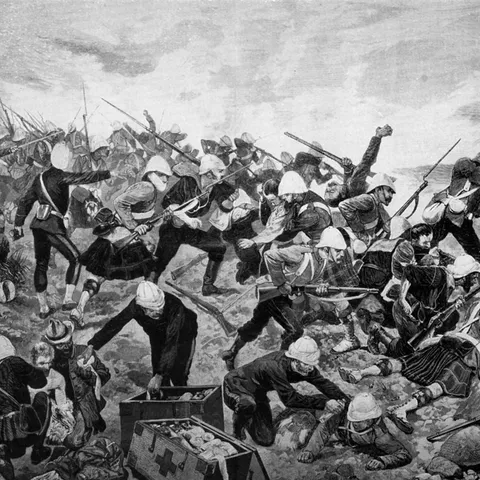
Now there are whole podcasts on the Boer War and I know you just want me to get to the flying columns already, but I think it’s important to give all this background. So let’s jump back in time a few decades, with the usual obvious caveat that this is a grossly oversimplified take on the war. Basically the Boers were, and still are, a group of white South Africans descended from Dutch colonialists. They did not like the British Empire’s influence in South Africa all that much, and fought a war to gain their independence from 1899 to 1902.
Though the Boers eventually lost, it took the British a huge amount of manpower to defeat them. And the reason they did so well despite the huge discrepancy in arms was, you guessed it, the Boers’ commitment to guerrilla warfare. The Boer commandos used hit-and-run tactics to harry the British for months and they did it very, very, very well.
It’s not all that surprising that the Irish nationalists at the time were very much on the side of the Boers. As one historian put it, pro-Boer fever swept Catholic Ireland. The playwright Sean O’Casey described Dublin in 1889 saying, All fancy good shops and newsagents were filled with Boer symbols. Streams of ribbons flashing colours of England’s enemies flowed through every street and sparkled in every second window.
You see, Arthur Griffith had actually visited South Africa before the war and wrote a lot about it in his newspaper. He was able to fan the flame of Boer support in Ireland and ever the expert propagandist wrote extensively of the Boers’ daring do. On top of this, John McBride, a guy who’d go on to lead the Irish Volunteers in 1916, actually fought alongside the Boers with a team of Irishmen.
In fact when he was executed after 1916 he refused a blindfold saying, I have looked down the muzzle of too many guns in the South African war to fear death and now please carry out your sentence. Not totally relevant but much too cool not to include.
Griffith, and McBride especially, would have had extensive knowledge of how the Boers were fighting. It’s not a stretch to imagine McBride, who’d been left out of plans from the 1916 Rising, telling the men under his command that the full frontal assault was madness and guerrilla warfare was what was needed. And as we know Collins, Richard Mulcahy and the majority of the Irish forces, all of whom would have heard of and been inspired by the Boer war, were well in favour of guerrilla tactics.
They then took these learnings and tried to disseminate them down the ranks. We’ve mentioned it before but on Tugluck the GHQ’s newsletter was full of guidelines on how to fight a guerrilla war. One edition in August 1919 described the IRA’s efforts saying, that quote, We are carrying out a well-considered plan of campaign in which the object is to harass and demoralise the enemy without giving them an opportunity to strike back effectively. We realise that it’s far more profitable to kill for Ireland than to die for her.
This is basically the main tenets of the IRA’s theory. Forget blood sacrifices, this war would be won by those who could kill and survive. You see, the way the GHQ seemed to work was they studied what was working around the country and then tried to push it elsewhere. For example, after the success of the barrack attacks, Mulcahy wrote to Liam Lynch, a brigade commander, saying, It’s not very important what post is attacked, nor when, nor how often an attack shall take place. The great thing is to have every attack that is made successful.
He continued in the same letter quite interestingly saying, Our war is distinct from all other guerrilla wars in this respect. It is the guerrilla war of a civilised modern people, and it would be a great mistake to willingly abandon any warlike resources placed at our disposal.
So I don’t know, I would argue that there was clearly a theory being handed down to men of the IRA, top down ideas from GHQ on how to run a guerrilla war. But, and this is where I agree with Townsend, due to the grassroots nature of the IRA, instructions from on high could only do so much. And so our theory lesson ends and we enter the world of instinct.
Though the GHQ were laying out general guidelines for guerrilla attacks, they actually did not really have complete control over their men. The leaders of each brigade were incredibly autonomous, and a lot of the discrepancies between active locations taking it to the British, and quieter areas, often came down to who was in charge.
It seems like it was kind of a complex relationship. The GHQ provided guidance and generally tried to sign off on plans, but often this just wasn’t feasible. People kind of did what they wanted and learned on their feet. Which is exactly what you need from a guerrilla army. And a lot of it was just common sense and necessity.
A great example of this is weaponry. As we’ve discussed, the IRA were lacking in both arms and ammunition. Like, really, really lacking. To put it in perspective, the average RIC man would carry 120 rounds. In contrast, the IRA were going to ambushes on average with something like 30 rounds, if they were lucky. This meant that any engagement with British forces had to be short and sweet.
The men would run in, fire off their weaponry, and skedaddle. So whether they wanted to or not, hit and run tactics were a must. Plus it just suited the landscape. They would attack at a crossroads or at a road somewhere, and then run off into the hills.
On top of this, the GHQ generally refused to provide arms to the IRA brigades, unless they were already active. This further encouraged barracks attacks and small weapon raids. For example, in response to one brigade asking for ammunition, Collins said, quote, So yeah, this meant that local brigades had to think on their feet, and work hard to develop a system that worked.
And at times, like with Solohead Beg, this led to a case of the tail wagging the dog. They were encouraged to be active first, and then the GHQ would back them up. Furthermore, the number of men, the Irish landscape, and the general lack of military training, all meant that local IRA leaders had to make quick decisions and figure things out as they went.
So do you see how it becomes a bit of a combination of both theory and instinct? The Boer war on Tugluk and the GHQ provided the theory, while the men on the ground learned by instinct. And both this theory and instinct taught the IRA that to stand any chance against the British, they had to fight a different kind of war.
They had to abandon uniforms, they had to work under a loose, decentralised chain of command, and of course they had to keep their weapons hidden. No amount of posters were going to change this. The IRA believed fervently that they were soldiers regardless of the British rules. They were creating a new kind of warfare, rather than being forced to fight under the laws of a system that would have ensured they lost.
I’ll give Townsend the last word on it. He puts it like this. The Republican campaign commands attention as a remarkable pioneering endeavour. If the reasons for its achievements were not entirely understood, either by the IRA itself or by others, those achievements could be used to establish a new framework for resistance against imperial power.
Next time we’re going to explore a vital tool in that Republican campaign, one that achieved a hell of a lot. It’s the ultimate example of how instinctual on-the-ground thinking combined with the GHQ theories to develop a highly effective new fighting force. Next time we’ll finally introduce the flying columns.
Thanks for listening. Subscribe wherever you get your podcasts and if you’re enjoying it, tell your friends. It’ll really help. You can also get in touch with us through thehistoryofireland.com or follow us on Facebook. If I made a mistake, let me know.
The History of Ireland was written and produced by me, Kevin Dolan. Additional research and fact-checking by Robert Babington, music by Liam Doyle and production help from Aoife Murphy. This podcast was recorded on the lands of the Wurundjeri people of the Kulin Nation. Sovereignty was never ceded.