Episodes Irish Revolution Season 1 — The Revolution
The Flying Columns
Transcript
Welcome to the history of Ireland. On May 15th, 1920, Untugluk, the IRAG HQ’s magazine, included an article entitled Speed up the work! in which it laid out the following. The pouring into Ireland of fresh enemy troops and the various signs of a disposition to renew military activity on the part of the enemy and of a determination to increase his military efficiency indicate clearly the strong necessity for bringing every unit of the Irish Republican Army up to the highest effective standard possible.
Those officers responsible for brigades who feel those under their command are not up to the standard required for intensive, persistent and widespread guerrilla warfare had better set about putting their house in order without further delay. The work must be speeded up!
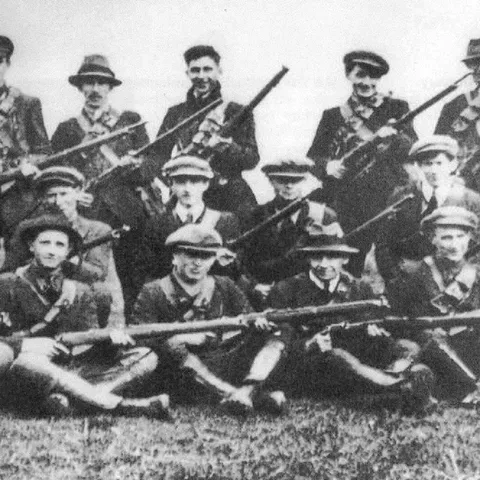
We’re getting into the beginning of one of the bloodiest periods of the war. The black and tans were arriving and the IRA needed to figure out how to ramp up their activities, to speed up the work as it were. And so, as we’ve discussed, it was the men on the ground and in the field who best figured out how to do this. Today, we look at what would become the spearhead of the IRA’s approach in Ireland, the famous Flying Columns.
If you’re not Irish, or don’t know anything about this period in history, you may not know what a Flying Column was. Don’t worry, it will all become clear. It’s hard to pinpoint exactly who first came up with the idea of the Flying Columns. But as far as anyone seems to make out, it all began with a walk through the East Limerick countryside in early June 1920.
Two men, Donegar O’Hanagan and P. Clancy had attended an IRA funeral in East Limerick. O’Hanagan was in charge of the East Limerick Brigade, while P. Clancy was a creamery manager from Cork. I can’t find his first name, and confusingly he’s a different P. Clancy to Padder Clancy who was a GHQ’s director of munitions and an active member of the squad.
But anyway, O’Hanagan and Clancy were at this funeral in a little town called Temple Glanton. The funeral would have been attended by IRA men from all over, and you can imagine them all chatting afterwards. It was here that the lads discovered the East Clare Brigade were planning an attack in Six Mile Bridge, a small town on the other side of the River Shannon. So O’Hanagan, Clancy and a few other men of the East Limerick Brigade decided to head from Temple Glanton to Six Mile Bridge to help in the attack.
Now I’m aware this is a lot of directions and tiny towns with strange names, so bear with me. I actually grew up around this neck of the woods, so I can picture it all, but even then I recommend throwing the locations into google maps, it really helped me get a sense for where they’re all going. So they marched from Temple Glanton to Six Mile Bridge, which would have taken them pretty much an entire day. And once they arrived, well the bloody attack had been called off. Don’t you hate when that happens?
They then traipsed back across the River Shannon, through more small towns in Limerick, eventually ending up back in a town called Cush, where Clancy was living. Now, who gives a toss I hear you say. They didn’t shoot anyone, they met no British soldiers and nothing happened. They had a nice walk through the countryside, why are you still talking about it all?
Well, that’s exactly the point. As O’Hanagan puts it, Fully armed, we had travelled over 30 miles cross country in daylight, without any great difficulty. It had occurred to us, since we had successfully done so, there was no reason why a larger number, organised and equipped as a unit, could not do likewise.
I can picture the two men walking through the green Limerick countryside on one of those rare, sunny Irish summer days, discussing tactics, and only realising halfway through the implications of what they were doing. O’Hanagan continues, We conceived the idea of the Active Service Unit, which was the original name of the fine column. What we had in mind was an efficient, disciplined, compact and swift moving body of men, which would strike at the enemy where and when a suitable opportunity arose.
And that, boys and girls, is a pretty solid definition of what the IRA Flying Columns were. An efficient, disciplined, compact and swift moving body of men who were constantly on the run, always ready to attack. It was a departure from how the IRA had been fighting in a few ways.
First of all, up until this point it was rare to have full-time soldiers. Usually people stayed at home, kept their jobs, and then gathered when an attack was planned. The Flying Columns were different. They left home and travelled together, attacking whenever possible. As O’Hanagan puts it, This resulted in a scheme of action which for the first time committed an IRA unit to keep the field continuously and engage in a deliberately planned and sustained series of operations.
Annoyingly for O’Hanagan, Clancy was arrested very quickly after their walk. So, on his own, he organised a group of 12 men from the East Limerick Brigade to form the IRA’s first Active Service Unit, carrying out their first attack on July 9th where they disarmed four constables of Bally and the Hinch.
But O’Hanagan is not the only person to claim to have come up with the idea for an Active Service Unit. And it seems that the concept was cropping up independently across the country. Dan Breen of Sallowhead Beg fame attributes it to Sean Tracy. Breen writes, We wanted full-time soldiers who were prepared to fight by day or by night, ready for any adventure. They would constitute a mobile force capable of striking at any given moment in one district and on the next day springing a surprise 30 miles away.
People also credit Dick McGee, a member of the squad. But it seems more likely that he heard what the likes of O’Hanagan and Breen were doing down the country and proposed to the GHQ that they should encourage all brigades to form their own flying columns. And by the middle of 1920 that’s exactly what the GHQ did, issuing orders as follows.
At the present time, a large number of both our men and officers are on the run in different parts of the country. The most effective way of using these officers and men would seem to be by organising them as flying columns. In this way, instead of being compelled to a haphazard and aimless course of action, they would become available as standing troops of a well-trained and thoroughly reliable staff, and their actions would be far more systematic and effective.
Interestingly, it was probably the British themselves who inspired some of these different men to latch on to the idea of mobile units. The Irish Bulletin had used the term as early as 1919, writing that quote, flying columns of English forces were travelling through Limerick. While the Irish Times reported in April 1920 that the British had established quote, a system of garrison posts and flying columns. All the while, Antioch warmed of roaming British forces and the danger they could cause the IRA, so it makes sense the IRA would have wanted to find their own way to combat these mobile units.
And so the Flying Columns began to form around the country, small bands of men who travelled the countryside attacking when the opportunity arose. Brigades would pool their weapons and leave them scattered in secret locations across the country for the Flying Columns to use. But even with these pools of weapons, the Flying Columns were stupidly under-armed.
For example, O’Hanagan’s East Limerick Column began with something like 6 rifles, 3 shotguns and 3 pistols, with 70 rifle rounds and a few cartridges for each shotgun and pistol. That’s crazy, it’s nothing, especially considering what they were up against. But they made do with what they had, the men would have drilled weekly, often being taught by Irishmen who had fought in the British army, who were vital in providing actual skills to the IRA. As we’ve said before, very, very few IRA men had any arms training, so they were forced to learn in the jobs and these veterans of the British army were so important to teaching them how to use their weapons.
For what they lacked in arms training, they made up for in local knowledge. Usually travelling by bike, they could quickly and inconspicuously traverse a countryside they knew infinitely better than the black in towns. And as well as an unmatched knowledge of the countryside, they also had a huge advantage over the British, they had the support of the community.
Because the Flying Columns would not have survived if they hadn’t had the support of Because the Flying Columns would not have survived without the help of civilians. They would have slept in small lofts of family homes or sacks in front of the fire. And there’s one story from the Waterford Flying Columns where they said they would arrive in the evening and quickly quote scan the skyline looking to gauge how many pieces of bacon were hanging from ceiling hooks.
Particularly well off homes would then be referred to with the names of Dublin hotels. Both as a bit of a joke and a fairly simple code. They’d then be expected to join in the family rosary wherever they stayed. It’s just such a crazy image, a bunch of dirty poorly armed soldiers hungrily eyeing a bacon but gathering around with the family to do the rosary first before dinner.
And this obviously put these sympathetic families in a lot of risk. There’s one story, again from Waterford, where a father of a Flying Column member was so sick of having his home raided by the RIC that he sent a key from the house to the barracks.
And when Flying Columns would attack, the British would retaliate on an entire area. Harassing both IRE sympathisers and non-supporters alike. Thus turning more and more people against the British. As the awesome Michael Laffin puts it in his lecture series, the British had not yet figured out how to deal with this guerrilla style of warfare. They just had no idea how to handle this new kind of non-uniformed semi-civilian unit.
And thanks to the community, as well as the IRA’s ever-improving intelligence network, the Flying Columns were able to stay one step ahead of the British. They would form up, attack and then disperse throughout the countryside and into the community.
Now Charles Townsend, who writes extensively about the Flying Columns, does note that there was a huge discrepancy between areas. He argues that some units were highly effective, while others existed purely to maintain a feeling of being involved. As he puts it, groups were marked by, quote, wild inconsistencies in strength, standards and control. Which is all true. So much came down to the skill of local leaders and the ability to get arms.
But those that were effective, like the East Clare and East Limerick Brigades, were highly effective. And they were an inspiration to all other groups and everyone else in the country. And this is one of the Flying Columns’ most important roles. They captured the imagination of everyone, from Irish civilians to British leaders. And the importance of this could not be understated.
As Ernie O’Malley put it, quote, the folk imagination can give the smallest action a heroic and epical quality. Not sure epical is a word, O’Malley, but you get its meaning. People became immensely proud of the Flying Columns, and to have a strong unit in your area was a big deal to be celebrated.
And the Irish propaganda machine romanticised the group and painted a picture of an all-knowing force that could strike anywhere. It didn’t matter that only half the units were actually in any way any good. The fact that any of these men were successful in their attacks against the biggest empire in the world is simply amazing and was, frankly, inspirational.
And this brings us to one of the tenets of guerrilla warfare. Something the boys would hint at, the Irish would discover, and groups like the Viet Cong would use to their advantage. Put pretty simply, all the Flying Columns had to do to be successful was survive. Their very existence meant that the British were failing at controlling the country. And as we’ll see, they didn’t have to defeat the British, they just had to persist. To constantly harry the black and tans while keeping the civilian population on side.
As we continue into 1920, we’ll explore how effective they were in all of this, delve into some more of their exploits, and examine how the British made survival increasingly more difficult.
Thanks for listening. Subscribe wherever you get your podcasts, and if you’re enjoying it, tell your friends. It’ll really help. You can also get in touch with us through thehistoryofireland.com, or follow us on Facebook. If I made a mistake, let me know.
The History of Ireland was written and produced by me, Kevin Dolan. Additional research and fact-checking by Robert Babington, music by Liam Doyle, and production help from Aoife Murphy. This podcast was recorded on the lands of the Wurundjeri people of the Kulin Nation. Sovereignty was never ceded. Sovereignty was never ceded.