Episodes Irish Revolution Season 1 — The Revolution
The Sack of Balbriggan
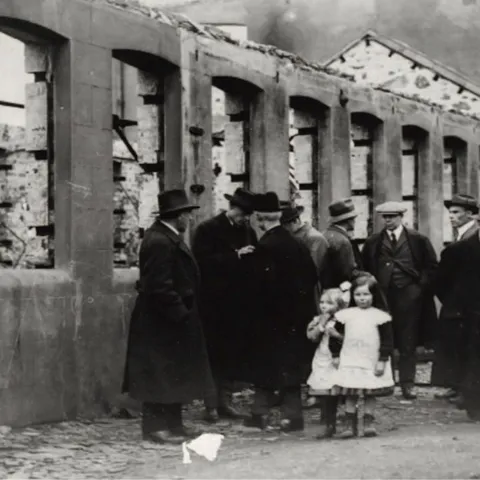
In this episode we look at how a few pints of a Monday night turned into one of the most infamous reprisals events of 1920.
For further information, check out the full talk from Jim Walsh of Balbriggran Historicla here:
https://www.youtube.com/watch?v=_Gs6hfcBCMo&feature=emb_title
Transcript
Welcome to the History of Ireland. On Monday, the 20th of September, 1920, Peter and Michael Bourke hopped out of a taxi and strolled into Smith’s Bar in the small town of Balbriggan, about half an hour’s drive outside of Dublin. The two men were brothers, both serving in the RIC. Peter Bourke was a head constable and Michael a sergeant. Peter was a very popular man among the black in towns and it was rumoured that he’d soon be up for a promotion to district inspector.
They were heading up to Gormansdown military camp, a training camp for incoming new black in town recruits, and stopped off at Balbriggan for a drink along the way. Balbriggan had become a bit of a watering hole for the black in towns. They’d take the 7.15 train to Balbriggan, grab a few drinks and then head back to Gormansdown on the 10.15. What a lovely way to spend an evening.
On the evening of the 20th, they decided to drink at Smith’s Bar. It was a typical Irish pub, owned and operated by a Mrs. Mary Smith. It’s actually still there today, under the name The Millrace. It’s a charming little pub with wood floors, a stove and those typical old upholstered stools. You can use Google Maps to go straight into the pub, and though it’s probably changed a bit since 1920, it helps get a sense of how everything that we’re talking about today went down.
At around 8pm that evening, Mary Smith had closed down the shop she ran on the premises and dropped into the pub, where her daughter was manning the bar. I pictured the group of black in towns in civilian clothes barrelling through the door of the pub. Probably wasn’t busy on a Monday night, but the fire would have been burning with the regulars perched comfortably at the bar or chatting quietly on the far side of the room. Maybe they would have looked up from their drinks, seen the men and put their heads back down. It was really no different from any other evening.
The Burke brothers ambled up to the small old wooden bar and ordered a round of drinks. But for whatever reason, on that night in particular, Mary Smith refused to serve them. I can imagine the temperature in the room plummeting and the atmosphere changing in an instant. Peter Burke standing there taken aback, while the whole pub quietly watched on. The Burke brothers and the other black in towns refused to leave and demanded that they be served. But Mary, she held her ground and simply said no.
It’s at this point that our scene cuts to Connolly’s, another bar down the street. It would have been very similar to Smith’s, wood stove, Guinness on tap and regulars perched on the stools. And amongst those regulars you would have had Mr Mick Rock, who had ordered a pint and been served without any issue.
You see Mick Rock was the most senior IRA man in the area. A member of Sinn Féin, the Gaelic League and an avid hurrer, Mick was a well respected man about town. Recently he had organised a sports day to secretly gather funds for the IRA. And ironically it’s said that it was mostly black in towns from Gormanstown who had taken part in the event. On Monday the 20th he just happened to be in Balbriggan paying expenses to the treasurer. They met at Connolly’s for a drink to sort it all out.
So Mick Rock, his second in command Willie Corcoran and the treasurer were sitting chatting away having a drink in Connolly’s. As they were enjoying their pints two men burst through the door of the pub. The two lads had snuck out of Smith’s Bar as soon as the black in towns arrived. They pelted it down the street straight to Connolly’s where they knew Mick Rock was hanging out.
Out of breath panting a little they came up to Mick and announced there’s murder up in Smith’s Bar. Which was a bit of an exaggeration but as we’ll soon find out it was also a pretty accurate prediction. On hearing this Willie Corcoran told Mick Rock that he had two guns hidden nearby. Rock described what happened next saying I had no gun but Corcoran got me one and one for himself and he came with me. We went to the back door of the public house where the tans were and with the guns in our hands entered and ordered them to clear out.
When they entered the pub they found that things had escalated since Mary had originally refused to serve the men. It seems that a few locals had tried to get the black in towns to leave and a fight had broken out. So the scene Rock and Corcoran walked in on was one of struggling regulars held down by black in towns. Mary Smith was probably still standing by the bar with her hands firmly crossed, refusing to budge, watching on as the men fought.
As Rock describes it With the guns in our hands we entered and ordered them to clear out. Amongst the party of tans who were seemingly unarmed but we knew always carried some kind of small arms were two head constables, two brothers named Burke from Kerry. As we entered we could see the tans had hold of men named monks. When I ordered them to clear out instead of doing so they made a rush at me and I had no option but to fire. I shot one of the head constables dead, I wounded the other who later recovered and then my pal and I cleared out the back door and got safely away.
The cynical part of me wonders whether it went down exactly like that or was it a case that make Rock heard the Burkes were in the bar and decided it was a good opportunity to assassinate some rising RIC stars. Really there’s no way for us to know. What we do know though is that Peter Burke died and that his brother just about survived. In fact it was falsely reported at the time and for years after that both brothers died. But the second Burke actually went on to fight in Palestine.
Something that no historian mentions but kind of fascinates me is how did poor Mary Smith react to having a dead body in her pub. I presume the black and tans would have carried the two Burke brothers out of the pub but that still leaves Mary and her daughter having to close up early to clean the blood on the floor. Grim.
Anyway Mick Rock thinking there might be a little bit of hassle after the shooting cycled straight home to a nearby village warning anyone that he met to keep their head down. Corcoran who lived in Balbriggan simply went off to bed. They were not expecting what happened next.
The men who’d survived the altercation at Smiths went back to Gormanstown to tell the rest of the black and tans about Burke’s murder. And a few hours later at about 1145 a contingency of lorries arrived in Balbriggan packed full of angry black and tans. The first thing they did was to commandeer a number of petrol cans at Bayonet Point from the local garage. No prizes for guessing what the second thing they did was.
They proceeded to go from pub to pub in the town looking for Mick Rock and Willie Corcoran and when they couldn’t find the men and no one would give up any information they burnt down Connolly’s pub. And they didn’t stop there. They broke shop windows, burnt more buildings and generally wreaked havoc.
American native Michael Hammond who had been a kid at the time described the scene in 1981 as follows I remember waking up with a terrible noise and shouting and the glass breaking, doors getting banged in all the roaring, the shouting and the shooting you know wing wing, the cowboy bullets you hear in the modern pictures the air was full of them we were crossing the fields at the back of the houses and on the far side of the street the flames and smoke was beginning to come up we were doing our best to get away
Kathleen McGilvery tells a similar story I do remember the sensations everyone screaming, two men being shot in Smith’s Bar at the time everyone was shouting there’s going to be trouble tonight we better all get out and like that to look from the landing window of our own back window on Dublin Street Glen Eyre Street was good and burned flames were up everywhere there were lorry loads of tans, guns stuck out whatever they’d seen they’d shoot and burnt whatever they could get and tried to find those fellas
you see the black and tans had moved on from burning down the pubs and proceeded to burn twenty or so homes along Glen Eyre Street known to be home to republican sympathisers they were simple thatched roof cottages and the black and tans set them alight as families fled into the surrounding fields the families could do nothing but spend the night sitting in the cold watching as everything they owned went up in smoke
after burning down the homes on Glen Eyre Street the black and tans continued through the town towards Smith’s hosiery factory Lily Collins who lived nearby described standing with her father at the door of their house as he heard the sounds of the black and tans boots marching down the street she watched in amazement as a man named Richard Gorman who worked in the factory came out onto the street and stood in front of the soldiers he argued with the officers and somehow managed to convince them to leave the factory alone
so the men turned around and headed towards another factory and burnt that town instead ironically this one unlike Smith’s was English owned so it was a bit of a stupid reprisal target though it did leave two hundred or so people out of work throughout the night as they rampaged through the town they picked up any known republican activists they could find two in particular John Gibbons and Seamus Lawless were beaten, tortured and shot on the street outside the RIC barracks all in all it was a fairly horrific night in Balbriggan
news of the reprisal spread quickly and soon the sack of Balbriggan became infamous around the world unlike other areas of the country Balbriggan had the advantage of being very close to Dublin this meant that the newly arrived international press corps who were staying in the Shelburne hotel were easily able to visit the town and document what had occurred soon you had British journalists, American writers and even press from wider Europe descending on Balbriggan
they captured, with the help of Sinn Fein destroyed cottages and displaced civilians you can still check it all out online within a week it was being reported all over the world and provoked huge amounts of outrage remember at the same time as this Terence McSweeney was making headlines for his hunger strike British newspapers like the Guardian came out against the sacking while even the Irish Times, a pro-British paper reported negatively on what had happened
Parliamentary debates were held and Herbert Asquith, the opposition leader at the time compared it to the acts of violence carried out by Germans against the French and Belgians in WW1 but as we’ve argued before, this system of reprisal was pretty much David Lloyd George and his cabinet’s policy at the time
General Tudor, very much a hawk and the man in charge of the Black and Tans simply argued that worse things can happen and he decided that it would be ridiculous to punish any of the men involved saying, how the devil can we round up and try 50 policemen when we know that they know the bulk of their officers up to the top agree in principle with their actions so no one was ever punished and the sack of Balbriggan became just another in a long line of atrocities though definitely one of the more publicised events of the period
we’re pretty lucky it’s obviously the centenary of the sack of Balbriggan this month and there’s a whole heap of renewed interest in the event I’d be remiss not to thank the Balbriggan Historical Society and Jim Walsh, whose talk on the whole thing really shaped this episode thanks to the pandemic his talk is actually up on YouTube every cloud, am I right?
but it’s our current president Michael D Higgins’ words that I want to leave you with at the centenary event he gave a speech in context he described it as follows that September night in Balbriggan on which we reflect today was a day of rampant violence and carnage its ferocity and reports of it resulted in the galvanising of support for the military struggle that would ultimately lead to the establishment of our independent state the atrocity that was the sack of Balbriggan the violence and collective punishment that were administered by British armed forces during the war of independence they marked an escalation in terms of their ferocity and were calculated to have a strategic impact on the local community
which is true, as we’ve been discussing the war really was escalating at this point in September 1920 and the idea was if you could attack the locals they would give up the IRA men part of this was down to public support of the IRA but also a huge part of it was down to the IRA making sure that no one spoke out it was a weird mix of public support and public intimidation
President Higgins continues and makes a point that I feel is important to remember he says reprisal based violence was a key element of the British military imperial strategy and was used effectively by the British ruling forces in India in the previous century collective punishments were used again some decades later by the British as an official policy to suppress the Mau Mau uprising in Kenya in 1952 and in 1956 Britain officially used collective punishment in Cyprus in the form of evicting families from their homes
I love that even in a memorial event he looks at the wider picture and makes a point that I find most important now just for the sake of time and clarity he says forgiveness is difficult but not impossible it is this idea of a gift that has the transformative and emancipatory potential of mutual recognition that can ultimately result in states of peace you’d know he was both a poet and a politician he says but that it’s even more important to forgive and focus on peace which is just solid advice for all walks of life
unfortunately in the autumn of 1920 there was still a fair way to go until anything like peace was even considered thanks for listening subscribe wherever you get your podcasts buy merch and get in touch at thehistoryofireland.com or follow us on facebook or twitter it’s always great hearing from you the history of Ireland was written and produced by me additional research and fact checking by Robert Babington music by Liam Doyle and additional help from assistant producer Aoife Murphy The history of Ireland was never ceded