Episodes Irish Revolution Season 1 — The Revolution
The Men & Women of the Revolution
Transcript
Welcome to the History of Ireland. As I’m sure you’ve gathered over the last few episodes, the last quarter of 1920 really did see an increase in the violence and activity across Ireland. Raids, ambushes, reprisals, assassinations. We are properly in the thick of it, people. It’s with that in mind that I want to use this episode to give you an overview of the Irish approach. Specifically focusing on how the IRA and Cumann na mBan were functioning at this point in the war.
First, I want to reiterate the basic structure of the IRA. Some of this I’ve gone through already, but I feel like a recap never hurts. The IRA were spread across the country. And ironically based on the British army system. If there’s one thing the IRA strove for, it was the appearance of a regular good and proper army. Since the British were continually calling them a murder gang, the IRA worked hard to prove to everyone, and to themselves, that this wasn’t the case.
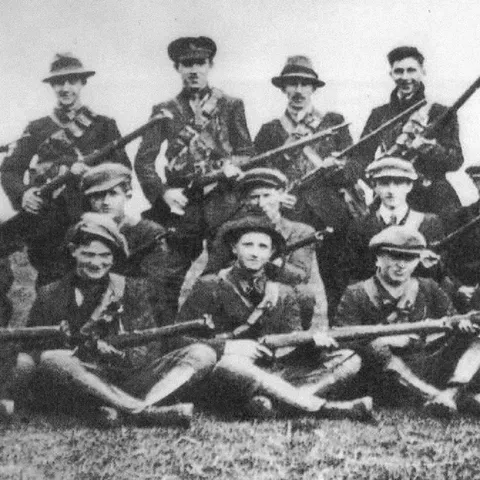
A basic uniform was implemented, consisting of a trench coat, a flat cap worn backwards, and generally a tie. With officers and more senior men wearing fedoras, trilbies, or fancier hats like that to denote their higher status. Towards the end of the war a range of photos were taken of men in these uniforms to further this sense of legitimacy. But you’ll notice the uniform was very much everyday civilian gear. Allowing the IRA to blend in and disappear among the civilian population as soon as they needed to. It was a constant balance between the trappings of a legitimate army and the practicalities of guerrilla warfare.
The basic building block of the army was a company, generally formed along parish lines. A group of companies formed a battalion, and battalions formed a brigade. So each county would have had two or three brigades, all broken into smaller autonomous units. It’s estimated over the course of the war that the IRA fielded about 65 brigades and 297 battalions.
If the IRA had worked like an actual regular army, then the command structure would have been quite simple. The president and the DOL, who answered to the people, would decide on a course of action. The minister for defence would instruct the army general headquarters on how to proceed, and this would have been disseminated as orders throughout the brigades. It’s something we don’t really think about, but this approach is vitally important to a functioning democracy, and ensures the army are answerable to the elected officials, and therefore the people. When this system breaks down, things go badly. Just ask any country in the midst of a coup.
In practice, this would have meant that, for example, a flying column would answer to a brigade leader, who would answer to Richard Mulcahy, the GHQ chief of staff, who answered to Cahill Brewer, the secretary for defence, who would consult with the president and the DOL. But as we know, the reality was far from this. Mulcahy and Brewer did not get on. The president, Eamon de Valera, was in America, and the acting president, Arthur Griffith, was a staunch believer in passive resistance. Into this power vacuum stepped Michael Collins, who ended up having a huge influence thanks to the IRB and his intelligence department, despite the fact that he was minister for finance.
To further complicate things, the troops on the ground often had very little time for the GHQ. So instead, companies acted fairly autonomously, and activity in a general area depended on how confident or committed the leaders were. We’ve had a whole episode on whether this was by design or a lack of control, but regardless, it was exactly how it needed to be. The IRA could not fight the guerrilla war with a top-down approach. This is further complicated by the fact that the IRA company and brigade leaders were often elected by the rank and file.
So on the one hand, the IRA were deeply undemocratic, as they did whatever they wanted with little to no oversight from the DOL. In fact, it wasn’t until August 1920 that the majority of them actually swore an oath to the DOL. But on the other hand, they were made up of men from all over the country, men who elected their leaders and were deeply involved in the political and civilian side of the movement via Sinn Féin. Really, at the end of the day, despite how the IRA would like to be viewed as a normal army, it gets too confusing if you start trying to squeeze them into that box. Their irregularity and the fact that they were unlike nearly any other army before them, that was their greatest strength. But this also hurt their legitimacy and so they hung on to anything that made them feel like a real army.
Now, two episodes ago, when I introduced Terence McSweeney, I mentioned the Restoration of Ireland Act, which was introduced on the 9th of August. In the interest of time, I skirted over it a little bit, but it’s important to mention when discussing the state of the IRA in the latter half of 1920. You see, the ROIA was brought in by the British government to give them the power to intern and court-martial civilians. The idea was that it would allow the British to more easily deal with the IRA fighters and work towards grabbing back control of the worst affected parts of the country.
And as we saw with Terence McSweeney, it was effective in allowing the British to lock men up. However, it also had an unforeseen circumstance. In response to the ROIA, the IRA ordered all officers to go on the run. This caused an uptick in the men available for flying columns and therefore led to an increase in violence.
In terms of funding the army and its increased activity, generally provincial units relied on two main revenue streams. First, men actually paid to join, contributing a weekly membership fee, with only the likes of the squad being paid an actual wage. Secondly, often times the IRA would tax the local community based on how much property you owned. Property owners were, unsurprisingly, not too fond of this approach and often the tax was coerced out of fear rather than given out of a sense of patriotic duty. One man’s tax is another man’s extortion and all that. But the system did work in that only richer property owners were taxed, placing quote, a manageable burden on those most able to afford it.
But even with these funds, as we know, the IRA were woefully under-armed, with only 3,000 rifles in use across the country by the end of the war. Because of this, the fighting units of the IRA were exceptionally cautious. Plans were carefully made and would only go ahead if the unit were sure they could win. This made them just very difficult to defeat. Living to fight another day was the aim of the game and small but frequent ambushes harried and demoralised the British. When it comes down to it, for the IRA, surviving equalled winning. Arguably, as long as they continued to exist, the British were losing the conflict.
But this was easier said than done. Even putting aside the fact they were fighting one of the most well-equipped military forces in the world, just the very act of living on the run was exceptionally difficult. The scabies, a literal infestation of tiny mites in the skin, was so rampant it became known as the Republican itch. While historian John Borganova points out, quote, anecdotal evidence suggests that numerous IRA veterans died young, as their rough guerrilla lifestyle seems to have damaged their long-term health.
They were also forced to make extensive use of disguises. You could choose from the ever-popular and effective university student look, a simple disguise that worked surprisingly well because the British didn’t believe upstanding students would join a dirty rabble like the IRA. Another popular choice was the cleric, easy to throw on a collar and bless your way to a checkpoint. And of course, there was the old faithful. With a handful of IRA men dressing in drag, often their young age made dressing up as a woman both an easy and effective disguise.
But even if you chose not to go on the run, catch scabies and dress as a woman, you could still act as a highly effective deterrent against the British. In fact, most IRA members would not have gone on the run or even carried a gun and instead would have engaged in vital non-violent operations. There were huge teams of men doing everything from cutting phone lines to digging up roads. This was done at night and was so common that throughout 1921, you had men consistently deployed to do nothing else but work nights taking a shovel to the back roads all across Ireland. And then there was the communications, which was hugely important. You had thousands of railway workers and postal employees working to deliver messages throughout the dispersed guerrilla forces.
One interesting quirk of the IRA and one which was tied back to its wish for legitimacy was its extensive filing system. Richard Mulcahy especially became more and more obsessed with recording minute organisational detail, i.e. pointless and dangerous paperwork. This meant brigades and battalions would set up offices with administrative staff in private homes where files would be kept and orders and messages written. Some on typewriters with their own letterheads, some scribbled very quickly. A lot of the men on the ground hated this kind of work. As one IRA man put it,
These letters and files would then be delivered throughout the country by means of an elaborate underground courier system. Couriers would generally cycle throughout the country with messages hidden in shoes or hats, inside bicycle tubes or even within empty beer bottles. Of course names weren’t used and rather you found a lot of references to the different battalions and brigades. A lot of this work would have been done by Cumann na mBan or by young teenagers, both of whom were a lot less likely to be searched by the British.
And this brings us to Cumann na mBan. For decades Cumann na mBan’s contribution and women in general’s contribution to the war effort has been egregiously overlooked. But you really can’t discuss the functioning of the IRA and the Irish fight against the British without highlighting the women of Cumann na mBan. We introduced Cumann na mBan way, way, way back at the beginning of the show and it’s important to note that they were just as active throughout this period as the IRA.
In fact really the IRA couldn’t have functioned without Cumann na mBan’s work. And as the IRA were forced to leave their homes and go on the run, Cumann na mBan became even more important. They were very much an independent entity however and sometimes this even caused tension as some local IRA commanders wouldn’t recognise this or would simply refuse to work alongside women. But in general they described themselves as an auxiliary to the IRA and the two groups worked effectively together. In fact it’s safe to say that without Cumann na mBan’s support the IRA probably would have collapsed.
But because of the secrecy behind the group and the sexist undervaluing of their contribution it’s quite difficult to get a sense of how many women were involved. In 1921 it was suggested there were 20,000 Cumann na mBan members but this figure is probably inflated. While only 1,243 women received certificates of military service in 1944. A figure that is definitely much too low as many women simply didn’t bother applying. So we can comfortably say the group was anywhere between 1,000 and 20,000 women strong. Yeah, how helpful is that?
But as we discussed they played a huge role in communications and intelligence gathering. Postmistresses across the country were able to intercept British communications while passing on any IRA messages. Especially at the beginning of the war the women of Cumann na mBan were simply just ignored and not considered a threat by British forces. This allowed them to befriend the British to gain information or transport messages and weapons without being searched. And I know we’ve already covered the vital work of the likes of Lily Merrin for Michael Collins but again it’s important to remember that there were women doing similarly dangerous intelligence gathering throughout the country.
On top of this they would steal weapons from the British and worked extensively to transport these weapons across the country. Concealing items in luggage or under their clothes. They would even take the risk of housing weapons in their homes. And when you only had 3,000 rifles for your entire army this transportation, protection and concealment of arms was vital to the success of the Irish forces.
And then of course they played the role of medics throughout the country. If the IRA were a traditional army then Cumann na mBan could be classified as their medical corps. Since their inception Cumann na mBan had been focused on how they could help once violence started. Some actively joined in in the fighting. But most saw it as their role to tend to the wounded men of the IRA. Cumann na mBan leaders would travel throughout the country to provide first aid lessons. This created a network of well trained women in parishes all over Ireland. After ambushes the IRA were able to retreat straight to the homes of Cumann na mBan women where they would be fed and their wounds tended.
Again it’s an obviously vital role for an army. Seriously count how many times I’ve said vital in this section. At the time though and since it was not nearly as romanticised or really recognised as say the Flying Columns or the IRA in general. And this can be seen in the difficulty some women had in receiving their military pensions. But at the end of the day their role was indispensable. Which is another word for vital if you’re counting along at home.
And though initially the British didn’t suspect women as being involved in the revolution As the war went on the British copped on and the risk for these women greatly increased. Women searchers were introduced in late 1920 and increasingly women were arrested for republican activity. Cutting off a woman’s hair also became a commonplace practice and made it out to women of Cumann na mBan. Though it should be stated that the IRA also used this brutal tactic against women accused of informing or fraternising with the enemy.
Interestingly and look I’ll be honest kind of surprisingly there’s little evidence of sexual assault carried out by either sides during the war of independence. To be honest I don’t know I find this hard to believe. What with everything else that was going on. And I’d speculate that maybe this is down to the lack of reporting. Ireland was a very catholic society after all. One which a victim of sexual assault would have most likely been shamed. But as I said there’s no evidence so this is just me speculating. Hopefully the lack of evidence is actually down to the lack of sexual violence.
Regardless though the risks across the board were huge for anyone in Cumann na mBan. In general the women involved in the conflict tended towards silence and their role had been overlooked. Sinead McCool the author of No Ordinary Women a book about female activists in this period that I highly recommend stated that it was difficult to get some women to discuss their roles in Cumann na mBan. It was almost something of a taboo. Many women argued that all they did was cook and take care of the fighters. But as I keep stressing that role was hugely important. And as we’ve seen they did so much more on top of that.
I debated separating Cumann na mBan into their own episode. But I decided it would actually do them a disservice. The quote woman’s work of the movement was not some peripheral thing that can be summed up in one episode and never mentioned again. They were intrinsically linked and intertwined in the entire conflict. And if I don’t mention the female input in this time period enough that’s simply my own bias and the bias of our male dominated history sources shining through. Sources that focus on the great men of any movement while forgetting those who lived the experiences on the ground. That’s compounded by the fact that Cumann na mBan women downplayed their own service.
Anyway that turned into a bit of a rant but those were the men and women of the revolution. I think a wider lens like this can really help give an insight into the day to day experiences of the time. Having said that next week we’re diving solidly into the story of one man. A young IRA foot soldier who became a legend.
Thanks for listening. Subscribe wherever you get your podcasts and if you’re enjoying it give us a review on Apple Podcasts or tell your friends. It really helps. You can also support the show, buy merch and get in touch all through our website thehistoryofireland.com or you can follow us on Facebook or Twitter. It’s always great hearing from you guys and if I’ve made a mistake please do let me know.
The History of Ireland was written and produced by me, Kevin Dole. Additional research and fact checking by Robert Babington, music by Liam Doyle and additional help from assistant producer Aoife Murphy. This podcast was recorded in the lands of the Wurundjeri people of the Kulin Nation. Sovereignty was never ceded.