Episodes Irish Revolution Season 1 — The Revolution
The Burning of Cork
Transcript
Welcome to the history of Ireland. We’re up to episode 50 people. What a cool milestone. I’ve said it before and I’ll say it again. Thank you all so much for listening. It’s stupidly fun getting to dive into the crazy world of Irish history, and it’s even more fun having you all come along for the ride. Your emails, your donations, and just the fact that you tune in make it all possible to keep it up, and I’m very grateful. Here’s to 50 more. But okay, on with the show.
With events like Bloody Sunday and the Kill Michael Ambush, there was a growing sense that the British were steadily losing control of Ireland. With this came increased calls for martial law to be implemented throughout the country. But as ever, Lloyd George didn’t want the negative pure of admitting that Britain kinda had a war going on in its backyard. Instead, he wanted to quote, have martial law in the distant provinces, a cloud on the horizon, leaving the seat of government, Dublin, free for them as once to negotiate. Which though it pissed off the more military minded hawks in his administration, as well as the soldiers on the ground, it did make a certain kind of sense. More and more as we move into 1921, you’ll see Lloyd George open up to the idea of negotiations.
Now because of the quote, recent outrage near Cork, i.e. the Kill Michael Ambush, martial law was declared on the 11th of December. But only across a limited number of counties, namely Cork, Kerry, Limerick and Tipperary, with Clare, Waterford, Kilkenny and Wexford getting added to the list in the first week of January. However, if martial law was somehow meant to bring the country under control, it fairly spectacularly failed, and this was proven pretty quickly. Mostly because the chaos being caused was not really because of Sinn Féin or the IRA, and most of it was down to the auxiliaries and the tans. As the historian Charles Townsend puts it, the first fruit of martial law was a reprisal on a scale beyond anything yet seen, putting the whole coercive policy under a baleful spotlight.
It all started on the evening of December 11th, in a quiet area of Cork City known as Dillon’s Cross. Ever since the Kill Michael Ambush, a palpable air of trepidation had hung over the city. Martial law and the curfew that came with it had created an oppressive mood. Tensions were high and the city was close to bubbling over. Dillon’s Cross was nearby to Victoria Barracks, the headquarters of the 6th Division of the British Army and home to three brigades. As well as this, Victoria Barracks housed the newly arrived K Company of Auxiliaries, who had been brought in with a declaration of martial law.
Now every night around 7 o’clock, an auxiliary patrol consisting of two trucks would leave the barracks and drive through Dillon’s Cross. On their way they would pass by O’Callaghan’s Field, a 40-metre long open area cordoned off with a large stone wall. The wall made for perfect cover, while the field provided an easy escape route. With this in mind, Sean O’Donoghue of the 1st Cork IRA Brigade decided that Dillon’s Cross would be an ideal location from which to host an ambush. The plan came straight out of the Kill Michael playbook, and the idea was to attack a convoy of auxiliaries as they left the barracks.
So on the evening of the 11th, as the convoy left the barracks, O’Donoghue stood out onto the road in front of the truck and raised his hand for them to stop. He was dressed in an overcoat, scarf, and cap, and was mistaken for a British officer. I don’t know why the auxiliaries didn’t get some kind of memo about not just randomly stopping for people on the road, but they hadn’t, and the auxiliaries began to slow down. And when they did, he blew his whistle twice, and his men, who were hidden in O’Callaghan’s Field, and his men, who were hidden in O’Callaghan’s Field, tossed grenades into the trucks.
One auxiliary, Leslie Emanuel, described how a grenade actually landed right in his lap. Just before it exploded, he managed to throw it out the window, but the second grenade did its job, flinging him and his driver out of the vehicle. O’Donoghue and the rest of the IRA emptied their pistols into the trucks and then made a run for it. Remember, they were literally around the corner from a barracks full of auxiliaries and British soldiers. If the men were going to survive, they needed to escape and hide, and they needed to do it ASAP.
As O’Donoghue describes it, quote, It was now a case of every man for himself to try and make a safe getaway. Under cover of darkness and hugging the walls, we ran towards Golden Glen and reached it in safety. A large stream ran through the glen. This was swollen by the winter rains. We crossed the bridge over the stream and got away into the open courtyard near Blackpool. I stayed at the house of Lieutenant D. Duggan’s father on that eventful night.
Eventful is rather an understated description of what happened next. In the end, one auxiliary was killed and 11 men wounded. Not a particularly decisive victory of any real military use, and it kinda hardly seems worth it, especially when you consider how the auxiliaries reacted. If the auxiliaries had done nothing, we would not be talking about Dillon’s Cross and no one would have noticed this pretty small ambush. But the auxiliaries did act.
At around 9.30, lorries filled with angry auxiliaries and British soldiers poured forth from Victoria Barracks. They were furious and began barging into homes and pubs under the guise of looking for the assailants. They dragged people out onto the street at gunpoint and began piling furniture inside the houses. They then began setting fire to the homes and buildings throughout the city.
One resident described how an auxiliary barged into his family’s kitchen. He was a fine big man, dressed in an RIC overcoat, soldier’s ordinary military cap, and khaki trousers. He was a walking arsenal, his pockets bulging out with bombs. These he showed us and offered to make us a present. He said he was an auxiliary and they, the auxiliaries, were going to blow up the city.
The same man describes how, while I was at Dillon’s Cross, under the threat of being shot, I saw an ordinary Tommy bringing a small bath full of paraffin or petrol from some house nearby and throw the contents in Brian Dillon’s house, which was burning rapidly. He ends his account saying, the house next door was by this time fiercely burning and the fire was gradually encroaching on ours, but we dare not move to save either. The crown forces kept guard over the burning houses and anybody trying to save even their own property was fired on.
The auxiliaries moved on through Dillon’s Cross into the centre of the city. One man, staying at the Shamrock Hotel on Grand Parade, explained what happened next. At about 9.30pm, a desultory rifle fire was heard in the direction of Patrick’s Bridge. The shooting came nearer. Then, some twenty minutes later, twenty or so tall figures, in trench coats and headgear, caps, hats or Glengarrys, appeared suddenly from Patrick’s street direction. All were heavily armed. They crowded around Sean Jennings’ furniture store at Tuckett Street, Parade Corner. They pounded on the shutters with their rifle butts. Then a small bar or bayonet was used to wrench the shutters free and make a large, gaping entrance to the front window.
Bang! A terrific report and the windows at our heads rattled. Instinctively, we ducked. Bang! Bang! Bang! More explosions. Peeping out cautiously, I see the tall figures crouch down on the opposite pavement at Jennings’. They are throwing bomb after bomb into the furniture display rooms. With each explosion comes the noise of breaking glass and fallings and smashing wood.
The fire brigade were called and came racing from the Grattan Street station. Senior Fireman Timothy Ring was in charge of the scene. But as soon as he saw the seriousness of the blaze, he raced to the Central Fire Station to brief his boss, Chief Fred Huston. Huston comes across as a total and utter methodically organised badass. Which in my opinion is the best kind of badass.
Once he was given the news that the city he was charged with keeping safe was burning at multiple points due to a rampaging group of drunken auxiliaries laden down with explosives, Huston reacted calmly and intelligently. Kind of hilariously the first thing he did was to ring the British military at Victoria Barracks and requested that they take their firefighting gear to Dillon’s Cross. This made sense and would have been the normal thing to do with a blaze of this size. However, as he puts it, they quote, took no notice of my request.
He then rang the Cork Waterworks to ensure the auxiliaries had not tampered with any of the water supply. This is just super smart thinking because if they had, Cork City would have been in a lot more trouble than it was. And it was already in a lot of trouble. Luckily he was told everything was fine. But that didn’t mean he had an unlimited supply of water.
The last thing he did was to check his watch. He knew low tide was at 22 minutes past midnight and that this would mean his fire engines would not be able to pump water from the river until early morning, with high tide being at 6.25am. This was not ideal. At this point it was maybe 9 or 10 o’clock and the rivers were low. This meant when Hostin joins his men at the centre of the blaze, he was forced to make the unfortunate decision of leaving certain buildings to burn. They simply were just not equipped to deal with such a huge fire.
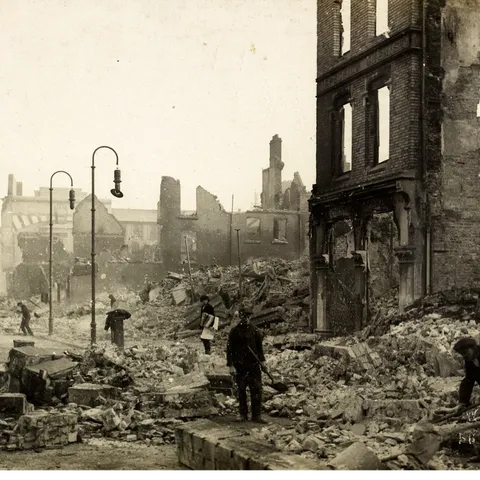
The city hadn’t seen anything like this in 300 years. So the flames spread quickly and fires raged throughout the city. Morgan Street, Robert Street, Oliver Plunkett Street, Cook Street, Winthrop Street, Winthrop Lane, Caroline Street, Mailer Street and Merchant Street, all burned. Imagine the chaos, the heat on your face, the sudden shock as another explosion goes off nearby, the jarring sound of gunfire in the dark. The city was under curfew and anyone found outside was searched and beaten. You would have heard them shouting. And all of this would go on for the rest of the night.
The firefighting historian Pat Poland describes the scene like this, quote, As the enormous fires sucked in more and more oxygen to feed their insatiable demands, the paintwork on the opposite side of the wide St. Patrick Street began to blister. And the British continued to recalc. Both the City Hall and Carnegie Library were targeted by the auxiliaries, with men carrying cans of petrol into the building and then detonating explosives. Huston describes the scene saying, The City Hall and the adjoining Carnegie Library, with its hundreds of priceless volumes, was suddenly a sea of flames. He really wasn’t having a great night.
And throughout the night, as he and his firemen fought the fires, they were constantly harassed and occasionally shot at by the auxiliaries. Four firemen were sent to hospital due to bullet wounds. And on top of this, auxiliaries were seen repeatedly driving their trucks over fire hydrants until they broke and were left useless to those fighting the flames. But regardless, Huston and his men fought on. They’d been on duty since 7am on Saturday morning, yet continued well through the night and into Sunday afternoon. Reinforcements were called in from both Limerick and Dublin, but realistically the damage was already done. And most of the work was done by this amazing group of local firefighters.
At its biggest, the fire had burned around five acres, the size of three football pitches. By morning, the city was a complete and utter wreck. It was reported that over three million pounds worth of damage was done, which equates to a whopping 178 million euro in today’s money. As well as this, about 2,000 people were put out of work or left homeless. But luckily, nobody died due to the fires themselves. Firefighters succeeded in that regard. Bloody good on them.
The burning of Cork very quickly went down as the mother of all reprisals. Newspapers both in England and Ireland cried foul. The Manchester Guardian described it as the crowning wickedness of the reprisal campaign. The sheer devastation was just impossible to ignore. The government was forced to hold an inquiry, led by Major General Strickland, and it found fairly conclusively that the auxiliaries were the ones who’d started the fire. Strickland even went further and blamed quote the higher authority who ordered a unit in so raw a state to such a dangerous area. This was a direct dig at General Tudor and the British government decided to suppress the whole report and they never released it. But by this point it was too late. People knew that the report existed and it just ended up adding to the negative PR. Then Tudor carried out his own investigation which tried to shift the blame away from the police but no one really believed it. It was a horrible night of needless wanton destruction.
I’ll leave you with an excerpt from a letter written by one of the auxiliaries. I think it sums it up better than anyone else could. He said the following. I am present in bed recovering from a severe chill contracted on Saturday night last, during the burning and looting of Cork, in all of which I took, of course, a reluctant part. We did it all night, never mind how much the well-intentioned Hamer Greenwood would excuse us. In all my life, and all the tales of fiction I have read, I have never experienced such orgies of murder, arson and looting as I have witnessed during the past sixteen days with the RIC auxiliaries. It baffles description and we’re supposed to be officers and gentlemen.
When the auxiliaries were describing themselves like this in letters, back to their own mothers, it becomes completely and utterly impossible to do anything but condemn their actions. And what’s worse, these reprisals did absolutely nothing to help gain control of the country. This policy of reprisal was failing, completely and utterly and doing a lot of damage in the process. The Archbishop of Toulme when complaining to Churchill put it well. He stated, the auxiliary police are exercising terror and torture unchecked, and still the spirit of Sinn Féin is as strong as ever. The British needed a new approach, which brings us nicely into 1921.
History of Ireland was written and produced by me, Kevin Dole. Additional research and fact-checking by Robert Babbington, music by Liam Doyle and additional help from Assistant Producer Aoife Murphy. This podcast was recorded on the lands of the Wurundjeri people of the Kulin Nation. Sovereignty was never ceded.