Episodes Irish Revolution Season 1 — The Revolution
Guess Who Just Got Back Today?
Transcript
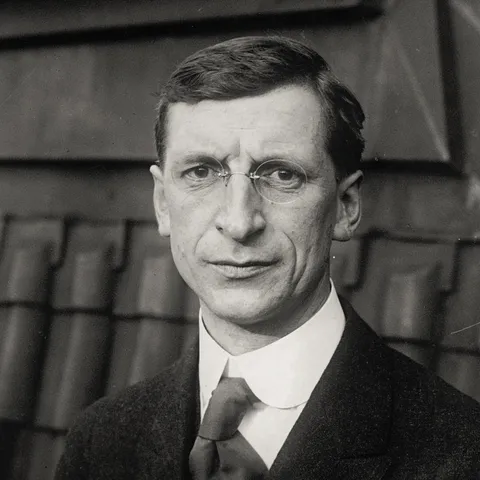
Welcome to the History of Ireland. On December 23rd, 1920, the Government of Ireland Act officially passed. And on that same day, Éamon de Valera, the President of the Irish Republic, stepped foot back on Irish soil after his 18-month tour of America. Dev had left for the States in June of 1919. June 1919! So bloody long ago!
If you remember, he had gone to America to raise funds among the diaspora and petitioned Woodrow Wilson to support the Irish cause. The latter never happened, but Dev was hugely successful in raising money. In fact, he raised, quote, five times the amount initially contemplated by the Irish cabinet. To do this, and to further the Irish cause, he had travelled throughout the States, holding huge rallies with upwards of 60,000 attendees. As Dev put it in a letter to Michael Collins, I spend most of my time shaking hands. I’ll have the biceps of a blacksmith before I’m finished.
It should be pointed out that while in America, he had also kinda helped fan the flames of a huge fracture in Irish-American politics. But that’s a whole separate story, and I feel like we don’t need to get into it. If there’s interest, we can always revisit.
So the question is, why, after 18 months, did he finally decide to return home at the end of 1920? Well, there were three different elements pulling him back home to Ireland. And no, it wasn’t just a craving for brown bread and black pudding.
First, Woodrow Wilson was now the outgoing president, and Dev’s last appeal for American political support was ignored. Wilson had always been Ireland’s best hope, due to his strong belief in the sovereignty of small nations. But if Wilson hadn’t helped the Irish cause, his Republican successor, Warren G. Harding, definitely wouldn’t either.
Secondly, there was the case of the power vacuum that had arisen in Ireland. With the dolls acting president, Arthur Griffith, arrested, Dev was worried that Michael Collins would take even more control of the movement. Griffith had appointed Collins as his replacement after all, making Collins acting acting president, I think. We’ll come back to this.
Finally, and most importantly for Dev, were the rumours of peace talks occurring with Britain. As we discussed in the last episode, the beginnings of peace were being discussed, and Dev knew he would have to be on hand in case Lord George reignited any kind of discussions. In fact, despite the collapse of the negotiations led by Archbishop Clune, Lord George had insisted on keeping a channel open between himself and Griffith, through a man named Patrick Moylett. As Lord George said, ask Griffith to keep his head, and not to break off the slender link that had been established.
So all of this is why Dev finally decided to return home. But the Ireland he was arriving in, was vastly different from the one he left. And Dev’s life changed dramatically too, as soon as he set foot on Irish soil. He went from living it up in the Waldorf Astoria hotel, and to sneak around Dublin as a quote, president in hiding.
He was ferried secretly into the country, and then hidden in a house in Dublin. Which is actually kind of funny, because Lord George had rescinded the order to arrest Dev on sight. He wanted Dev free in case peace talks started up again. But the Irish didn’t know this, and so Dev was needlessly sneaking around the capital. And it made for a very different experience, than his time in New York, being applauded by giant crowds throughout the country.
Of all those three reasons that Dev had come home, the second one, that power vacuum, was what worried him the most. There was not much he could do about peace talks, until Lloyd George re-engaged. And there was obviously nothing he could do, about getting American support from Ireland. So he began building up his power base.
As the president of the Irish Republic, Devolair should have been top dog in the Irish movement. But when you send yourself off to America for 18 months, it’s pretty much impossible to stay in control. Remember, communication was slow between America and Ireland. So, there was really no way for him to play, any practical kind of leadership role, within the Irish movement, between 1919 and 1920. And in fairness, he knew this, and he never tried to take control from America.
Instead, as we know, Michael Collins, the Minister for Finance, the Director of Intelligence, and the leader of the IRB, had become quote, the effective leader of the Irish revolution. Now I can imagine Devolair was asking, why Arthur Griffith, the acting president of the Dáil, wasn’t the guy everyone looked to for leadership? Well, despite being technically in charge, Griffith never really had much of an aptitude, for running a government. It’s said that he quote, remained at heart an agitator, rather than an administrator.
And despite a rocky start to their relationship, Collins and Griffith were fierce allies by 1920. And Griffith was happy to let the energised, and efficient young courtman, basically run the joint. Also, there was the small fact, that Griffith kept getting arrested by the British, for basically being the acting president. He spent something like 17 months in prison, between May 1919 and June 1921.
When Dev had arrived home, Griffith had been in prison since about October, and this time, as we’d said, he actually made Collins acting president. This wasn’t really planned though, and rather happened because Cothell Brewer, the minister for defence, turned down the job. We’ve talked about Brewer before, and he’s an interesting one. He was also an inadvertent reason for Collins’ power.
Basically, he was a completely, and utterly useless minister for defence. Before the war, and before joining the Dáil, Brewer ran a candle making firm, and worked as a travelling salesman. But he never gave this job up, and so was often distracted by travelling around the country, selling candles. But this was fine by Collins, as one historian puts it, Brewer was minister for defence, but never did anything. He was not able, but he was never on the run. Meanwhile, Collins was so energetic, that he had usurped many of Brewer’s functions. For this reason, and a few others, Brewer, quote, hated Collins like poison. I was a staunch supporter of de Valera’s. Remember this as we continue. This whole episode is about the relationships between all these different men, and it’s fascinating.
And finally, on that note, it was Collins’ relationship with Richard Mulcahy, the leader of the GHQ of the IRA, that really cemented his power. The two worked really well together, and I often say that Collins overshadowed the quieter Mulcahy. But the two had worked together for years at this point, and Mulcahy was a vital ally for Collins. So with the support of Mulcahy and Griffith, Collins basically ruled the roost. And Dev, quote, simply could not cope with Collins’ decisiveness, realism, and ability to learn quickly.
On his return, Dev immediately began chipping away at Collins’ power, and quote, effectively demoted Collins by appointing Austin Stack as acting president, should anything happen to him. Stack was the Minister for Home Affairs, and is credited with the creation of the Dáil Courts, which was a huge deal. So he was a pretty good choice for acting president, but it also helped that he was a big supporter of de Valera’s.
So as well as effectively demoting Collins, Dev also started taking more of an active hand in all elements of government. He began holding meetings across all government departments, and quote, tried to ginger up departments that had lost their way or their nerve under the impact of the British Autumn Surge. His approach was to hold long and boring meetings where he would eventually get his way by letting meetings go on until dissent was silenced by persuasion or exhaustion.
This hands-on approach was really important, and you have to commend Dev for this. Neither Griffith nor Collins paid that much interest into the actual running of the Irish Republic, and many departments had kind of stopped doing anything. When Dev arrived, this changed. And generally, Collins didn’t mind Dev stepping in like this. One of Dev’s biographers says that Collins was unswervingly supportive of de Valera as president throughout his time in America, and never then or after his return challenged his decision.
The only place where Collins would get annoyed with Dev’s interference was in military matters, and Dev started interfering as soon as he arrived home. On Christmas Eve, he berated Mulcahy for the revolutionary guerrilla tactics that were really the only reason the IRA stood a chance against the British. He stated, You are going too fast. This odd shooting of policemen here and there is having a very bad effect from a propaganda point of view on us in America. What we want is one good battle, about once a month, and with about 500 men on either side. Yeah, Dev was looking for set-piece battles, when the only reason the IRA were succeeding was through these guerrilla tactics. It was madness.
He also made it clear that he was very much against Bloody Sunday, stating that it was represented in the American papers as brutal murders of British officers in their bed. He had no knowledge of the facts and was compelled willy-nilly to let the reports go uncontradicted until it was too late. As the writer Ronan Fanning puts it, While he did not explicitly disown the killings, de Valera’s remarks suggest that he would not have authorized them if he had been told of them in advance. And you’ll notice in both instances his complaint was that the IRA was making the Irish movement look bad in front of the Americans. This kind of shows how his priorities were a bit out of whack.
But Dev took it further than simply giving out to Mulcahy. Again, Ronan Fanning describes it saying, He interviewed his cabinet and IRA headquarters man by man, inquiring minutely into the military position. And this is when Collins got annoyed. His contemporaries described that Collins made no real attempt to impress de Valera. He hated these meetings. I would attend them, as one person put it, in a queer humor, almost melancholy.
Collins especially hated Dev’s long and winding approach to meetings. Dev would draw meetings out for ages and ages and ages and Collins saw it as a complete waste of time. Apparently, Collins was especially irked by Dev’s tendency to wax on lyrically about his time in America. In one meeting, after he had another American story from Dev, Collins reportedly growled, Oh, I have it off my heart.
And maybe Dev talking about big set battles wouldn’t have been an issue, except he did have support from the likes of Austin Stack and Colin Brewer. And so with his return, a bit of a rift started to develop. Mulcahy and Collins and a few others, with the support of Griffith, wanted to continue with how the IRA had been fighting, believing, rightly, that the approach was effective and that to reduce attacks would be seen as a weakness and that giant set piece battles would just be disastrous. But on the other hand, you had de Valera, Brewer, Austin Stack and a few others who wanted less guerrilla fighting and bigger, more traditional battles.
Toward the end of January, Dev, Brewer and Stack even tried to remove Collins from the scene entirely and wanted to send the corkmen to America to quote, obtain money and munitions, organize a boycott of British goods to help restore unity in Irish American forces. This was a suggestion that went down like a lead balloon. Collins was furious, stating, the long whore won’t get rid of me as easily as that. In the end, the idea was dropped after a number of IRA officers threatened to resign. But it’s a prime example of how much Dev was working to reduce Collins’ influence. And you can see how this Collins vs. Dev narrative just develops and is very hard not to get sucked into. It just seems kind of petty and foolish.
However, on his return, there was one thing Dev Valera did that was long overdue. Something Collins and Griffith really probably should have done quite a while previous. Let me explain. Though the IRA had taken an oath of allegiance to the Dáil, the Dáil had never taken responsibility for anything the IRA did. And this worried Dev. He believed that this lack of acknowledgement or ownership over the IRA’s actions suggested that the Dáil was not in control of the military wing of the Irish movement.
Now, of course, the Dáil really weren’t in control of the IRA. As we’ve discussed previously, for the guerrilla tactics to have any chance of working, they needed a bottoms-up approach. Flying Collins couldn’t really wait for orders from the Dáil. And as historians like Charles Townsend puts it, this suited the likes of Richard Mulcahy just fine. He was, quote, dedicated to the principle that the army was subordinate to the government, but not at all happy that ministers should interfere in actual military decisions.
But it was a dangerous line to walk, and Dev had a point. The less political oversight the army had, the less legitimate they were as a real Irish Republican army. And if the army was its own entity without any political oversight at all, well, that could get dangerous. That’s how coups occur.
So, in January 1921, Dev promptly issued a pamphlet called The Irish Republican Army, in which he wrote, The IRA is a regular state force under the civil control of the elected representatives of the people, with an organization and a discipline imposed by those representatives under officers who hold their commissions under warrants from these representatives. Phew, man, if his sentences were anything like his committee meetings, I can see where Collins was coming from.
Anyway, he continued, The government is therefore responsible for the actions of this army, and these actions are not the acts of irresponsible individuals or groups. What I find interesting here is that Dev simultaneously was complaining about the methods of the IRA, but also aware that he and the Dáil needed to be seen to be taking ownership of those methods. It’s a great example of backroom politics differing from the public stance that needed to be taken by the government.
And it shows how savvy a politician de Valera was. You’ll see this again and again as the political force that was Éamon de Valera re-enters the story. And this taking ownership of the IRA was vital for the peace talks that would come. There was no point negotiating with someone if they didn’t have any control over the people doing the killing. So you’ve got to tip your hat to de Valera there.
So that’s the return of Éamon de Valera to Ireland. And you’ll see there are good and bad sides to his political maneuverings. He was playing games with the likes of Collins trying to send him off to America, and I don’t think that helped with the movement. But he encouraged the important work of government departments and he forced the Dáil to take ownership of the IRA, which would be vital in the peace talks to come.
Additional research and fact-checking by Robert Babington, music by Liam Dáil, and additional help from assistant producer Aoife Murphy. This podcast was recorded in the lands of the Wurundjeri people of the Kugan nation. Sovereignty was never ceded.