Episodes Irish Revolution Season 1 — The Revolution
The Burning of the Custom House
Transcript
Welcome to the History of Ireland. When De Valera returned to Dublin at the end of 1920, you’ll remember he complained about the piecemeal guerrilla tactics of the IRA. He believed they were having a negative effect on how the wider world viewed the Irish cause. That these tactics were literally the only reason the IRA were surviving against the British seemed to be totally and utterly missed by Dev. But regardless, he called for a bigger attack. One that would both showcase the IRA as a proper, respectable army worthy of the Irish Republic, and act as a huge piece of pro-Irish propaganda. What this would translate into is an attack in Dublin that, depending on how you look at it, was either a propaganda masterpiece or a total disaster of empiric victory. Yep, today we’re looking at the burning of the Custom House on May 25th, 1921.
Before we do though, it’s important to think about the state of Dublin at this period of the war. There were about 2,000 men enrolled in the IRA’s Dublin Brigade, but only around 100 of them were active. Remember that figure, it’s important. In comparison, the British had just over 10,000 troops and 16,000 police, including 400 auxiliaries. That’s pretty much 5 British men for every Irishman. Not great odds. This huge number of British forces, who were constantly on patrol throughout the city and strictly enforcing a 10.30pm curfew, made IRA activity very, very difficult indeed. With this in mind, the Dublin IRA kept to what it was good at. Assassinations and small, quick attacks throughout the city. Both of which had the British on the back foot, and made for a capital that felt both a little unsafe and not particularly under control of the British.
But despite all of this, De Valera wanted his big statement. Now you’ll remember the last episode, I quipped about and briefly touched on how the Dáil declared war on the British on March 11th. The reason they finally got around to doing this was due to Dev wanting to take control of the narrative surrounding the IRA and to stave off the negative press. When the Dáil met on March 11th, Dev put it like this. The Dáil should let the world know that they took full responsibility for all the operations of the army. It’s fascinating to me that they’re only getting around to this now. And in fairness, one TD from Leitrim pointed out that it should have been done 6 months ago. It can be argued though that the one reason Dev was insistent on doing this now, even if it was a bit late, was that it would be vital for future peace talks. There would be no point negotiating with the Dáil if they were not seen to be in control of the IRA. And so, war was declared.
With that done, Dev began pushing even harder for a big set-piece military action similar to that of 1916. He argued the quote, that time had come to deliver a smashing blow to England, some bigger military operation than anything yet attempted. The two locations he suggested were Beggars Bush, the Auxiliary’s headquarters, and the Custom House, which has been described as a focal point of British administration in Ireland. It was very quickly decided that the former target was total and utter madness. Beggars Bush was just too well guarded and full of soldiers. You know, on account of it being a headquarters. So it was agreed that the Custom House was a much more viable target. Having said that, both Michael Collins and Richard Mulcahy were sceptical to say the least, with Mulcahy later saying that the GHQ was dragged into the whole operation.
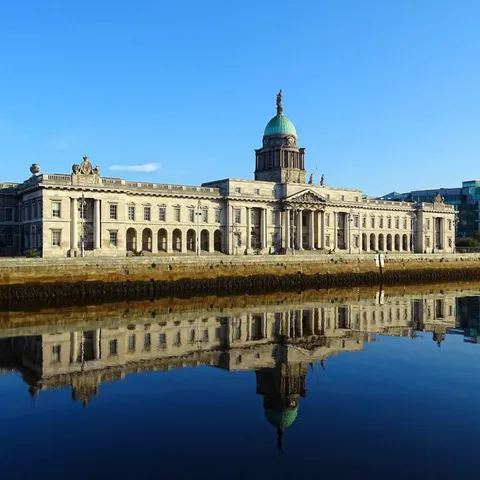
But what was the Custom House? Well, it was where the British kept all the boring paperwork needed to run a country. Things like wills, land ownership and tax records were all stored in the Custom House. The idea was that by destroying these it would become increasingly difficult for the British to carry out any practical day-to-day running of the country. And there was precedent. The IRA had burnt down Custom Houses all over the country to great effect. It also helped though that the Custom House was, and still is, a fairly impressive building. Around 5 minutes walk from O’Connell Street, sitting right by the livvy. Any Dubliner will know it well. The Irish Bulletin described the building as the seat of tyranny in Ireland. And well, kind of looks exactly like how you’d imagine it. Built in an 18th century neoclassical style. There’s lots of columns and crests and a big green copper dome. It’s old school and beautiful. Setting it alight would create just the spectacle Dev O’Leary was after.
It was decided to attack the building with 120 IRA men. Dev knew the risk, stating that if these 120 men were lost and the job accomplished, the surrender would be well justified. This is some proper 1916 martyrdom right here. The antithesis of how the IRA fought throughout the war of independence. I can imagine the likes of Collins and Mulcahy being bewildered. Despite that though, the Dáil signed off on the attack, and strangely it actually became the only armed action discussed and approved by the Dáil cabinet during the Irish war of independence. So let’s see how it went down.
The attack was planned for Wednesday, May 25th, 1921. At lunchtime the IRA gathered at Sean Connolly Hall, a few minutes from the Custom House. A man named Tom Ennis was put in charge of the entire operation. There were some very experienced men involved. Despite Collins’ objection, the squad had been roped into it. But the majority of the 120 had not done much more than parade. In some cases this would have been very much their first real piece of action. The IRA soldiers were given a revolver and six bullets each, as well as paraffin oil and hatchets to smash windows with.
The plan was pretty simple. The squad would take care of the police guard, cut the telephone lines and take the staff prisoner. Meanwhile one battalion would work through the building setting fire to key spots, while the rest took up positions in the surrounding area. Thanks to the IRA’s ever impressive intelligence network, they had full access to the plans of the building, knowing where the most important files were, and knowing exactly where to light the fire to cause the most damage. In fact some of the Dublin Fire Brigade, who were also in the IRA, helped plan the arson. For the plan to work, they needed to hit the wheel room, situated on the ground floor in the middle of the building. As one man put it, this was the only combustible part of the building capable of forming a large fire.
So it all kicked off at around one o’clock. The staff of the custom house, probably discussing what to have for lunch, was sitting around when quote, strangers armed with revolvers poured into the building. As one staff member put it, several young men passed us carrying tins of petrol. One of the leaders announced that the custom house was being set on fire, and warned us against causing any commotion. An elderly caretaker Francis Daly rushed to the phone. He wanted to call the authorities but was quickly shot dead.
At around ten past one, a policeman from outside did call Dublin Castle for reinforcements, and within minutes three truckloads of auxiliaries had arrived. Dan Head, a seventeen year old IRA man, was outside ready for justice eventuality. He saw the trucks trundling down the street and hurled a grenade towards one of them. It was a huge explosion, and quote, the whole place seemed to rock. Shots fired throughout the street, and seventeen year old Dan Head was quickly gunned down.
Inside the building meanwhile, the sounds would have been deafening as a revolver fire echoed throughout the custom house. Cutting through a noise a whistle was blown. This was the signal to set fire to the whole place. Imagine the men dousing the floors, documents and furniture with oil and simply dropping a match. The fire would have burned quickly as smoke filled the stuffy eighteenth century offices. Onlookers quickly called the fire department and were told that help was on its way. This was a lie. The IRA, with the help from a number of key firefighters, had taken control of the fire stations across the city to ensure no one would be able to put out the blaze.
The auxiliaries surrounded the building, and the IRA managed to hold them off for about half an hour until eventually their ammunition ran out and the firing came to a halt. Imagine how strange it would have been, just hearing revolver crack after revolver crack, and then slowly just hearing nothing. Nothing except the sound of a building slowly catching fire. A British military report describes the quote, a large number of civilians came out of the custom house when it burst into flames with their hands up. These were all marshals by the auxiliaries, and the head custom officials were asked to identify their own employees, who were not detained. On completion of identification about 70 civilians remained, of whom 7 showed distinct traces of petrol. These 70 civilians were arrested. The number of people arrested actually turned out to be 111, and it’s estimated around 88 were IRA men. The arrests were a crushing blow to the IRA, taking a huge chunk of experienced and inexperienced soldiers alike.
The building continued to burn. By the time the fire brigades did get there it was too late to do all that much. In the end it took 5 days for the fire to be put out. One onlooker describes how on the next day, quote, towards midday the tower took fire and spread it out flame. The copper dome held out till the afternoon, when the flames burst out underneath it and caused it to belly out like the sails of a ship. Finally the sheeting gave way, disclosing the pedestal of the statue of hope. Huge crowds watching the fire. Another man wrote in his diary about the day, and we have that amazing first hand account written in that cool diary language. Here’s what he had to say. Returning to the office from lunch. Saw the custom house in flames. Saw it several times during the day burning furiously. It was set on fire by the IRA. Shortly after which the military surrounded it and kept guard as usual after the damage had been done. Tried to get down to the quays after. Too much shooting going on. Building still burning.
The spectacle would have been phenomenal, and the imagery of the burning custom house travelled around the world. So in fairness, De Valera did get exactly what he wanted, and as he said he was happy for those 88 men to be arrested. But was it worth it? On the one hand it crippled the Dublin IRA, leaving them remarkably weak. The capture of so many men made it even harder to continue the military campaign in the city. And the documents destroyed, though they did hurt the ability of the British to govern in Ireland, also hurt everyday people. These were just normal people’s wills and what not after all. Some argue that the whole attack was totally and utterly unnecessary, proving no real military value to the IRA, especially considering how truce talks were beginning to occur.
But this kind of leads us to the on the other hand. You see you could argue that Dev really did need this big propaganda moment. He wanted to further prove to the British and the world that the Irish were not nearly defeated. Maybe it was just what was needed to force the British to take peace negotiations seriously. In a weird way I actually think it was one of the things that made a truce appealing to both sides. The GHQ could see how stretched thin the IRA were, and now the Dublin forces even more so. The leadership knew they couldn’t hold out much longer, though some on the ground would have disagreed. This disastrous military blunder brought them very close to the edge. But even if it was a pyrrhic victory in a military sense, the attack was a big bold statement that proved how out of control the Irish situation was. And this was always where the IRA succeeded most, by just causing chaos throughout the country and proving that Britain didn’t have a firm grasp on Ireland. That was success.
I guess it’s impossible to tell, but the image of the burning Custom House must have been fresh in the minds of the British cabinet as they debated whether or not to give credence to the idea of a truce. So whatever your thoughts on the attack, military blunder, pyrrhic victory, propaganda gold or something in between, it does set the scene nicely for us as we move into the final stage of the war. The final stage which doesn’t take place on the cobblestone streets of Dublin, or the wild fields of West Cork, but rather in a quiet office in London, as the Welsh Wizard and the Longfellow finally meet.
This podcast was recorded in the lands of the Wurundjeri people of the Kulin Nation. Sovereignty was never ceded.