Episodes Irish Revolution Season 2 — The Civil War
Young Lawlor & The Legalities of Conflict
Transcript
Welcome to the History of Ireland Today I want to talk about the Army Emergency Power Resolution A resolution that allowed the Irish Free State to crack down on the anti-treaty IRA But before I do, first let’s look at where the anti-treaty IRA were sitting at this point in the civil war Around September and October of 1922
Now in theory Éamon de Valera was the leader of the organisation As he was president of the republic that these soldiers argued they were fighting for But in reality Dev had virtually no control over the anti-treaty IRA Instead he spent the period as Charles Townsend puts it Quote shepherded through the countryside from a regular unit to a regular unit The awkward symbol of a lost state
Writing to one friend Dev put the situation like this The republicans had to choose between a heartbreaking surrender of what they have repeatedly proved was dearer to them than life And the repudiation of what they recognised to be the basis of all order in government And the keystone of democracy It’s interesting the language he uses here He talks about the republicans, almost othering them, separating them from himself
Liam Lynch the leader of the anti-treaty IRA didn’t seem to be worried about this choice For him he would always be the republic regardless of what the majority thought As he put it views and opinions of political people are not to be too seriously considered Our aim and our course are now clearly defined and cut and dried
This didn’t stop some of the anti-treaty IRA trying to act in a way that wasn’t purely militaristic however Other IRA leaders like Liam Mellows and Ernie O’Malley argued that they needed a clear idea of what the republic actually was They needed an alternative government to the Irish provisional government Similar to how the second doll had formed a second functioning government as an alternative to British rule
As Mellows put it an object, a target, must be presented to the enemy to hit at Otherwise it becomes a fight apparently between individuals He also argued that a social program be put forward to demonstrate what the republicans believed in Mellows version of this was quote a pretty full-blooded socialist document advocating nationalization of banks and industry O’Malley writing from prison also pushed Lynch writing We consider it imperative that some sort of a government whether a provisional or republican government or a military one should be inaugurated at once
So Dev, O’Malley, Mellows and many others tried to push Lynch into creating some form of republican government Some social manifesto or policy document or anything They wanted to get labour and the workers and really anyone else on side But Lynch, well he was having none of it, describing the labour manifesto as gas
And despite the fact that they had no backing from Lynch and therefore the majority of the anti-treaty military Dev did reconvene what was left of the second doll on October 25th But as Townsend puts it the cabinet he formed had an air of unreality Without Lynch’s support it didn’t really matter what Dev or the political side of the anti-treaty side did If their own army ignored them well it was very easy for everyone else to do the exact same thing
So the anti-treaty IRA were firmly militaristic and as Lynch put it the decision would be to fight to a finish and accept no more compromises Them’s fighting words if ever I’ve heard them And so fighting continued all across the country It was piecemeal guerilla fighting similar to what had been done against the British
And if Lynch and the majority of the anti-treaty IRA were determined to fight with no compromises Well so were the Irish provisional government Last episode I mentioned Cosgrave’s threat to exterminate 10,000 republicans He was very much backed up in this by Richard Mulcahy new leader of the Irish Free State Army It’s often said that Mulcahy was a lot quote less sentimental about old comrades than Collins had been
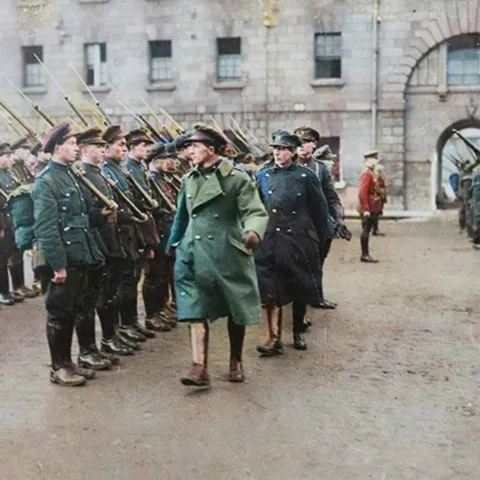
With this in mind on the 15th of September Mulcahy wrote up a document with the powers he believed the army would need to quash the anti-treaty opposition What came out of this was the Army Emergency Powers Resolution which was put to the Dáil on September 27th
Now without getting too deep into legalese it is interesting as to why it’s called a resolution or at least I think it’s interesting Basically under the treaty the provisional government as legal historian Thomas Moore puts it could only pass temporary legislation that dealt with matters of administration that the British had already transferred to it They were just meant to keep things on track until December 6th when the Irish Free State would come into power
But you know a civil war has a mighty way of knocking things off track and so something had to be done Between April and October 10 degrees were passed not laws but decrees covering a few different areas But you know you better believe that giving the army extra powers had not really been covered in the treaty and that kind of power was quote not deemed to have been transferred to the provisional government There was also the risk that any decree might become unlawful after December 6th and that would be the last thing you’d want to happen when fighting a civil war
So what was the solution? Rather than making a decree, an act or a law Hugh Kennedy a lawyer for the provisional government dubbed it a resolution And this name change was enough to make it all hunky-dory apparently Lawyers eh?
So the Army Emergency Powers Resolution introduced a system of military courts empowered to serve up fines, imprisonment, hired labour and even the death penalty It controlled the ownership of firearms and though it was meant to combat the anti-treaty IRA it could be applied to anyone So basically any citizen whether a combatant or not could be brought before a military court and condemned without jury, much of a legal process or anything of the like
Labour the main opposition party in the Dáil dubbed it a blank check for the army and compared them to the military courts that were going on in Soviet Russia at the time and complained that it turned Ireland into a military dictatorship Thomas Johnson the Labour leader put it like this We are giving that army military power over every person in the country setting up by vote of the Dáil a military dictatorship We should at least have some reasons given us and some thorough examination and disclosure of the military position throughout the country
But Cosgrave argued firmly in favour stating If murderous attacks take place those who persist in those murderous attacks must learn that they have got to pay the penalty for them Just now those people think as far as our action is concerned up to this it has looked as if they had the perfect liberty to attack our soldiers to maim them, to wound them, to kill them and to suffer no greater penalty than internment Those people not alone take part in those things but go away silently smiling and laughing at the destruction they have wrought They must be taught that this government is not going to suffer their soldiers to be maimed and ruined, crippled and killed without at least bringing those responsible for such destruction before a tribunal that will deal out justice to those people
As ever at this point Cosgrave really wasn’t messing around and in the end the resolution was passed 41 votes to 18 Towards the end of the year the legality of the resolution was brought before the courts Moore writes that quote Lord Chief Justice Maloney openly admitted that the Irish National Army had no basis in statute or any other legal instrument Basically without the Irish Free State coming into being on December 6th well what was this army doing? Who was in legal control of it?
But the Chief Justice also pointed out that quote Again translating that a little bit he’s just saying if someone attacks a country they have the right to set up an army and give that army powers to defend themselves and I can see his point So that’s what the Irish Provisional Government and the Irish Free State Army did Over the next two years the resolution allowed them to intern 11,000 people and execute 81
Some argue that the first person to be killed under this legislation was John Lawler a 22 year old anti-treaty IRA man from Ballyhague in County Kerry Though there’s no record of Lawler taking part in the War of Independence his older brother David was a member of a Kerry Flying Comm and John was probably involved but played a smaller role in the war considering his age Regardless he was definitely involved in the anti-treaty IRA and had been fighting throughout Ballyhague in October
In this period Ballyhague had seen quite a little bit of action and the Irish Free State had even brought down an 18 pounder gun nicknamed the Rose of Tralee In the last week of October Lawler was caught by the Free State Army As the Cork Examiner wrote Rounding up operations were carried out on an extensive scale in Ballyhague, North Kerry on Monday and Tuesday During the operation one irregular was killed and three arrested A Ford motor car and two shotguns were captured
But the way the paper reports it suggests that Lawler was killed in battle and that’s not really what happened In his excellent article on Lawler Brian McMahon quotes a local Kerry woman Dorothy McArdle who wrote about that night She had this to say On the night of 30th October a division of the Free State troops surrounded Ballyhague John had good luck and bad luck on that night Having helped to extricate two companies of volunteers he went with a couple of comrades to secure arms
They were captured They disarmed their guards and dashed away over the fields with a rifle in triumph They headed by mistake into an enemy post and were seen and fired on The others escaped But John fell wounded and was taken prisoner They condemned him to death that night and killed him in the early morning They left his body in the street of Ballyhague outside the church gate
Now it should be said that neither the Dhal nor the Free State Army Command authorized the execution But it was the first to take place after the army resolution was passed making it arguably perfectly legal The man who ordered the execution was Michael Hogan a 23 year old Free State soldier Think about that A 22 year old injured and a prisoner was shot dead on the orders of a 23 year old who a year previous had been fighting on the same side This is what people say when they talk about the horrors of the Irish Civil War Things would only get worse
Now I’ll be taking a break over Christmas to enjoy well the first Christmas I’ve had at home in Ireland in over 4 years now But I’ll be back in the new year raring to go where I’ll be going back over 1922 and looking at what was happening from a northern perspective See you in the new year
www.thehistoryofireland.com You can also get in touch through the website or on Facebook and Twitter It’s always great hearing from you guys and if I’ve made a mistake, please do let me know The History of Ireland was written and produced by me, Kevin Doher with music by Liam Doyle and additional help from assistant producer Aoife Murphy