Episodes Irish Revolution Season 2 — The Civil War
The Executions Begin
In this episode we look at the first series of executions carried out by the Free State in November 1922.
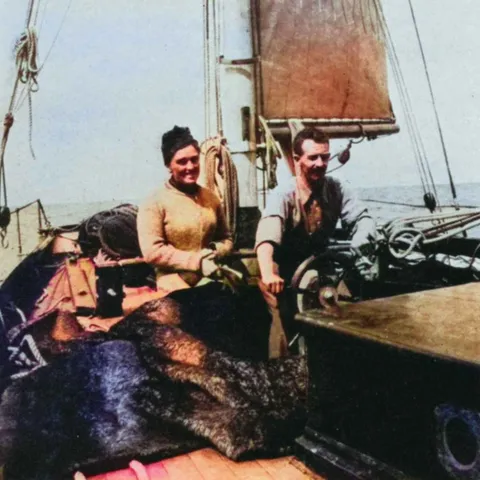
The image used for this episode is of Erskine Childers and his wife Molly, on their yacht the Asgard.
Transcript
Welcome to the History of Ireland. Before I start this episode, two quick corrections. First, last week I flippantly assumed Charles Dalton was no relation to Emmett Dalton, but turns out they were brothers. Second, while discussing the McMahon murders a few episodes back, I mentioned a detective inspector John Dixon, when in fact it was John Nixon, like the president. Not sure how I messed those two up, but Abdulrahman Ryan and Martin McGill reached out to correct me on each respectively. Much appreciated. Gold star for ye, and a merit for me.
Anyway, as we discussed last week, the civil war had entered an increasingly bloody period. With atrocities being carried out on both sides. To date we’ve focused on mostly free state atrocities. But know that both sides were brutal, and sadly there are more shocking incidents to come. Today, I want to look at the executions carried out by the free state towards the end of 1922.
With the passing of the Emergency Powers Act on September 27th, the government gave itself the power to execute anyone carrying arms or quote, taking part in or aiding and abetting attacks on the national forces. Cosgrave’s cabinet agreed unanimously that the executions were the only way forward. With the Minister for Justice Kevin O’Higgins stating, it was done deliberately in the belief that only by that method could representative government and democratic institutions be preserved. Cosgrave was harsher, simply saying, we are dealing with the dregs of society. People who had no regard for life are all the people held dear.
Despite the law passing at the end of September, it wasn’t until November 17th that the first anti-treaty IRA prisoners were executed. The first to be shot were Peter Cassidy, James Fisher, John Gaffney and Richard Tuhigg. These were rank and file members of the IRA, all between the ages of 18 and 21, and all from the Liberties, a working class area in Dublin. They were arrested for carrying arms.
Some say they were targeted because it was believed they were either part of an attack on Oriel House, the Provisional Government’s secret service, which hopefully we’ll dive into at a later date, or involved in the murder of Patrick Cosgrave, W.T. Cosgrave’s uncle. The man had been killed in an IRA raid of his pub. Well, a raid or a robbery, it’s hard to say, but despite his links to W.T. Cosgrave, I can’t find any connection of Patrick Cosgrave’s to the conflict. It seems he was nothing but a well-connected civilian. This is how personal all of this had become.
Regardless, it was never proven that the four lads had anything to do with either the Oriel House attack or Patrick Cosgrave’s murder. But thanks to the Emergency Powers Act, they could be executed for carrying weapons and for being part of the IRA. That’s all that was needed.
The four lads were brought to Kilmainham Jail, where the British had executed the leaders of the 1916 Rising. What’s quite sad and really highlights the brutality of a civil war is that it’s argued that the lads were actually treated worse under the Irish than the 1916 leaders had been under the British. For example, the British had allowed visitors. The Irish did not. Instead, all the boys could do was write letters.
Peter Cassidy, age 21, wrote, Dear Mother, do not worry for me as I am proud to die for Ireland. I have the priest with me. He is preparing me to meet my God. While James Fisher, the youngest, was a little less composed. I am going to die a good Catholic and a soldier of the Irish Republic. Lord Jesus, give me courage in my last moments. If I had only got told of my sentence, I would have been well prepared before now. O Mother, if I could only see you. The letters are on display in Kilmainham and I highly recommend checking them out if you ever get the chance.
It would have been a dark and cold November morning when the four lads were walked out to the women’s exercise yard in Kilmainham at 7am for the execution. The Free State Army Firing Squad were probably around the same age as the lads. Young, inexperienced, and apparently extremely unhappy with their job. Some of the rifles used were purposely armed with planks so that no one would have to know who actually fired the killing shot. And they didn’t do a great job at the executions. Poor Cassidy, the 21 year old proud to die for Ireland, didn’t die immediately. The commanding officer of the firing squad debated calling for an ambulance but after a few moments he took it on himself to end Cassidy’s misery with a shot to the head.
They were IRA men. And the anti-treaty IRA was causing havoc throughout the country. Burning down homes, attacking soldiers, killing civilians and waging war on a new state trying desperately to prove that it could survive now that it had gained some form of independence. You can argue that this was war, that these lads were going against the public will. Personally, it’s hard to not focus on the individuals. To let the wider politics of it all fall away and instead just think of the young men driven to kill each other. It’s horrible.
And why had these four low-level soldiers been chosen for execution? Well there are two reasons. First, it was exactly because they were low-level grunts that they were chosen. Kevin O’Higgins put it, If you took as your first case some man who was outstandingly active or wicked in his activities the unfortunate dupes through the country might say oh he was killed because he was a leader or he was killed because he was an Englishman. Better to take the plain ordinary case.
The second reason, which O’Higgins touches on there and is bordering a little bit on a conspiracy theory was that these lads were chosen to pave way for the execution the Irish government really wanted to carry out. That being the execution of Erskine Childers.
You should remember Erskine Childers. He’s one of those people with an amazing life. Here’s a quick reminder just to be sure. Childers was born in London to Irish parents but after their death was brought up in Wicklow. He was cousin to Richard Barton of the plenipotentiary fame remember. He was also the famous author of the spy novel The Riddle of the Sands. A skilled soldier who had fought in the British Army. He had smuggled guns into Ireland for the 1916 Rising. Had acted as the Dahl’s director of publicity. And as we know had been an important part of the treaty negotiation delegation. Though he was not a signatory.
In fact if you remember he was very much against the treaty. And had been furious with how Griffiths and Collins handled the whole negotiations. They in turn soon began to resent him. So it’s not surprising that he chose the anti-treaty side in the civil war. Becoming the head of republican propaganda. Though he wasn’t particularly trusted by the anti-treaty IRA either. Many on both sides of the civil war believed he was an English spy. Though I have yet to find any evidence of that.
In his capacity as head of propaganda. He started operating out of Cork. Editing the Cork Examiner. And a republican newspaper Public Naharan. But after Cork City was taken by the Free State. Childers was forced to go on the run throughout the hills of West Cork. Soon that became unviable. And in November he decided to return to his cousin Robert Barton’s family home in Wickham.
The Free State was looking for anything to pin on Childers. To arrest the damned Englishman as Griffith had called him. But they were struggling to find anything they could charge him with. On November 10th the head of Free State Intelligence wrote. I am instructed to enclose your file and papers in connection with Erskine Childers. And to state that neither the file nor the papers supply anything which would be the basis of a charge.
Regardless, that same day Childers was arrested. And he was found to be in possession of a pistol. A pistol given to him by Michael Collins. He was taken to Portobello Barracks. And on November 19th he was sentenced to death under the Emergency Powers Resolution. According to that new law the pistol was all they needed to charge him with.
So back to the thinking that verges on conspiracy theory. The idea is that the Free State wanted Childers dead. He was high profile, an anti-treatyite and he was pumping out anti-treaty propaganda. But they couldn’t execute him first as it would be seen as too personal. And so they chose to kill the four lads first. Make of that what you will.
Childers lawyers tried to appeal the decision. Arguing that he was a civilian and therefore couldn’t be tried under a military court. And they weren’t the only ones. He was a famous author after all. And many people wrote asking for clemency. What followed in the few days between his arrest and his execution was a lot of legal humming and hawing. But in the end the government argued that this was a time of war and they proceeded with the executions regardless. They didn’t wait for the appeal to come through or for a judge to make a final ruling. Because of this many regard Childers death as a judicial murder.
Much like the four lads Childers was allowed no visitors but could write letters which are still available to read. Three days before his execution he wrote to his wife saying, I die at peace with all men. Asking all to forgive me for wrongs I have done. And in my turn bearing ill will to no one. Personal things merge in something much bigger. I see big forces rending at the same time moulding our people in affection. I pity and hope without bitterness. And I die full of intense love for Ireland. I hope one day my good name will be cleared in England. I felt what Churchill said about my hatred and malice against England. Don’t we know it isn’t true and what line I ever spoke or wrote justifies that charge. I die loving England and passionately praying that she may change completely and finally towards Ireland.
Isn’t that fascinating, a fascinating insight into an English born Irish Republican. Childers was as die hard as he can get. But as he went to his death he quote would die loving England. This is what he was worried about. It is fascinating to see the dualities of the man and the complex realities of people’s identities in this time period.
He was set to be executed on November 24th. Childers had requested for the execution to be delayed so he could see one last sunrise. And that request at least was granted. On the morning of he wrote to his wife one last time. It is 6 a.m. You would be pleased to see how imperatively normal and tranquil I have been this night and a.m. It all seems simple and inevitably like lying down after a long day’s walk. I enclose a lock of hair. Smile now. It must be washed. Now I am going. Coming to you. My heart’s love. Sweetheart. Comrade. My wife. I shall fall asleep in your arms. God blessing us. All four of us. Preskin.
Childers was brought out to the firing squad later that morning. He strolled down the line and ever the military man inspected the soldiers. Shaking hands with each of them in turn. He then took his place up against the wall. The officer in charge went to put a bandage over his eyes. Childers refused. The officer insisted. More for the morale of his own troops than for Childers it would seem. With his blindfold on, facing the young soldiers, he uttered his last words. And I have to say, they do befit a famous spy novelist, gun runner and propagandist. Take a step or two forward. It will be easier that way. And with those last words spoken, the order was given and he was shot.
In his biography of Childers, Leonard Piper writes, To the British, he was a traitor. To the Irish, a spy. And so he died. A curious end for an honest man.
While reading about the treaty debates, I have to admit, I found Childers difficult. He seemed annoyed whenever he was kept out of meetings. He was paranoid about Irish naval defence and he didn’t trust Collins or Griffith. He was also unbending in his republicanism right when compromise was what was needed. Having said that though, the man was one of a kind and had done so much for the Irish cause. Even as people labelled him a spy and damned Englishman. The fact he was arrested for the possession of a gun that was gifted to him by Michael Collins is just one of the many poetic cruelties you find all over the civil war.
The executions of Peter Cassidy, James Fisher, John Gaffney, Richard Tuhigg and Erskine Childers was just the beginning. Many, many more men were still to be executed by the Free State and the anti-treaty IRA wasn’t stopping any time soon.
www.thehistoryofireland.com You can also get in touch through the website or in Facebook and Twitter. It’s always great hearing from you guys. And if I’ve made a mistake, please do let me know. The History of Ireland was written and produced by me, Kevin Dolan, with music by Liam Doyle and additional help from assistant producer Aoife Murphy. This podcast was recorded in the lands of the Wurundjeri people of the Kulin Nation. Sovereignty was never ceded.