Episodes Irish Revolution Season 2 — The Civil War
Weaponising the Sacraments
Transcript
Welcome to the History of Ireland. From the inception of the Irish Free State, the Catholic Church has had a very strong role in Irish political life. Remember, for the Unionists back in 1914, the biggest worry they faced was that Home Rule would be Rome Rule. Obviously, the Church’s role in Ireland has diminished over the last 20 or 30 years, but in the 1920s, as the state was being formed, the Church had a lot of clout, and the Unionists were not wrong to be a little worried about this.
This had played out in a number of ways during the War of Independence, with a huge number of the clergy siding with Republicans against the British, and the Church as an organisation, well, never really coming out dramatically against the Irish. They came out against violence on both sides, but they never said that Republicanism was wrong. There was a sense among Irish Republicans that they were doing the morally just thing, and as we discussed in the episodes on the treaty debates, often the hardline Republicans who were against the treaty were those who were most Catholic. Because, yes, though the Church denounced violence, they never did it unequivocally, and often spoke out in favour of the Irish.
For example, as far back as 1917, you had people like Archbishop Thomas Gilmartin of Turin writing, How can a priest or bishop denounce crime without denouncing the real authors of the crime? Everybody now admits that Ireland has been grossly misruled. Misrule always leads to violations of public order. Is it the duty of bishops to denounce those violations and say nothing about the government? And in July 1921, the Irish bishops came together and actually condemned the British, writing, Unless repression ceases and the right of Ireland to choose her own form of government is recognised, there is no prospect that peace will reign amongst us, or that reconciliation, which His Holiness the Pope so ardently desires, will be accomplished.
So during the War of Independence, the Republicans felt like they had the Church on their side, or at least not actively against them. However, the way in which the hardline Republicans tied their ideals to concepts of religious morality would prove tricky as the Civil War broke out. Why? Well, because the Catholic Church came out staunchly in favour of the treaty. Today, we’re going to look at the Catholic Church’s influence on the Civil War.
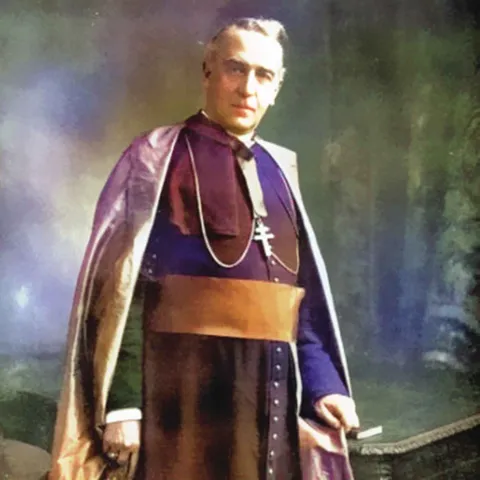
Throughout the treaty debates, the Church pleaded with the anti-treaty side to vote in favour. In private, Archbishop Edward Byrne of Dublin tried to persuade Éamon de Valera to back the treaty. While in public, Cardinal Michael Logue, Archbishop of Armagh, prayed that God would preserve Irish people from the disaster that rejection of the treaty would bring.
Once the treaty was passed and it became increasingly clear that violence might break out, the Church exerted even more pressure across the country. In masses throughout Ireland, the clergy called unequivocally for everyone to get behind the treaty. And they didn’t mince their words, declaring from the pulpit with the terrifying dramatic flair that old Irish priests were famous for. Saying things like, Ireland is now the sovereign mistress of her own life. The rusty chains of bondage are scraped forever. Unless, indeed, by our own folly we put them back on again.
This was quite at odds with some of the views of those on the anti-treaty side, obviously. They believed they had a moral and religious right to declare a republic. But the bishops were having none of it. Writing that, to ignore the public will was, quote, a claim to military despotism and subversion of all civil liberty. It is an immoral assertion and confiscation of the people’s rights. Things continued like this until October.
And as the civil war became bloodier and bloodier, the Church decided that it had to take more drastic action. So on October 10th, after the Special Powers Act had been voted on, but before it was brought in, the Church issued a pastoral letter, basically an open letter to the congregation. As historian Dahio Curran explains, the pastoral had four main goals. First, to strip the republican campaign of legitimacy. Second, to appeal for, quote, civic obedience to government authority. Third, to exclude anti-treaty forces from confession or Holy Communion. And fourth, was to convince the anti-treaty side to, quote, pursue grievances through constitutional action. I would add that the pastoral letter was also clearly a means with which to provide the provisional government with a moral sanction for the harshness of the Special Powers Act.
The pastoral didn’t beat around the bush, declaring that there was no real civil war, only, quote, a system of murder and assassinations of the national forces, as well as the demoralization of the young whose minds are being poisoned by false principles. But really, it was the exclusion of anti-treaty forces from confession and Holy Communion that was seen as the biggest deal. The anti-treaty side saw this as, quote, weaponizing the sacraments.
Dev was furious with this move and tried to go above the Irish bishops, protesting directly to the Vatican. As O’Coran puts it, Dev denounced the hierarchy’s attempt to use religious sanctions to enforce a political standpoint on a constitutional matter. And the Vatican would try to intervene, sending an envoy to Ireland in March 1923. But by then it was pretty much too late and the envoy had very little effect. And even as Dev was going over the heads of the bishops, many anti-treaty clergy disobeyed them on the ground, still continuing to serve the anti-treaty forces.
And you would think all of this might knock the anti-treaties religious fervor, but no. As historian Brian Heffernan puts it, far from rejecting Catholicism, they criticized the bishops on the latter’s own religious terms. Basically, the way the anti-treaty lad saw it, it was the bishops who weren’t being religious enough. Such was the ferocity of hardline anti-treatyites republican ideals and its entanglement with their Catholicism.
An example of this is Mary MacSweeney, who was arrested on November 4th and immediately went on hunger strike in protest of the Irish Free State. MacSweeney, you’ll remember, was a hardline anti-treaty republican who had led diatribe after diatribe against the pro-treaty politicians during the treaty debates. She was also brother of Terence MacSweeney, who had died after a hunger strike during the War of Independence. But though Terence had been seen as a hero across the country, for Mary things were a little more mixed. As Diarmuid Verder explains, for supporters, her protest underlined her purest republican credentials, marking the continuation of her brother’s sacrifice. For her detractors, it marked her hysteria and incorrigibility. Again, you’ll see that word hysteria being thrown around constantly for Mary MacSweeney and any of the women who came out against the treaty.
As previously discussed, Mary MacSweeney most definitely framed her republicanism in terms of the sacred. And her hunger strike did cause both the Free State and the Church a huge amount of embarrassment, raising the international profile of the treaty divide and calling out the illegitimacy of the Church’s involvement and how it was, as she put it, supporting one political side over another. And the treatment the Church showed to Mary was, frankly, very, very different to what they’d shown to her brother. When Terence MacSweeney had gone on hunger strike, generally the clergy had supported him. When it came time for Mary to do the same, the Church declared all who participate in such crimes are guilty of the gravest sins and may not be absolved nor admitted to Holy Communion. An example of religious doctrine shifting with the politics of the time.
In the end, after 23 days without food, the Irish government released MacSweeney, not wanting any hunger strike to die on their watch. They all knew too well how much of a propaganda boon a dead hunger striker could be, doubly so if she had been a woman.
In the end, the pastoral letter and the Church’s weaponization of the sacraments, well, it didn’t do all that much to stop the anti-treaty acts directly. Many just continued to receive the sacraments from anti-treaty clergy. But I can imagine it didn’t help their cause with the wider population, who had already voted for peace. By coming out so boldly against the anti-treaty side, the Church just further removed the anti-treaty’s public support, further ostracizing the group.
As well as this, importantly, that pastoral letter gave moral legitimacy to the Free State. Legitimacy, it sorely needed at this point, for two main reasons. First, it helped to shore up their moral standing against the attacks of the likes of Mary MacSweeney, who were declaring themselves and any other die-hard Republicans to be better Catholics than the leadership of the new Free State. Secondly, as I mentioned, it allowed the government to justify its increasingly harsh measures. The Church removed these people’s chance to get Holy Communion. In the end, how bad is an execution versus eternal damnation?
And in return for its support of the Free State, the Church gained more and more clout in the young country. I’m not suggesting any kind of quid pro quo. The Church leaders did genuinely want peace, but by backing the treaty side so firmly, the Church continued to cement its power and position within the Free State. They got involved in politics and weren’t afraid to do it. And this was a Free State whose constitution would only come into law right in the middle of all this chaos. But we’ll leave that until next time.
Thanks for listening. Subscribe wherever you get your podcasts and if you’re enjoying it, give us a review on Apple Podcasts or tell your friends. It really helps. If you want to go further, you can support the show, get ad-free listening, and bonus content on our Patreon page. Simply follow the Patreon link in the show notes or visit our website, thehistoryofireland.com. You can also get in touch through the website or on Facebook and Twitter. It’s always great hearing from you guys. And if I’ve made a mistake, please do let me know. The History of Ireland was written and produced by me, Kevin Dolan, with music by Liam Doyle and additional help from assistant producer Aoife Murphy. This podcast was recorded in the lands of the Wurundjeri people of the Kulin Nation. Sovereignty was never ceded.