Episodes Irish Revolution Season 2 — The Civil War
The First Attempt At An Irish Constitution
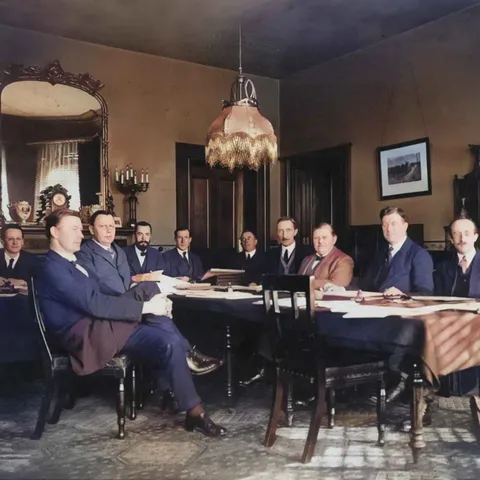
In this episode we look at the creation of Irish Free State constitution which was brought into law on December 6th 1922.
Here's the Radiolab episode on the Irish electoral system that I mention in the show:
https://radiolab.org/podcast/tweak-vote
Transcript
Welcome to the history of Ireland. The first constitution of the new Irish state was innovative. It asserted the sovereignty of the people. It included a Bill of Rights, a guarantee of free elementary education, trial by jury and direct democracy. That’s a quote from journalist and broadcaster Vincent Brown writing in History Ireland.
Now, innovative is not a word I would associate with the Irish constitution, especially historically. Instead, you think of church control and a woman’s place in the home. But what Erne is speaking about here is not the constitution we have today. No, he’s referring to the first constitution, which is a very different document to the one that we ended up with. I know I have quite a few American listeners and I’m sure you think this is mad. But in Ireland, we created a constitution and within 20 years we had scrapped it and rewritten another.
Understanding that first constitution, which came into effect on December 6th, 1922, is super important for understanding where Ireland was in this period. So today we’re going to look at that document, how it was written and what’s involved in the creation of a country’s constitution. Buckle in people, because there is nothing more exciting than constitutional law.
So to begin with, we have to go back to the start of 1922. After the Anglo-Irish treaty, it was agreed to put together a constitution committee to draw up a suitable constitution for the Irish Free State. The committee was led by Michael Collins, though he only ever attended one session and in the end it was mostly led by Vice Chair Daryl Figgis. Figgis was a poet friend of Arthur Griffiths that no one else really seemed to like all that much.
The committee was an interesting mix of people, consisting of five lawyers, a mathematics professor, a former British civil servant and Figgis, a poet. It also did consist entirely of men, which wouldn’t have been unusual at the time but is worth noting. All of the men were pro-treaty nationalists. An attempt was made to try and choose people who were as neutral as possible. You know, people that everyone could get around. With that in mind, four of the nine were heavily involved with the Irish White Cross.
This was important as it was hoped that the constitution would do a lot of heavy lifting. As Laura Callaghan writes in her great book Drafting the Irish Free State Constitution, the treaty would need to not only be a document which would appease the provisional government and the British authorities, but also one which would satisfy the southern unionists and would entice the moderate anti-treaty leaders back in from the cold. In essence, these men were being asked to prevent both a civil war and a return to hostilities between the fragile Irish state and Britain. The significance of their task would not have been lost on these men. Callaghan’s book, by the way, is fantastic. It’s a really good way of looking at what was going on in 1922 and you’re going to hear me quoting it a lot in this episode.
At their first meeting, Collins outlined that he wanted, quote, a constitution that would be short, simple, easy to alter at the final stages of complete freedom were achieved and only contain what was necessary to establish constitutional machinery to govern Ireland. His advice was to bear in mind not the legalities of the past, but the practicalities of the future. As Callaghan puts it, Collins was pressing for a radical and highly independent constitution. Basically, what he was saying was that they needed to obviously ensure the constitution matched the treaty from which it would need to be derived, but not to be beholden to it.
He wanted any mention of the king or a governor general to be left out of the constitution. And there was some legal hand-wringing among the committee about excluding the oath from the constitution. No one wanted to antagonise the British. But in the end it was agreed it was not legally needed. The treaty covered that. And the exclusion of things like the king and the oath would help appease the anti-treaty side. Or at least that was the hope. Remember at this point there was still maybe a hope that a civil war could be avoided.
Now one difficulty for the committee was that most of them were experts within a British legal system. But they were trying to create a constitution that was inherently Irish. And in fact stood apart from anything resembling a British model. So what they did was to quote, seek inspiration from continental models, however experimental, rather than from the empirical framework of the British constitution. They actually ended up creating a booklet called Select Constitutions of the World. Featuring constitutions from the likes of Yugoslavia, Poland, Austria, Estonia, Czechoslovakia, Germany, the Soviet Union, Mexico, Denmark, Australia, France, Switzerland, Canada, Belgium, Norway, Sweden and the United States. A bit like an animaniac doing that bit but anyway.
As historian Bill Cassan writes, the earliest constitutions in the booklet placed the weight of power in the executive, while those from the 19th century privileged legislative institutions. The more recent European constitutions tended to place more and more power in the hands of the people themselves. Let’s break that down for us mere mortals who are not constitutional lawyers. And note this is all very basic, I am no lawyer, so if I get anything wrong in a broad brush painting I’m about to do, please do forgive me.
But basically, early constitutions placed most of the power in the hands of the leader of the country, the executive. For example, you had the British system, where power was derived from the monarch. The king or queen was head of state and everything flowed down from them. Though technically the British system is a weird unwritten mix of parliamentary sovereignty and all sorts of nonsense. Then in the 1800s, constitutions started to favour the idea of power residing with elected groups of people, known as the legislator. The French constitution of 1848 is a good example of this, where they created a national assembly, which was a legislative body elected by the people. Finally, you get to what was the cutting edge of constitutional thinking in the 1920s. The idea of a constitution which put power directly in the hands of the people. That’s what the Irish were gunning for.
And they did this in a few ways. Now, obviously the treaty meant the Irish could not have a formal republic. You know, that’s just a little sticking point we’ve discussed from time to time. And it’s important when getting into this nitty gritty stuff that we should actually define what a republic is. It’s quote, a state in which supreme power is held by the people and their elected representatives, and which has an elected or nominated president rather than a monarch.
But even if they couldn’t declare a republic, the committee made this constitution as republican, in the literal sense of the word, as possible. Writing in article 2 that all powers of government and all authority, legislative, executive and judicial, in Ireland are derived from the people of Ireland. That’s kind of a big deal, considering up until this point all power in Ireland had derived from the British monarchy. To give power to the people, the Irish brought in proportional representation, as well as the use of referenda, and it enfranchised women under 30. All of which was fairly radical at the time. Britain didn’t allow women under 30 to vote for another 6 years. And there’s actually a great Radiolabs episode on Ireland’s political system and proportional representation that highlights how effective it really is. I’ll link it in the show notes.
Now, three drafts of the constitution were put together, A, B and C. A and B differed only slightly, with B written in a way to try and bring the anti-treaty side into the fold a little bit more. Draft C went further, providing a possibility for northern counties to enjoy representation in the Dáil, but it was never really seriously considered. In the end, the Dáil agreed to go with draft A, and bring that to the British. This happened on May 26th.
Now, let’s just highlight that the commission had started writing up this new constitution in January, and were expected to have it finished only 5 months later. That really isn’t a lot of time, and as Callaghan puts it, considering the length of time they were given within which to draft a constitution for a new state, it is notable that the committee managed to come up with three drafts of such quality and strength.
Unfortunately, the British didn’t really agree with that idea of quality or strength. For some reason, the British were not too pleased with this new constitution that made no mention of the crown and ignored a lot of the treaty. Who would have thunk it? Lloyd George accused Collins and Griffith, both still alive at this point, though not for long, of creating a republic in disguise, which stripped the monarchy of any influence or prestige and made it ridiculous. As Callaghan writes, all on the British side were in agreement that the document was a complete evasion of the treaty. In fact, there were even talk of opening up hostilities again with Ireland if this was the road the provisional government was going to take.
Now remember, all of this constitutional politicking was taking part while the anti-treaty side took control of the forecourts and the Collins-De Valera pact was being made ahead of the June 16th Irish election. There was a lot going on. It was agreed that a draft the British were happy with had to be published before the election. Otherwise people wouldn’t really know what they were voting for or against. And so a few weeks of furious rewrites, debates and letters back and forth between Griffith and Lloyd George followed.
By June 14th a new draft had been put together with a number of tweaks brought in. The biggest change, and the one that critics of the document argue weakened considerably, was the conclusion of what was known as a preliminary. This was like a little introduction to the constitution, which basically confirmed that the constitution had to be, as Callaghan puts it, construed with reference to the treaty. This basically meant that the treaty was really the most important legal document in the country and that any law that was seen to be in contradiction to it would not be constitutional. The treaty trumped the constitution, that was it plain and simple. Even pro-treaty politicians were pissed about this, but it was seen as the only way to ensure there was not a return to hostilities between Britain and Ireland.
On top of this an oath to the crown was included. The Irish argued this was not needed as the treaty already called for it, but the British declared it of vital importance for a commonwealth country. Interestingly though, in a small win for the Irish, members of the Dáil would swear allegiance to the Irish constitution first, and then only afterwards they would swear, quote, faithfulness to his majesty. As well as that, the role of the governor general was clarified. For example, the governor general would appoint judges, but only on the recommendation of the Free State Executive Council. Meanwhile, the king could even bestow honours on free state citizens, apparently this was something important to the British. And interestingly, many elements which were originally written as Gaeilge were removed as the British saw them as crude and unwieldy.
Now for you. But as Callaghan writes, although the British managed to force the Irish to compromise on many issues, the Irish had still managed to retain quite a sovereign and democratic document. Despite this though, as we know, the Irish had not managed to create a document the anti-treaty side could stand behind. The original draft, without mention of the crown and whatnot, may have flown, it may have avoided a civil war, but there was no way this new version would ever be backed by the anti-treaty side. In stopping hostilities with Britain, constitution all but guaranteed the civil war. Talk about a rock and a hard place.
Leo Cohn, a historian who also writes about the Irish Free State Constitution, had this to say about the document. It was a most comprehensive and in spirit, essentially republican constitution on most advanced continental lines. Its archaic symbols had to be introduced, but their meaningless for Ireland was writ large on every page. Basically, the Irish had gotten everything they wanted in terms of practical democratic rulings, but to do so had to keep what could be called meaningless British symbols. And Callaghan reckons that Griffith, Collins, and the rest of the constitution committee had a lot to be proud of.
Now, I’ll leave you with one quote from that committee. Just because it seems nice that at least one group in this period was getting along. One of the committee members had this to say about his time working on the document. I do not think I ever worked on a committee where there was more good fellowship and where it was possible to have strong differences of opinion without any personal feelings whatsoever. I doubt if a better committee from the point of view of character and goodwill ever attempted to draft a constitution in any country. How lovely is that?
Sadly, the committee couldn’t bring that feeling of good fellowship to the rest of the country and it was probably an impossible task to ever expect them to be able to do. Next episode, we’ll look at the day the document was made official and how, sadly, it did nothing to unify a country that by the end of 1922 was just about managing to avoid tearing itself apart. New constitution or not.
Thanks for listening. Subscribe wherever you get your podcasts and if you’re enjoying it, give us a review on Apple Podcasts or tell your friends. It really helps. If you want to go further, you can support the show, get ad-free listening and bonus content on our Patreon page. Simply follow the Patreon link in the show notes or visit our website, thehistoryofireland.com You can also get in touch through the website or on Facebook and Twitter. It’s always great hearing from you guys and if I’ve made a mistake, please do let me know. The History of Ireland was written and produced by me, Kevin Doyle with music by Liam Doyle and additional help from assistant producer Aoife Murphy. This podcast was recorded in the lands of the Wurundjeri people of the Kulin Nation. Sovereignty was never ceded.