Episodes Irish Revolution Season 2 — The Civil War
The Irish Free State Is Born & A TD Is Murdered
Transcript
Welcome to the history of Ireland. An end and a beginning. The most solemn of all occasions in the nation’s history. An almost bewildering moment of transition. The chance for the Irish people to make their own laws, shape their own progress, and establish their own traditions of government. The honour of success or the shame of failure would fall upon the Irish people alone. This was how the Irish Times described the inauguration of the Irish Free State on December 6th, 1922, as Ireland, or at least most of it, gained independence from England. Or at least some form of independence.
Last episode we dove into the nitty gritty of the constitution of the Irish Free State. In this episode we’ll explore how it came into effect. The run up to December 6th saw mounting tensions from both the anti-treaty IRA and the Irish Free State Army. In the week previous, as we know, Erskine Childers was executed. In response to this, Liam Lynch, leader of the anti-treaty IRA, wrote a letter on the 27th, threatening any TD who had voted for the Special Powers Act with quote, very drastic measures. Then on the 30th of November, Lynch laid out what that meant and went further ordering all anti-treaty IRA soldiers to shoot TDs who had supported the quote, murder bill on sight.
So understandably, as the 80 or so TDs gathered in the government buildings on the 6th of December, they were a little worried. The fear of what historian Thomas More describes as quote, a spectacular attack in the run up to December 6th was very real. There were talks of an attack to delay the constitution from coming in or even a coup d’etat. It’s said that TDs even slept on mattresses in the government buildings so as to be more easily protected by the Irish Free State Army.
Cosgrave himself was asked in an interview in the week prior whether he was worried about his own assassination. More describes his response writing, Cosgrave reacted with laughter, but followed this with a grim assessment that the assassination of members of the provisional government might have made a difference at the time of Michael Collins’ death in August 1922, but he added that such acts would have little effect now in December 1922. The momentum behind the emergence of the Irish Free State had become unstoppable.
That emergence began on the morning of December 6th, with King George V making a proclamation that formally brought the new Irish constitution into force. Of course, I’m sure this made anti-treaty IRA even more annoyed, and even today many of us might not like the idea of the British King kicking off what is in all effects the closest thing that we have to an independence day, but sure look that’s how it was.
Next, the Governor General, the King’s representative in Ireland, was sworn in. This was a man by the name of Tim Healy. A Cork-born Catholic, Healy had risen to prominence during the Parnell years, and was considered an elder statesman by both the British and the Irish. He was sworn in from his home in Chapelizard.
Now, Dublin was decked out in tricolour flags, many of which had been sewn for the occasion, and one of my favourite little facts is that there were huge queues outside all the post offices. Why? Because the stamp collectors were keen to get the first Irish-issued stamps. These were green stamps depicting a map of the whole of Ireland. Famously, the post boxes were now also painted from the British Red to the Irish Green. And some anti-treatyites, or those less enamoured by the Irish Free State, often argue that this was the only real change the Free State managed. The argument goes that this new Ireland was the exact same as Britain, except for the colour of the post boxes. To cement that point, there are even stories of anti-treaty women holding placards, sarcastically celebrating Empire Day.
So with the stamps printed, the post boxes painted, the flags up, the Governor General sworn in, and the protesters out in full force, it was time to officially open the new Parliament, the Oireachtas. As per the constitution, this would be made up of the Dáil and the Seánad, though only the Dáil met on the 6th, as the Seánad was still being elected. At 5pm on the 6th of December, proceedings began. W.T. Cosgrave was voted in as President of the Executive Council and then gave his first speech as leader of the new Free State. Despite the momentous occasion, he spoke quietly.
He began his speech saying he was proud to lead the first government which takes over the control of the destiny of our people, to hold and administer that charge, answerable only to our own people and to none other, to conduct their affairs as they shall declare right without interference, not to say domination, by any other authority whatsoever on this earth. He also spent quite a bit of time speaking about Northern Ireland, saying he and his government were quote, looking forwards with hope and confidence that whether now or very soon, the people of that corner of our land will come in with the rest of the Irish nation, and share with us its government, as well as the great prosperity and happiness which most certainly follow Concord and Union. Let them, we beg them, weigh well the substantial guarantees assured to them in the events of their deciding to recognise the treaty position as it regards them.
It’s interesting how much he speaks about the North. Yes, at points he did call for peace in South of Ireland, but he was firmly fixed on the North and truly did believe he would see a united Ireland sooner rather than later. He concluded with one last plea to them, In so far as my government and myself are concerned, we shall say nothing, nor do anything, that may in any way hold apart from us that part of the province of Ulster now separated, or retired the advent of the Union which alone can bring real harmony and lasting and genuine security to our common motherland.
Though some complained that they couldn’t hear Cosgrave while he actually gave the speech, the written text was published throughout newspapers and described as the finest and most effective speech Cosgrave has yet delivered. After leaving the Dáil he gave a series of interviews to newspapers saying we were always quietly confident that we would win through, but it required time and patience, and he hailed the day itself as a notable day when our country has definitively emerged from the bondage under which she has lived through a week of centuries.
And despite the civil war, across the country there were actually celebrations, though understandably they were a little muted. Bonfires were lit and locals organised music, dancing and torch lit processions, but there was no government organised celebration anywhere in the country. You know a civil war can make that a little hard admittedly, the northern unionist papers loved this, running headlines like a joyless greeting, free state inaugurated, and writing that the whole atmosphere was funereal and sombre.
But then a journalist writing in the London Times laid it out well, writing at the time that the silence and restraint however need no explanation, the realisation of freedom will come later. It is chiefly of the price of freedom that Ireland is thinking today, and of the heavy tasks that must be achieved before peace can be made more secure and the foundations of progress truly laid. Furthermore, anxiety exists about the possibility of some specially desperate outbreak of violence. In spite of its preoccupation however, the general public awaits the coming of the free state with sober thankfulness and with real hope.
That real hope was tested the very next day though. On December 7th, one day into the free state’s existence, two TDs, Podrick O’Malley from Mayo and Sean Hales from Cork finished up their lunch in a hotel on Ormond Quay and left to hop into a car for the ten minute drive to Leinster House. O’Malley was the lake hound caller, or the deputy speaker of the house, and he had voted for the special powers act. Hales on the other hand hadn’t voted for the act and some believe he was up in Dublin to plead with the Dáil to instigate a ceasefire.
As they got into their car, two anti-TD IRA men fired upon the two TDs, immediately killing Hales and severely wounding O’Malley. A British armoured car was driving by at the time and the soldiers fired after the attackers in what has been described as quote, the last actions ever by British soldiers in Dublin.
It was clear that Hales was not the intended target. The men were after O’Malley and the head of the IRA Dublin Brigade, a man by the name of Frank Henderson, had apparently given orders to have O’Malley shot. By all accounts he was severely unhappy that Hales had been killed instead. Hales hadn’t voted for the special powers act and therefore should not have been a target as per the orders given by Liam Lynch. It’s said that for the next sixteen years Henderson had his son, a priest, say mass for Hales. It’s a nice gesture though I’m not sure how much good that did to Hales or his family.
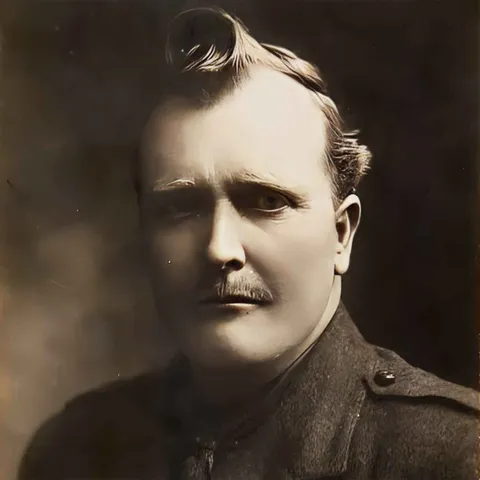
Hales was typical of his day. He’d fought with the Cork IRA and had been a huge supporter and good friend of Collins. He was a military minded republican but one who supported the treaty as a stepping stone. As historian Liz Gillis explains, military men who accepted the treaty like Sean Hales were republican. They really did believe the stepping stone theory of Michael Collins, that the treaty was not the be all and end all and that once they were strong enough they could get the six counties back. The fact that he was killed while coming to try and organise some kind of truce, well it’s just doubly disheartening. This was a man who was a bit of a bridge between the two sides. But as we’ve seen over and over the civil war did away with these middle minded types and just further cemented a rift in the country that would last for decades.
And sadly Hales is a typical example of how the rift famously split families. We always hear of the civil war pitting brother against brother and the Hales were a prime example of this. Sean and his sister supported the treaty while their four brothers opposed it and fought with the anti-treaty IRA.
The murder of a sitting TD right after the inauguration of the free state was a huge psychological blow. And sadly what follows tends to overshadow December 6th. But we’ll leave the free state’s response to Hales’ murder until next time.
The History of Ireland was written and produced by me, Kevin Doyle, with music by Liam Doyle and additional help from assistant producer Aoife Murphy. This podcast was recorded on the lands of the Wurundjeri people of the Kulin Nation. Sovereignty was never ceded.